Schell Games today announced that Lost Recipes, its upcoming historical cooking sim, is set to release January 27th on the Quest platform, bringing with it the chance to cook ancient recipes in period accurate kitchens from around the world.
Arriving from the VR veterans known for I Expect You to Die, Until You Fall, and the upcoming VR adaptation of Among Us, Lost Recipes throws you into a time portal to recreate dishes from centuries past.
Schell Games says Lost Recipes teleports you to “historically-accurate kitchens, using authentic ingredients, utensils, and techniques.” Check out the announcement trailer below:
CES wouldn’t be the Consumer Electronics Show without Razer bringing at least one prototype product to the event. This year was no different with the company using the annual trade show to unveil Project Sophia, a concept modular gaming desk. In its current iteration, the table includes room for 13 separate modules. These can be used to add components like touchscreen hotkey panels, external capture cards and audio mixers to Project Sophia, thereby allowing you to modify the station to your needs. Razer claims it’s possible to reconfigure the table “in seconds.”
The computer that powers everything is housed in a chassis that magnetically snaps underneath Project Sofia’s glass tabletop surface. Razer says it features the latest components from Intel and NVIDIA, and you can detach the case at any point to install new upgrades. Naturally, this being a Razer product, you’ll find plenty of RGB lighting, all of which you can control through the company’s Chroma software. But arguably the most eye-catching aspect of Project Sophia is the 65-inch OLED display Razer has built into the station. The company says it will also offer a model with a 77-inch display – but we’ll note here Project Sophia may never make it to market.
Looking at the rest of the concept, Razer appears to have paid less attention to ergonomics. Judging from the renders the company shared, you can’t adjust the height of Project Sophia to make it a standing desk or to better accommodate the position of a chair. And speaking of chairs, the company also unveiled a “Pro HyperSense” version of its $399 Enki gaming chair. Razer partnered with D-Box to add haptics to the chair. It will support 2,200 games, movies and TV series, including releases from publishers like Ubisoft and Microsoft. Oh, and it too will come with RGB lighting.
They’re really tightening their control on video games.
China appears to have banned the global version of Steam. This leaves Chinese gamers with access to just Steam China, which offers a much more limited library of games, with the most popular ones being Dota 2 and CS: GO.
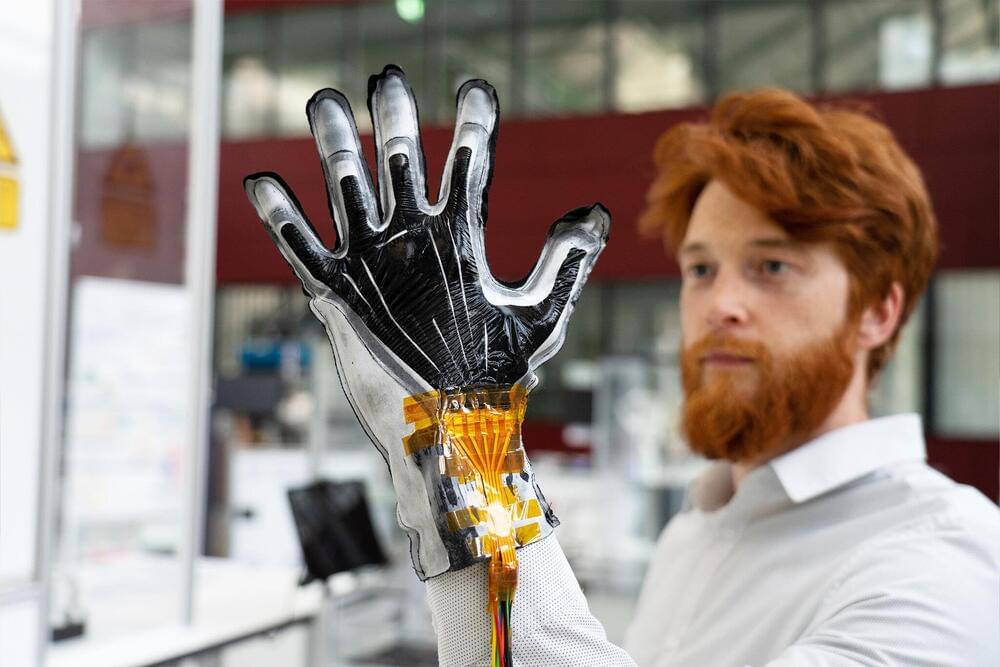
Researchers at the RIKEN Center for Emergent Matter Science (CEMS) and the RIKEN Cluster for Pioneering Research (CPR) in Japan have developed a technique to improve the flexibility of ultra-thin electronics, such as those used in bendable devices or clothing. Published in Science Advances, the study details the use of water vapor plasma to directly bond gold electrodes fixed onto separate ultra-thin polymer films, without needing adhesives or high temperatures.
As electronic devices get smaller and smaller, and the desire to have bendable, wearable, and on-skin electronics increases, conventional methods of constructing these devices have become impractical. One of the biggest problems is how to connect and integrate multiple devices or pieces of a device that each reside on separate ultra-thin polymer films. Conventional methods that use layers of adhesive to stick electrodes together reduce flexibility and require temperature and pressure that are damaging to super-thin electronics. Conventional methods of direct metal-to-metal bonding are available, but require perfectly smooth and clean surfaces that are not typical in these types of electronics.
A team of researchers led by Takao Someya at RIKEN CEMS/CPR has developed a new method to secure these connections that does not use adhesive, high temperature, or high pressure, and does not require totally smooth or clean surfaces. In fact, the process takes less than a minute at room temperature, followed by about a 12-hour wait. The new technique, called water-vapor plasma-assisted bonding, creates stable bonds between gold electrodes that are printed into ultra-thin—2 thousandths of a millimeter—polymer sheets using a thermal evaporator.
Science fiction shows and movies can sometimes struggle with a bad reputation passed down to them by a number of low-budget, poorly executed films in the genre. The Amazon series “The Expanse”, based on the novels by James S. A. Corey, however, tries to overthrow the idea that sci-fi can’t hold up to science. So, how well does it do? In this video, Unveiled finds out!
This is Unveiled, giving you incredible answers to extraordinary questions!
LG Electronics USA has just announced its first gaming laptop, the LG UltraGear 17G90Q.
The LG UltraGear 17G90Q is powered by an 11th Gen Intel® Tiger Lake H processor, NVIDIA GeForceTM RTX 3,080 Max-Q graphics card, dual-channel memory and an ultra-fast dual SSD setup. In addition to a 17-inch IPS panel with a 1 millisecond response time and a 300Hz refresh rate, the LG UltraGear gaming laptop ensures immersive, fluid gameplay. To stop all this high-end hardware from melting, the LG 17G90Q cooling system features a vapor chamber that keeps the laptop running cool, even when pushed to the limits.
Digital fashion marketplaces have recently opened, including DressX, hoping that shoppers will be keen to start a virtual wardrobe. Credit: DressX
Outfitting our digital personas is nothing new, from making pixelated Dollz in the early 2000s to shopping these days for new wardrobe additions in Animal Crossing. The video game industry has more recently laid the groundwork for digital fashion, with outfits or “skins,” in games like Overwatch and Fortnite generating billions in revenue.
Some major fashion players have already begun capitalizing on the gaming market — in 2019, Louis Vuitton designed skins for League of Legends, and Nike and Ralph Lauren have this year offered avatar accessories through the virtual world-building platform Roblox. Outside of gaming environments, NFTs — or non-fungible tokens, which use blockchain technology to verify ownership of digital assets — have allowed digital fashion to be monetized more broadly as well. (This fall, Dolce & Gabbana’s NFT collection sold out for 1,885.719 ETH, at the time equivalent to $6 million).
The months-long project demonstrates the physics behind the CPUs we take for granted.
Computer chips have become so tiny and complex that it’s sometimes hard to remember that there are real physical principles behind them. They aren’t just a bunch of ever-increasing numbers. For a practical (well, virtual) example, check out the latest version of a computer processor built exclusively inside the Minecraft game engine.
Minecraft builder “Sammyuri” spent seven months building what they call the Chungus 2, an enormously complex computer processor that exists virtually inside the Minecraft game engine. This project isn’t the first time a computer processor has been virtually rebuilt inside Minecraft, but the Chungus 2 (Computation Humongous Unconventional Number and Graphics Unit) might very well be the largest and most complex, simulating an 8-bit processor with a one hertz clock speed and 256 bytes of RAM.
Minecraft processors use the physics engine of the game to recreate the structure of real processors on a macro scale, with materials including redstone dust, torches, repeaters, pistons, levers, and other simple machines. For a little perspective, each “block” inside the game is one virtual meter on each side, so recreating this build in the real world would make it approximately the size of a skyscraper or cruise ship.
Script Editing: Andy Popescu. Connor Hogan. Edward Nardella. Eustratius Graham. Gregory Leal. Jefferson Eagley. Luca de Rosa. Mark Warburton. Michael Gusevsky. Mitch Armstrong. MolbOrg. Naomi Kern. Philip Baldock. Sigmund Kopperud. Steve Cardon. Tiffany Penner.