Toggle light / dark theme

Are gas turbines ready for the hydrogen economy?

Can we fuel gas turbines with hydrogen instead of fossil fuels and cut 15% of global carbon dioxide (CO2) emissions? Gas turbines generate around 22% of the world’s electricity. Replacing fossil fuels is a key step toward more sustainable power generation. Hydrogen is widely considered a promising alternative fuel for gas turbines in both power generation and aviation. However, before hydrogen can be used safely on a large scale, researchers need to better understand how it affects the materials exposed to the extreme operating conditions inside turbines.

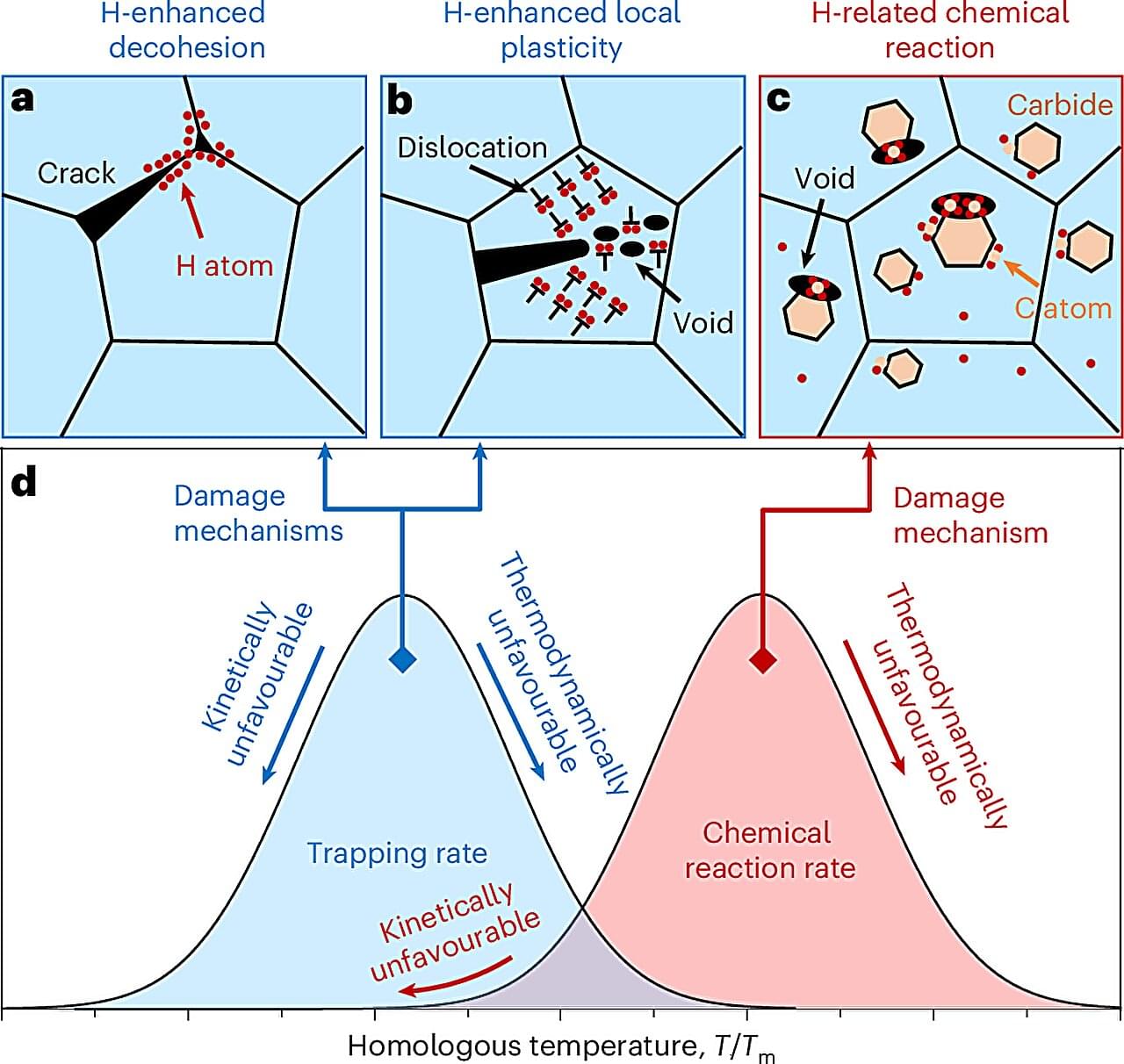
While the interaction between hydrogen and metallic materials has been extensively studied at ambient temperatures, far less is known about its effects at the elevated temperatures found in gas turbines. An international team of researchers has now investigated how hydrogen affects nickel-based superalloys—the materials of choice for gas turbines—at elevated temperatures.

Their results indicate that hydrogen-induced embrittlement can be at least twice as severe, posing a significant challenge for components that must meet the highest standards of safety and reliability. Researchers at the Max Planck Institute for Sustainable Materials (MPI-SusMat) and their collaborators published the new findings in the journal Nature Materials.

World Happiness Report 2026: Complex Global Picture of Social Media and Happiness

Life evaluations among under 25s in the United States, Canada, Australia and New Zealand have dropped dramatically (by almost one point on a 0–10 scale) over the past decade, while the average for the young in the rest of the world has increased, according to Gallup World Poll data.

One international survey1 of 15-year-olds in nearly 50 countries suggests heavy social media use is associated, on average, with a significant drop in wellbeing among the students surveyed, though any effect is highly dependent on the type of social media platform being used, how it is used, as well as demographic factors such as gender and socio-economic status.

Other factors, such as social connections and a sense of belonging, are associated with much bigger changes in how respondents feel about their lives.

Jaron Lanier: The Singularity Is A Religion for Geeks

Fifteen years ago, I sat down with the father of virtual reality, and he told me the Singularity was a religion for geeks.

I disagreed with him. To his face.

Jaron Lanier was no technophobe. He built the tech. He just refused to worship it. In 2011, that made him an outlier. Everyone in my orbit was mapping exponential curves and setting dates for digital immortality.

Now look at the culture around #AI.

We have prophets and prophecies, heretics and true believers, people who genuinely expect a machine god to arrive and solve death, meaning, and the economy on our behalf. Lanier saw the shape of that faith before most of us would admit it was a faith at all.

I still think he was wrong about parts of it. I also think he was early on the part that matters most: technology is the How. It was never going to answer the Why or the What. That is the work a religion does, and for a lot of brilliant people the #Singularity quietly became exactly that.

Charlie Stross: The World is Complicated. Elegant Narratives Explaining Everything Are Wrong!

Fifteen years ago, I interviewed Charlie Stross about a short story called “Lobsters.”

This spring, a thousand people queued outside Tencent’s Shenzhen headquarters to raise one.

June 2011, Singularity 1 on 1. Back then, “singularity” was a word most people filed under astrophysics, not #AI. Charlie’s 2001 story “Lobsters,” which grew into Accelerando, was one of the sharpest early maps of what happens when intelligence stops being exclusively biological. Uploaded minds. Post-scarcity economics. Legal personhood for software. An economy run by optimization processes no human fully follows.

He wrote it six years before the iPhone.

Now look at 2026. OpenClaw, the open source agent built by Austrian developer Peter Steinberger, now at OpenAI, became the fastest-growing project in GitHub history. In China, installing it is called 养龙虾, “raising lobsters,” after the red logo. Shenzhen, Wuxi and Changshu rushed out subsidy packages. Retirees, schoolkids and office workers lined up for help. A grey market of house-call technicians appeared within days.

Any connection to Charlie’s story? None. The logo is a claw pun on Claude.

Kindness emerges intuitively in young children before reflection catches up, study finds

While humans are inherently social beings, psychology studies suggest that their social skills are gradually fine-tuned over time and with experience. Understanding when different social skills emerge and how they typically develop could help devise new strategies that encourage people to behave prosocially and cooperate with others around them.

Researchers at London School of Economics, University of Stavanger and University of Milan-Bicocca recently carried out a study exploring how social behaviors emerge and become stable across childhood. Their findings, published in Nature Human Behavior, suggest that while kindness and cooperation are intuitive behaviors in early childhood, they later become deliberate and part of children’s personal disposition.

“Our study was initially motivated by the wish to extend findings of our previous paper in Scientific Reports,” Elena Nava, senior author of the paper, told Medical Xpress.

Cyber Hygiene In The AI Era—Our First Line Of Digital Defense

By Chuck Brooks


From normal maintenance to strategic resilience, cyber hygiene is changing. The AI era is incredibly promising. It can enhance government services, healthcare, education, productivity, scientific research, and economic expansion. However, those same technologies are giving cybercriminals previously unheard-of capabilities. Fear is not the answer. It is getting ready.

The easiest, cheapest, and most successful cybersecurity investment is still cyber hygiene. It serves as the cornerstone for the development of trustworthy digital societies when combined with Zero Trust architectures, AI-enabled defense, identity-centric security, ongoing education, governance, and resilience planning.

Cyber hygiene is an ongoing discipline rather than a one-time endeavor. Organizations that regularly practice excellent cyber hygiene will be much better able to protect against new threats, keep consumer trust, and build long-lasting digital resilience in an era of AI, cloud computing, quantum technologies, and hyperconnectivity.

AMD’s new AI PC #amd #lisasu #gpu

In a recent demo, Lisa Su showed off a compact AI PC powered by AMD’s Ryzen AI Max+ 395.
The key feature is not just speed. It is memory.
Ryzen AI Halo systems support up to 128GB of unified memory, which gives the CPU and GPU access to a much larger shared memory pool than most consumer PCs usually have for AI workloads.
That matters because large AI models do not just need compute. They need enough memory to actually fit and run.
For developers, researchers, founders, and power users, that is why cloud GPUs, hosted AI tools, API credits, and monthly subscriptions have become such a normal part of the workflow.
If hardware like this makes local AI more practical, the economics start to change.
Instead of renting compute every month, you own the machine. Instead of uploading sensitive files to external servers, more work stays on your desk. And instead of dealing with usage limits, you have a local system you can keep using.
Cloud AI platforms like ChatGPT, Claude, Gemini, and Cursor are not going away. For most people, they are still easier and more capable.
But for local agents, private documents, coding workflows, research, and anyone juggling multiple AI subscriptions, this feels like a serious step toward a different model.
The future of AI will still include massive data centers. But more of it may also run on personal computers than people expect.

Source: AMD

#amd #ai #artificialintelligence #technology #localai #lisasu #founder #ceo #entrepreneur #businessmindset

Updates on nature, land and biodiversity

Nature is humanity’s lifeline. Human health, food, economies and well-being depend on nature. Yet nature is in crisis. One million of the world’s estimated 8 million species of plants and animals are threatened with extinction. Meanwhile, ecosystem degradation is affecting the well-being of 40 per cent of the global population.

The spotlight on nature and biodiversity highlights updates from around the UN System, from partners and others, helping to call attention to the need for a just, prosperous and sustainable future for all.

/* */