And if they exist, are there alternate-reality versions of you out there, too?
Read more
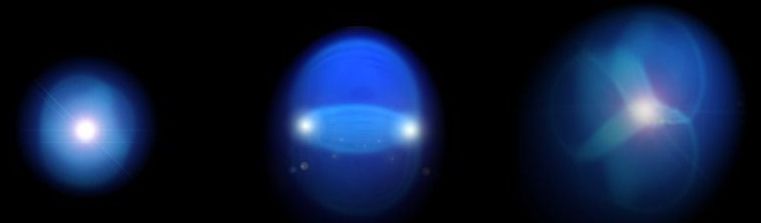
An international team of scientists has created tiny droplets of the ultra-hot matter that once filled the early universe, forming three distinct shapes and sizes: circles, ellipses and triangles.
The study, published December 10, 2018 in the peer-reviewed journal Nature Physics, focuses on a liquid-like state of matter called a quark gluon plasma. Physicists believe that this matter filled the entire universe during the first few microseconds after the Big Bang when the universe was still too hot for particles to come together to make atoms.
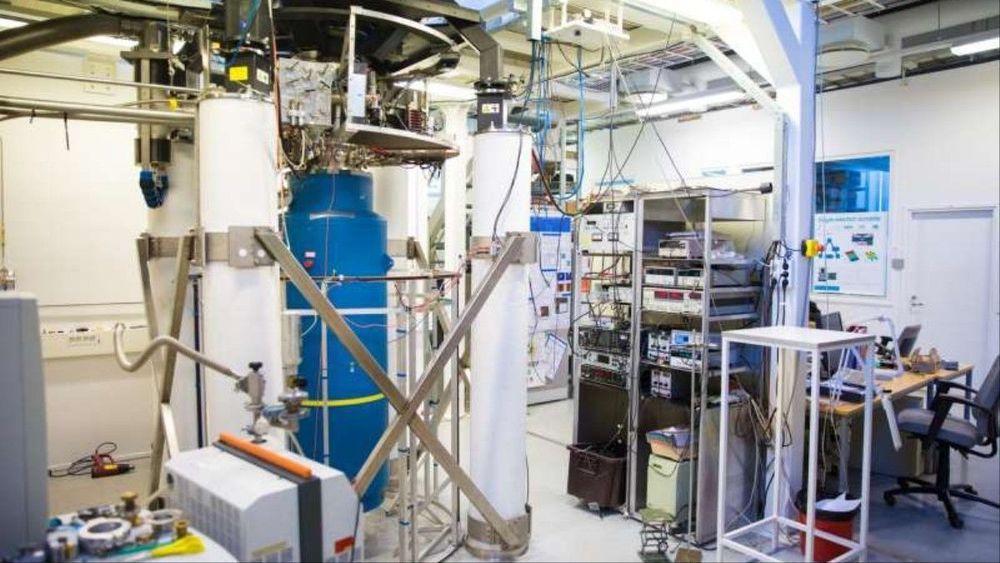
The researchers used a massive collider at Brookhaven National Laboratory in Upton, New York, to recreate that plasma. In a series of tests, the researchers smashed packets of protons and neutrons in different combinations into much bigger atomic nuclei. They discovered that by carefully controlling conditions, they could generate droplets of quark gluon plasma that expanded to form three different geometric patterns.
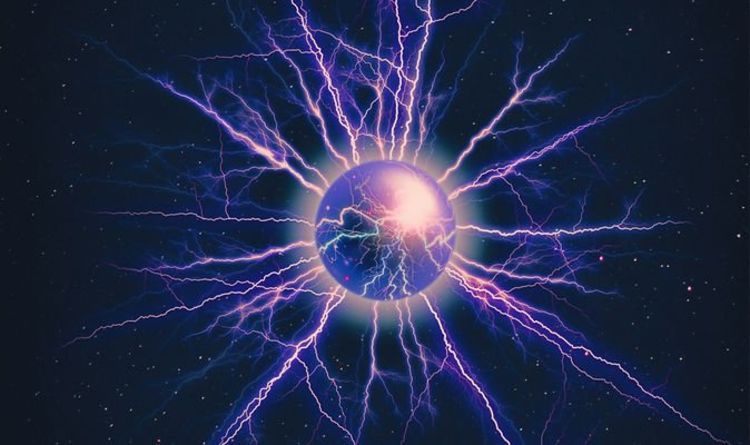
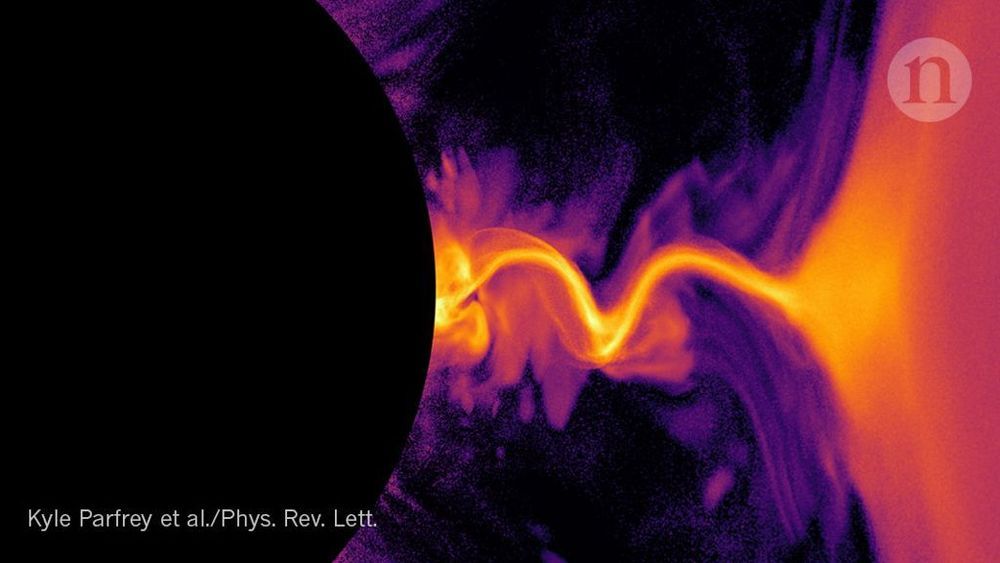
What is dark matter made of? It’s one of the most perplexing questions of modern astronomy. We know that dark matter is out there, since we can see its obvious gravitational influence on everything from galaxies to the evolution of the entire universe, but we don’t know what it is. Our best guess is that it’s some sort of weird new particle that doesn’t like to talk to normal matter very often (otherwise, we would have seen it by now). One possibility is that it’s an exotic hypothetical kind of particle known as an axion, and a team of astronomers are using none other than black holes to try to get a glimpse into this strange new cosmic critter.
Axion Agenda
I’ll be honest with you, we don’t know if axions exist. They were invented to explain a conundrum in high-energy physics. There’s a certain kind of symmetry in nature in which switching out the electric charges of all particles in a random interaction and running the process in the mirror produces the exact same result. This is known as charge and parity symmetry, or CP-symmetry for short.
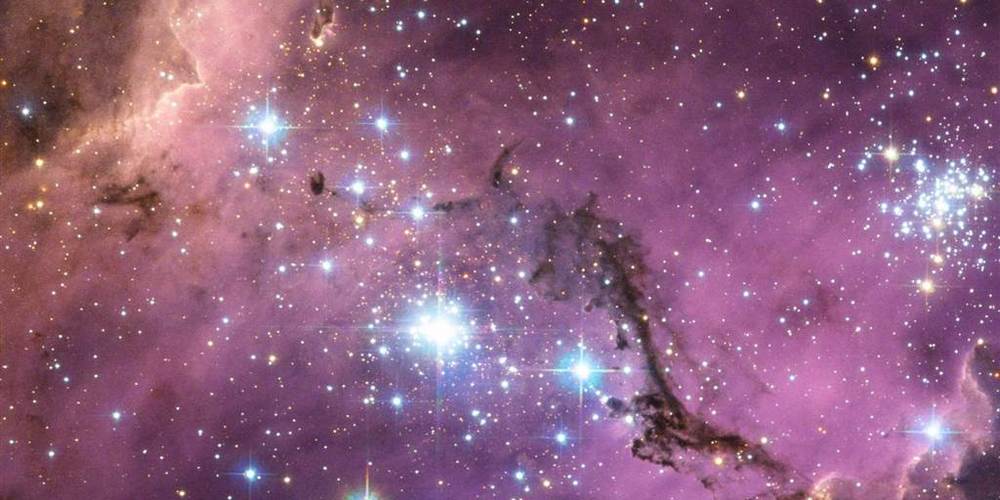
Combining Einstein’s theory of relativity with one of the most powerful telescopes in the world has helped an international team of researchers measure where and how dark matter structures grow in the universe. Their analysis suggests cosmic structures might be evolving more slowly than previously predicted.
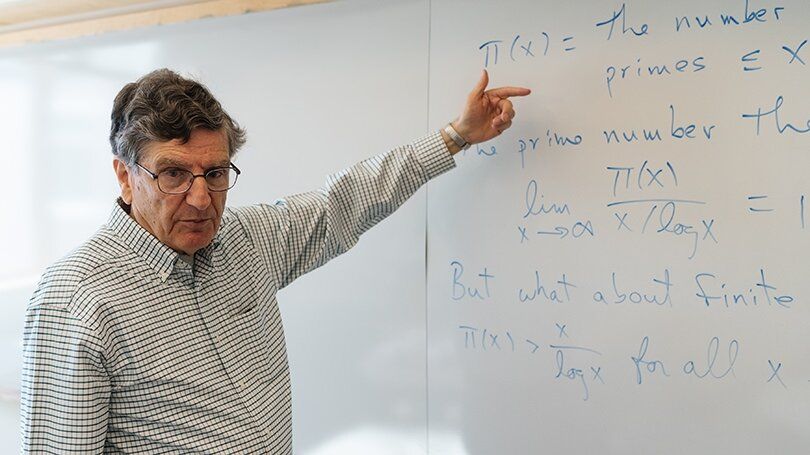
A prime number theory equation by mathematics professor emeritus Carl Pomerance turned up on The Big Bang Theory, where it was scrawled on a white board in the background of the hit sitcom about a group of friends and roommates who are scientists, many of them physicists at the California Institute of Technology.
In a recent paper, “Proof of the Sheldon Conjecture,” Pomerance, the John G. Kemeny Parents Professor of Mathematics Emeritus, does the math on a claim by fictional quantum physicist Sheldon Cooper that 73 is “the best number” because of several unique properties. Pomerance’s proof shows that 73 is indeed unique.
The Big Bang Theory is known for dressing the set with “Easter eggs” to delight the self-avowed science nerds in the audience. When UCLA physics professor David Saltzberg, technical consultant for The Big Bang Theory, heard about the Sheldon proof, he contacted Pomerance to ask if they could use it in the show, which was broadcast April 18.

Before he could legally drive, high school student Adam Rebei was already submitting jobs on the Blue Waters supercomputer at the National Center for Supercomputing Applications at the University of Illinois at Urbana-Champaign (NCSA) to run complex simulations of black holes.
“My first time using Blue Waters, we did a tour first and got to see the computer, which is a very amazing thing because it’s a very powerful machine,” Rebei told the NCSA, “and I just remember thinking, ‘All of the GPUs!’ It’s an insane amount of GPUs, and I’ve never seen anything like it.”
To get there, Rebei first took an astronomy class that led him to his work with the NCSA. Once there, he teamed up with research scientist Eliu Huerta, who leads the group’s Gravity Group.