Toggle light / dark theme

Dark Matter and Dark Energy Don’t Exist, New Study Claims

A new study argues that dark matter and dark energy might be illusions caused by the universe’s forces fading over time. For many years, scientists have thought that dark matter and dark energy make up most of the cosmos. A new study, however, challenges that long-held belief by proposing that th

Rethinking Our Place in the Universe

The new map of the Universe’s expansion history released by the DESI Collaboration offers hints at a breakdown of the standard model of cosmology.

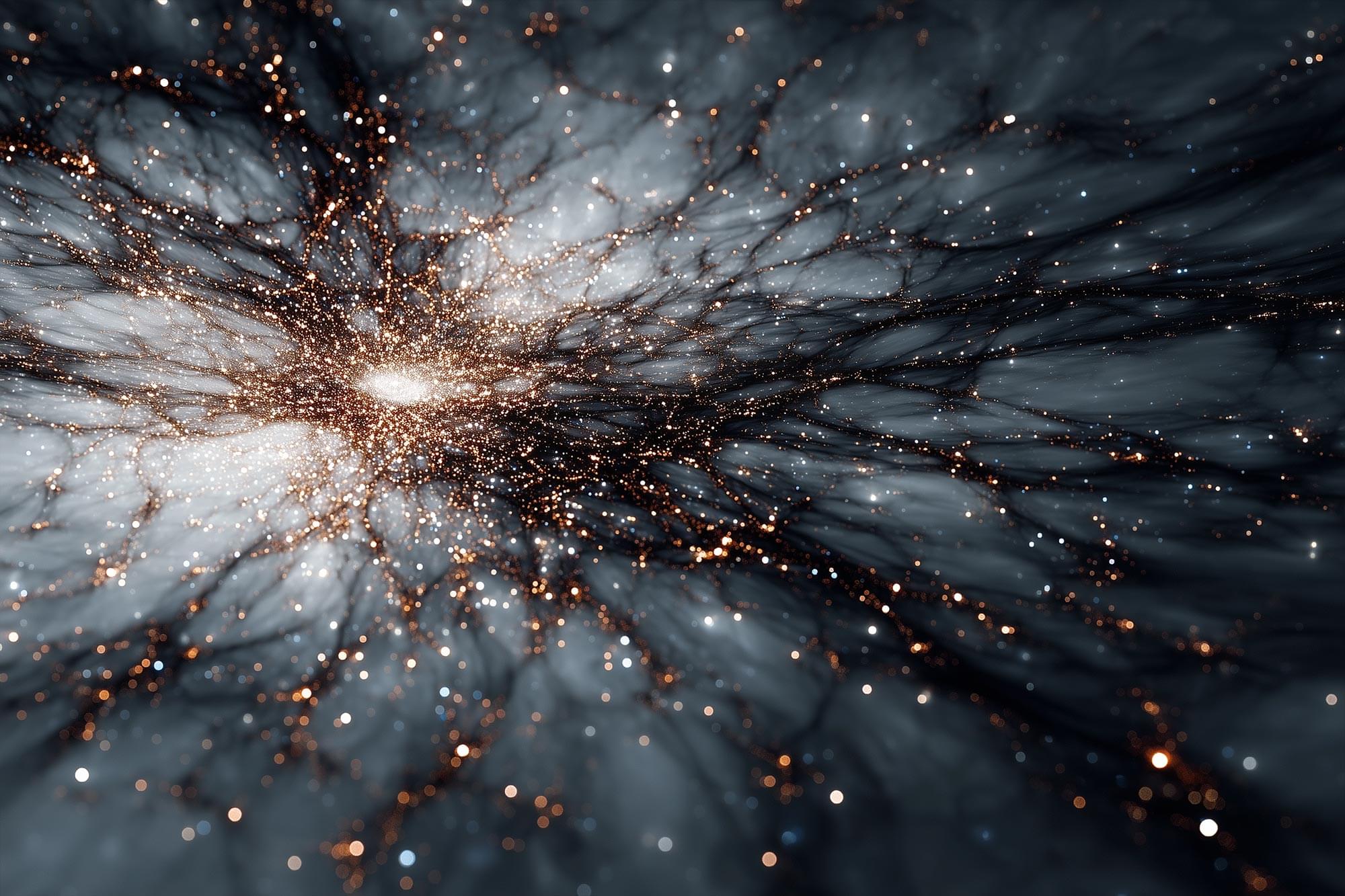
For nearly a century, we have known that our Universe is expanding. For the past quarter-century, we have also known that this expansion is accelerating, a discovery that earned the 2011 Nobel Prize in Physics [1, 2]. But what is the mysterious “dark energy” that drives this acceleration? The simplest explanation involves what Einstein dubbed a “cosmological constant” (Λ) and implies that dark energy is a constant energy inherent to spacetime itself. This idea is the cornerstone of the standard model of cosmology, the Λ cold dark matter (ΛCDM) model, which for decades has consistently explained all available astronomical observations. Now high-precision measurements of the Universe’s expansion history are putting this model to its most stringent test yet. The Dark Energy Spectroscopic Instrument (DESI) has created a cosmic map of unprecedented scale (Fig. 1) [3–9].

Astronomers Stunned by Black Hole Growing Beyond Known Limits

A black hole in a distant quasar is growing faster than the usual limit, according to Chandra observations. This may explain how the first supermassive black holes emerged. Astronomers have identified a black hole growing at one of the fastest rates ever observed. The finding, made with NASA’s Ch

What if the Universe Remembers Everything? New Theory Rewrites the Rules of Physics

For over a hundred years, physics has rested on two foundational theories. Einstein’s general relativity describes gravity as the curvature of space and time, while quantum mechanics governs the behavior of particles and fields.

Each theory is highly successful within its own domain, yet combining them leads to contradictions, particularly in relation to black holes, dark matter, dark energy, and the origins of the universe.

My colleagues and I have been exploring a new way to bridge that divide. The idea is to treat information – not matter, not energy, not even spacetime itself – as the most fundamental ingredient of reality. We call this framework the quantum memory matrix (QMM).

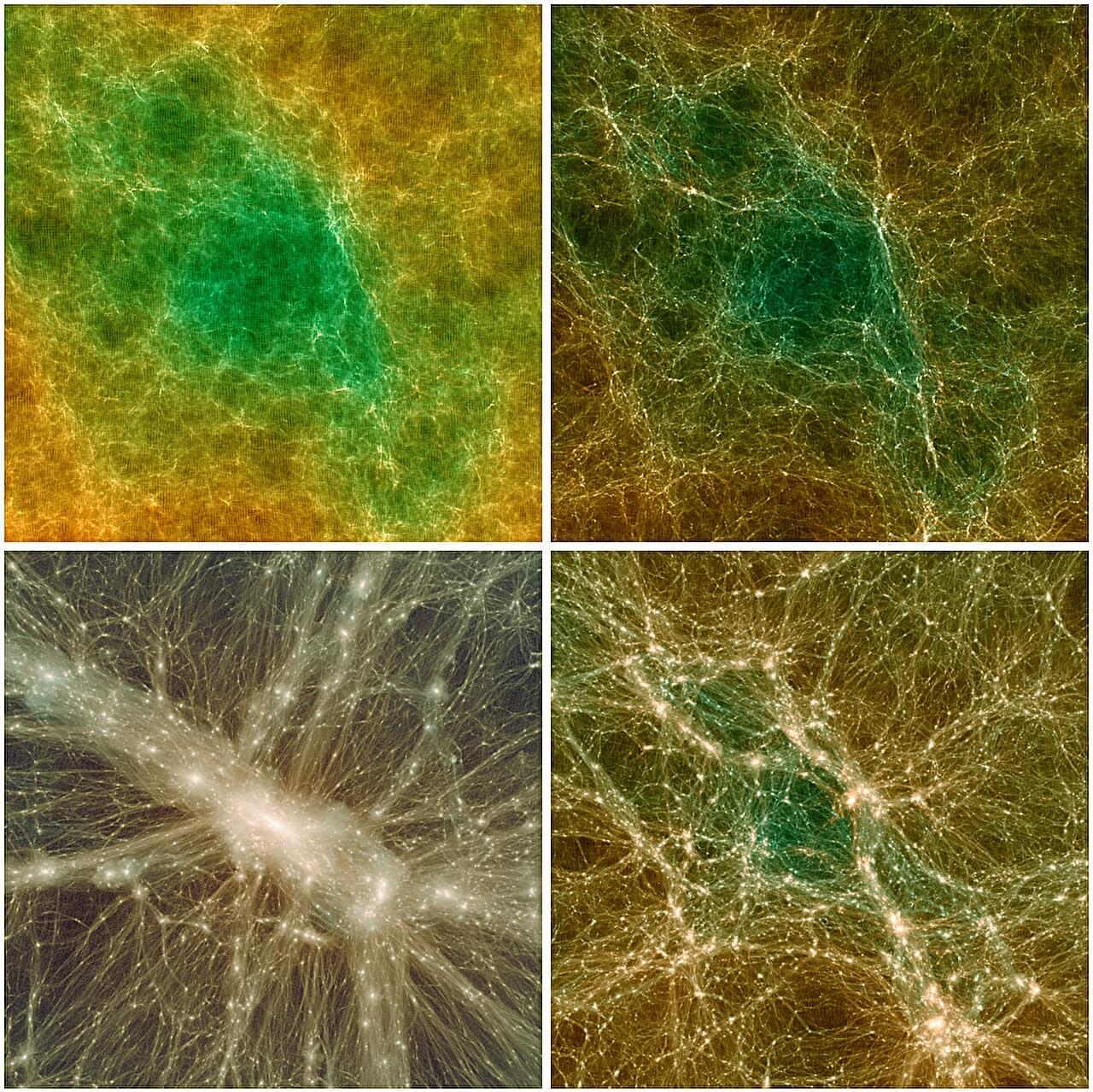
Could dark energy change over time? Supercomputer simulations challenge ΛCDM assumption

Since the early 20th century, scientists have gathered compelling evidence that the universe is expanding at an accelerating rate. This acceleration is attributed to what is known as dark energy—a fundamental property of spacetime that has a repulsive effect on galaxies.

For decades, the leading cosmological model, known as the Lambda Cold Dark Matter (ΛCDM), has assumed that is a constant entity, unchanging throughout cosmic time. While this simple assumption has served as the bedrock of modern cosmology, it has left a fundamental question unanswered: what if dark energy is not constant, but instead a time-varying property of the universe?

Recent observations have provided some of the first hints that the above-mentioned assumption may not be correct. The Dark Energy Spectroscopic Instrument (DESI), a sophisticated experiment for conducting astronomical surveys of distant galaxies, has produced data suggesting a preference for a dynamic dark energy (DDE) component.

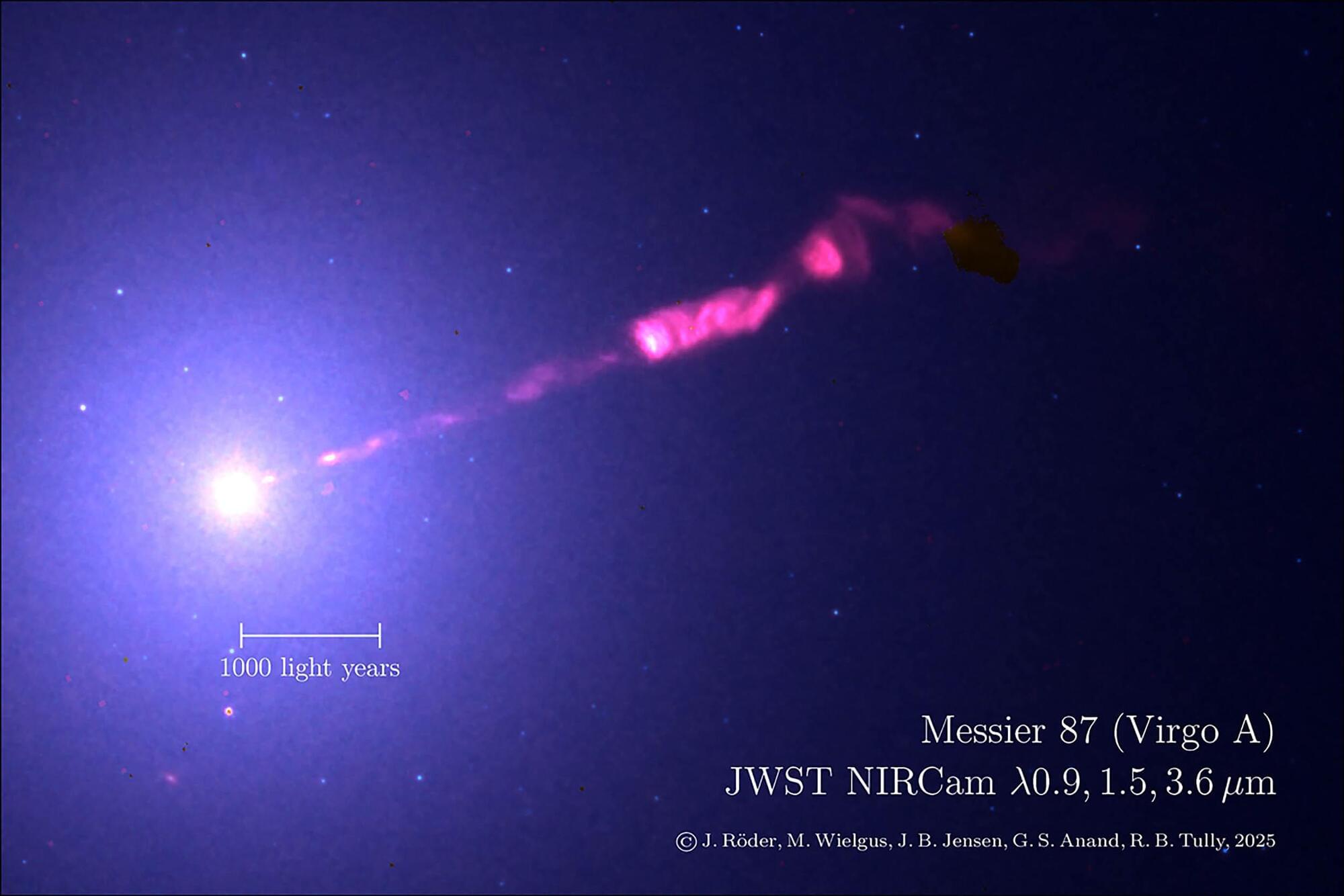
Infrared data from the James Webb Telescope reveals more structural details of M87’s black hole jet

Scientists have long been aware of the massive elliptical galaxy, M87. The galaxy was first observed in the late 18th century by Charles Messier, who cataloged objects in the sky specifically to avoid them when looking for comets. However, numerous later observations in the radio, X-ray, optical, UV, and gamma-ray bands revealed that the object is a galaxy with a prominent jet emerging from a supermassive black hole at its core. This jet is now well known for its synchrotron emission in the radio to optical wavelengths.

Although many observations have been made on M87, data had been somewhat lacking in the . But now, a group of scientists have utilized new data from the James Webb Space Telescope (JWST) and its near infrared cameras (NIRCam) to resolve some previously fuzzy details about M87’s jet. The work is now published in the journal Astronomy & Astrophysics.

The JWST+NIRCam images were taken in four infrared bands at 0.90, 1.50, 2.77, and 3.56 µm. In order to isolate the light coming from the actual jet, the team used background subtraction methods, calibration, and galaxy modeling to remove light from stars, galactic dust, background , and globular clusters. This revealed a detailed infrared picture of the main jet, as well as the counter-jet, which points in the opposite direction coming out from the black hole.
Long-term radio observations track the evolution of a tidal disruption event

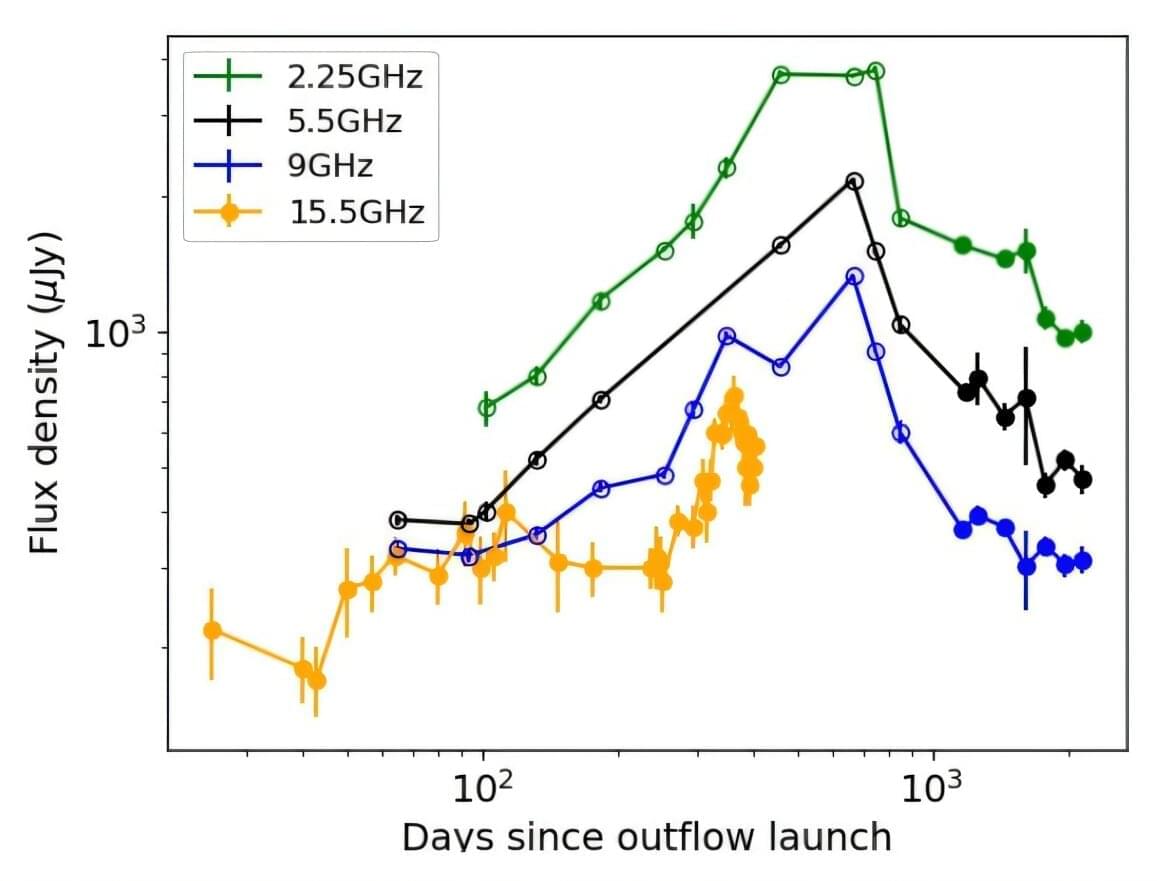
Astronomers from Curtin University in Australia and elsewhere have performed radio observations of a tidal disruption event known as AT2019azh. Results of the new study, published September 22 on the arXiv preprint server, provide crucial information regarding the evolution of this event.

Tidal events (TDEs) are phenomena that occur when a star passes close enough to a (SMBH) and is destroyed by the black hole’s tidal forces. As a result, around half of the stellar debris is unbound from the system, while the rest of the material remains bound, producing a luminous flare as it accretes onto the SMBH.

AT2019azh is a TDE at a redshift of 0.022, detected in 2019 in the galaxy KUG 0180+227. It showcases persistent blue colors, has a high blackbody temperature, and previous observations have reported a lack of spectroscopic features associated with a supernova or an (AGN), which confirmed its TDE nature.

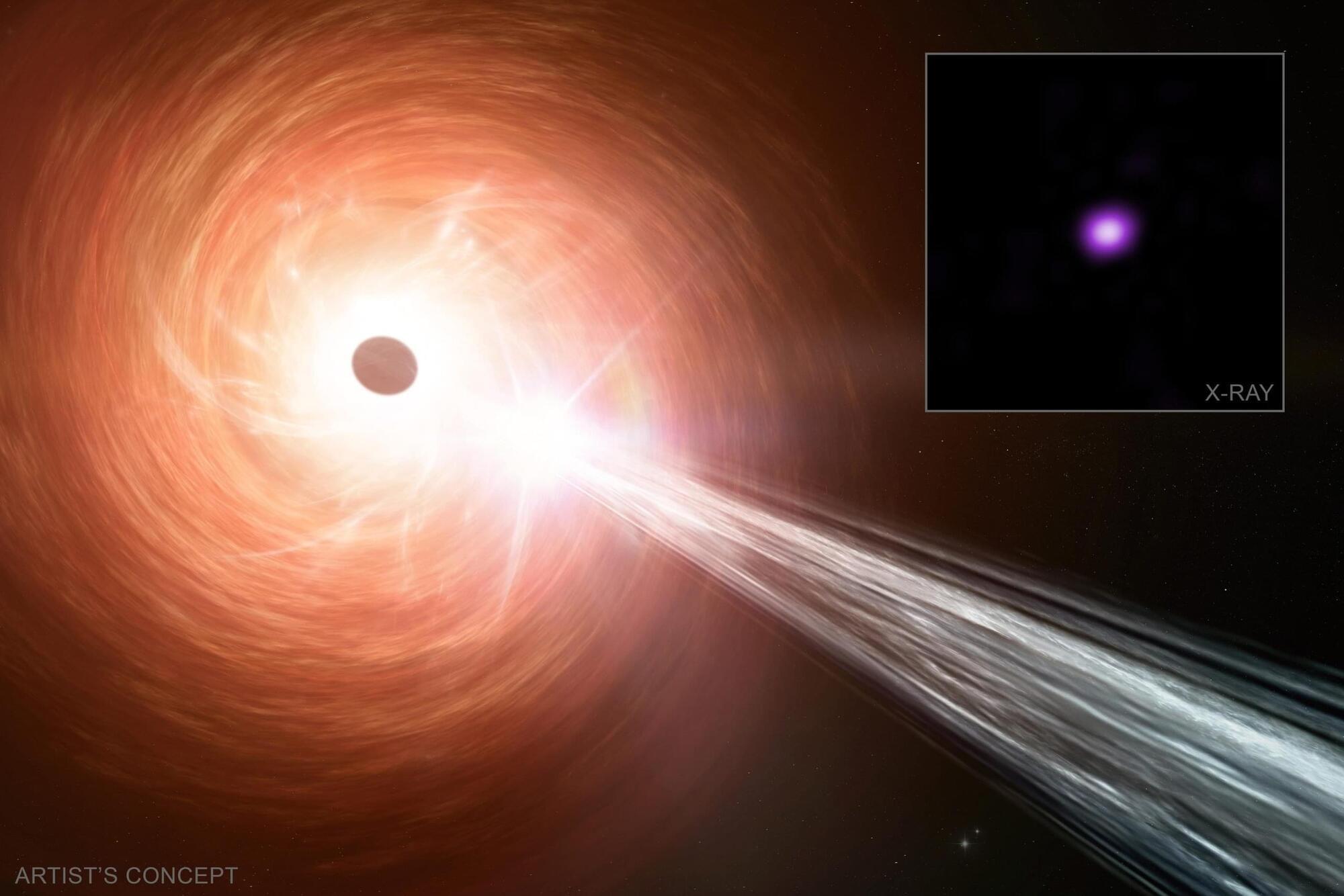
Chandra finds black hole that’s growing at 2.4 times the Eddington limit

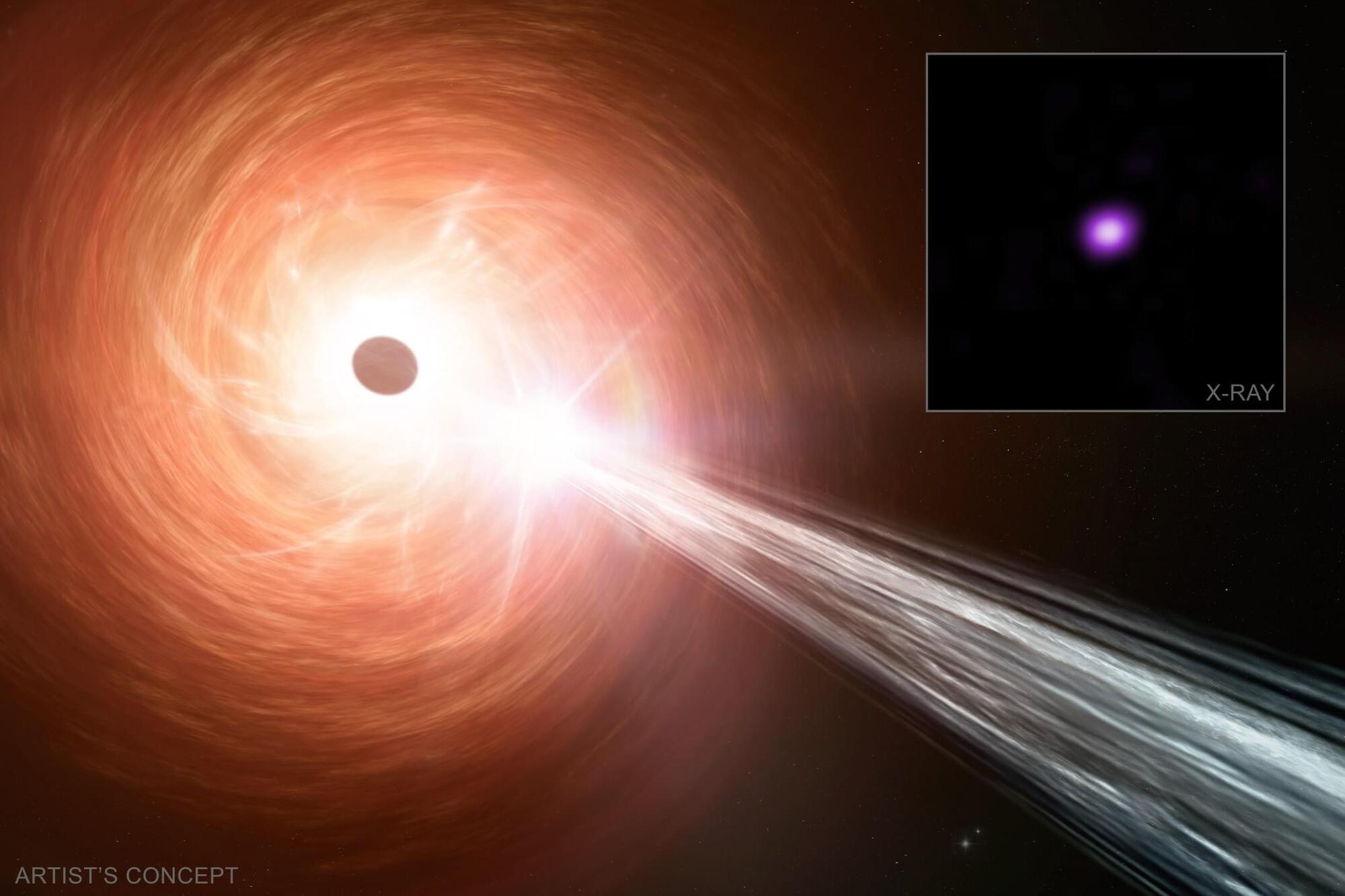
A black hole is growing at one of the fastest rates ever recorded, according to a team of astronomers. This discovery from NASA’s Chandra X-ray Observatory may help explain how some black holes can reach enormous masses relatively quickly after the Big Bang.

The black hole weighs about a billion times the mass of the sun and is located about 12.8 billion light-years from Earth, meaning that astronomers are seeing it only 920 million years after the universe began. It is producing more Xrays than any other black hole seen in the first billion years of the universe.

The black hole is powering what scientists call a quasar, an extremely bright object that outshines entire galaxies. The power source of this glowing monster is large amounts of matter funneling around and entering the black hole.

Exploring The Multiverse

The universe is beyond immense, and yet it might be nothing more than a tiny dot beside the rest of reality.

Support us on Patreon: / isaacarthur.
Support us on Subscribestar: https://www.subscribestar.com/isaac-a… Group: / 1,583,992,725,237,264 Reddit: / isaacarthur Twitter: / isaac_a_arthur on Twitter and RT our future content. SFIA Discord Server: / discord Credits: Exploring The Multiverse Originally aired as Episode 462b; September 1, 2024 Produced, Written & Narrated by: Isaac Arthur Editors: Thomas Owens Select imagery/video supplied by Getty Images Music Courtesy of Epidemic Sound http://epidemicsound.com/creator Stellardrone, “Red Giant”, “Ultra Deep Field” Sergey Cheremisinov, “Labyrinth”, “Forgotten Stars” Taras Harkavyi, “Alpha and…“
Facebook Group: / 1583992725237264
Reddit: / isaacarthur.
Twitter: / isaac_a_arthur on Twitter and RT our future content.
SFIA Discord Server: / discord.
Credits:
Exploring The Multiverse.
Originally aired as Episode 462b; September 1, 2024
Produced, Written & Narrated by: Isaac Arthur.
Editors: Thomas Owens.
Select imagery/video supplied by Getty Images.
Music Courtesy of Epidemic Sound http://epidemicsound.com/creator.
Stellardrone, \

/* */