A new twist to address an old problem.
Micro-drops of water channeled through the chip silicon looks like a promising way to keep chips cool and increase their performance.
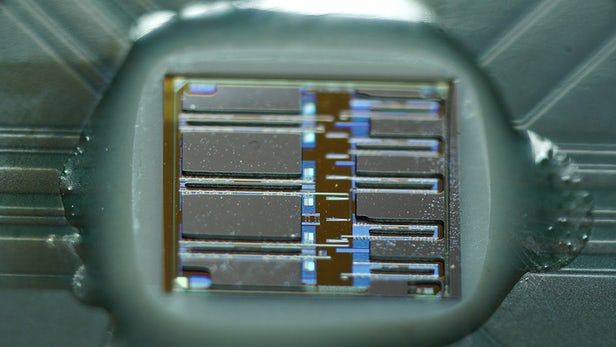
Terahertz radiation, or T-rays, can do some really incredible stuff. It can be used to scan for tumors and bombs build ultrafast wireless networks and see through solid objects. As an imaging technology, however, T-ray cameras have always had a resolution limitation. Well, they used to. Researchers at the University of Exter has developed a new terahertz camera that can see at a microscopic level — and they want to use it to find defects in microchips.
This breakthrough kind of changes the game for terahertz imaging. The radiation has always been able to look through solid objects without damaging them — which is why it’s frequently used in the art world to look past the surface layer of various masterpieces — but resolution limitations kept it from being used to diagnose broken computer chips.
Project lead Rayko Stantchev says his team has effectively doubled the technology’s resolution, creating a proof-of-principle prototype that can see a microscopic image printed on a circuit board obscured by a thick silicon wafer. “With our device you could test the quality of microchips that have buried under optically-opaque materials,” Stantchev says. “Allowing you to tell if a hidden chip is broken without having to open it up.”
Of course it can — why we have Biocomputing efforts today.
Living cells are capable of performing complex computations on the environmental signals they encounter.
These computations can be continuous, or analogue, in nature—the way eyes adjust to gradual changes in the light levels. They can also be digital, involving simple on or off processes, such as a cell’s initiation of its own death.
Synthetic biological systems, in contrast, have tended to focus on either analogue or digital processing, limiting the range of applications for which they can be used.
Definitely aligns with my NextGen transformational roadmap leading to Singularity. 5th Revolution is with Quantum technology, BMI, early Biocomputing. 6th Revolution is Singularity with Biocomputing evolved and all things living are enhanced via both technology and Biocomputing and several cases of hybrids through synthetic genes and technology. So, no shocker here.
A team of researchers at MIT has developed a technique to integrate both analogue and digital computation in living cells, allowing them to form gene circuits capable of carrying out complex processing operations.
Living cells are capable of performing complex computations on the environmental signals they encounter.
These computations can be continuous, or analogue, in nature — the way eyes adjust to gradual changes in the light levels. They can also be digital, involving simple on or off processes, such as a cell’s initiation of its own death.
It certainly is.
Quantum computing’s full potential may still be years away, but there are plenty of benefits to be realized right now.
So argues Vern Brownell, president and CEO of D-Wave Systems, whose namesake quantum system is already in its second generation.
Launched 17 years ago by a team with roots at Canada’s University of British Columbia, D-Wave introduced what it called “the world’s first commercially available quantum computer” back in 2010. Since then the company has doubled the number of qubits, or quantum bits, in its machines roughly every year. Today, its D-Wave 2X system boasts more than 1,000.
(Phys.org)—In order to determine how fast quantum technologies can ultimately operate, physicists have established the concept of “quantum speed limits.” Quantum speed limits impose limitations on how fast a quantum system can transition from one state to another, so that such a transition requires a minimum amount of time (typically on the order of nanoseconds). This means, for example, that a future quantum computer will not be able to perform computations faster than a certain time determined by these limits.
Although physicists have been investigating different quantum speed limits for different types of quantum systems, it has not been clear what the best way to do this is, or how many different quantum speed limits there are.
Now in a new paper published in Physical Review X, Diego Paiva Pires et al., from the UK and Brazil, have used techniques from information geometry to show that there are an infinite number of quantum speed limits. They also develop a way to determine which of these speed limits are the strictest, or in other words, which speed limits offer the tightest lower bounds. As the researchers explain, the search for the ultimate quantum speed limits is closely related to the very nature of time itself.
A very interesting press release appeared yesterday morning that was brought to our attention. A startup company, Gravitomagnetism, LLC, was granted a patent that enables it a multitude of applications ranging from energy generation to teleportation.
“We are reaching the limits of how precisely we can test quantum theory on Earth,” says Daniel Oi at the University of Strathclyde. Researchers from the National University of Singapore (NUS) and the University of Strathclyde, UK, have become the first to test in orbit technology for satellite-based quantum network nodes. With a network that carries information in the quantum properties of single particles, you can create secure keys for secret messaging and potentially connect powerful quantum computers in the future. But scientists think you will need equipment in space to get global reach.
Personally, I cannot wait to see all of the improvements in AI via Quantum technology.
Recent tests show that quantum computers made by D-Wave systems should solve some problems faster than ordinary computers. Researchers have begun to map out exactly which queries might benefit from these quantum machines.