Toggle light / dark theme

Scientists slow and steer light with resonant nanoantennas

Light is notoriously fast. Its speed is crucial for rapid information exchange, but as light zips through materials, its chances of interacting and exciting atoms and molecules can become very small. If scientists can put the brakes on light particles, or photons, it would open the door to a host of new technology applications.

Now, in a paper published on Aug. 17, in Nature Nanotechnology, Stanford scientists demonstrate a new approach to slow light significantly, much like an echo chamber holds onto sound, and to direct it at will. Researchers in the lab of Jennifer Dionne, associate professor of materials science and engineering at Stanford, structured ultrathin silicon chips into nanoscale bars to resonantly trap light and then release or redirect it later. These “high-quality-factor” or “high-Q” resonators could lead to novel ways of manipulating and using light, including new applications for quantum computing, virtual reality and augmented reality; light-based WiFi; and even the detection of viruses like SARS-CoV-2.

“We’re essentially trying to trap light in a tiny box that still allows the light to come and go from many different directions,” said postdoctoral fellow Mark Lawrence, who is also lead author of the paper. “It’s easy to trap light in a box with many sides, but not so easy if the sides are transparent—as is the case with many Silicon-based applications.”

Using a public restroom? Mask up!

Think you don’t need to worry about COVID-19 while using a public restroom? A group of researchers from Yangzhou University in China recently reported that flushing public restroom toilets can release clouds of virus-laden aerosols for you to potentially inhale.

If that’s not cringeworthy enough, after running additional computer simulations, they’ve concluded that flushing urinals does likewise. In Physics of Fluids, the group shares its work simulating and tracking virus-laden particle movements when urinals are flushed.

The researchers’ work clearly shows public restrooms can be dangerous places for potentially becoming infected from a virus, especially during the COVID-19 pandemic. Other work has shown that both feces- and urine-based virus transmission is possible.

First ever observation of ‘time crystals’ interacting

For the first time ever, scientists have witnessed the interaction of a new phase of matter known as “time crystals”.

The discovery, published in Nature Materials, may lead to applications in quantum information processing because time crystals automatically remain intact—coherent—in varying conditions. Protecting coherence is the main difficulty hindering the development of powerful quantum computers.

Dr. Samuli Autti, lead author from Lancaster University, said: “Controlling the interaction of two time crystals is a major achievement. Before this, nobody had observed two time crystals in the same system, let alone seen them interact.

Gearing for the 20/20 Vision of Our Cybernetic Future — The Syntellect Hypothesis, Expanded Edition | Press Release

“A neuron in the human brain can never equate the human mind, but this analogy doesn’t hold true for a digital mind, by virtue of its mathematical structure, it may – through evolutionary progression and provided there are no insurmountable evolvability constraints – transcend to the higher-order Syntellect. A mind is a web of patterns fully integrated as a coherent intelligent system; it is a self-generating, self-reflective, self-governing network of sentient components… that evolves, as a rule, by propagating through dimensionality and ascension to ever-higher hierarchical levels of emergent complexity. In this book, the Syntellect emergence is hypothesized to be the next meta-system transition, developmental stage for the human mind – becoming one global mind – that would constitute the quintessence of the looming Cybernetic Singularity.” –Alex M. Vikoulov, The Syntellect Hypothesis https://www.ecstadelic.net/e_news/gearing-for-the-2020-visio…ss-release

#SyntellectHypothesis


Ecstadelic Media Group releases the new 2020 expanded edition of The Syntellect Hypothesis: Five Paradigms of the Mind’s Evolution by Alex M. Vikoulov as eBook and Paperback (Press Release, San Francisco, CA, USA, January 15, 2020 10.20 AM PST)

Picture

Named “The Book of the Year” by futurists and academics alike in 2019 and maintaining high rankings in Amazon charts in Cybernetics, Physics of Time, Phenomenology, and Phenomenological Philosophy, it has now been released as The 2020 Expanded New Deluxe Edition (2020e) in eBook and paperback versions. In one volume, the author covers it all: from quantum physics to your experiential reality, from the Big Bang to the Omega Point, from the ‘flow state’ to psychedelics, from ‘Lucy’ to the looming Cybernetic Singularity, from natural algorithms to the operating system of your mind, from geo-engineering to nanotechnology, from anti-aging to immortality technologies, from oligopoly capitalism to Star-Trekonomics, from the Matrix to Universal Mind, from Homo sapiens to Holo syntellectus.

New Algorithm Paves the Way Towards Error-Free Quantum Computing

To avoid this problem, the researchers came up with several shortcuts and simplifications that help focus on the most important interactions, making the calculations tractable while still providing a precise enough result to be practically useful.

To test their approach, they put it to work on a 14-qubit IBM quantum computer accessed via the company’s IBM Quantum Experience service. They were able to visualize correlations between all pairs of qubits and even uncovered long-range interactions between qubits that had not been previously detected and will be crucial for creating error-corrected devices.

They also used simulations to show that they could apply the algorithm to a quantum computer as large as 100 qubits without calculations getting intractable. As well as helping to devise error-correction protocols to cancel out the effects of noise, the researchers say their approach could also be used as a diagnostic tool to uncover the microscopic origins of noise.

A light bright and tiny: Scientists build a better nanoscale LED

A new design for light-emitting diodes (LEDs) developed by a team including scientists at the National Institute of Standards and Technology (NIST) may hold the key to overcoming a long-standing limitation in the light sources’ efficiency. The concept, demonstrated with microscopic LEDs in the lab, achieves a dramatic increase in brightness as well as the ability to create laser light—all characteristics that could make it valuable in a range of large-scale and miniaturized applications.

The team, which also includes scientists from the University of Maryland, Rensselaer Polytechnic Institute and the IBM Thomas J. Watson Research Center, detailed its work in a paper published today in the peer-reviewed journal Science Advances. Their device shows an increase in brightness of 100 to 1,000 times over conventional tiny, submicron-sized LED designs.

“It’s a new architecture for making LEDs,” said NIST’s Babak Nikoobakht, who conceived the new design. “We use the same materials as in conventional LEDs. The difference in ours is their shape.”

Demonstrating entanglement through a fiber cable with high fidelity

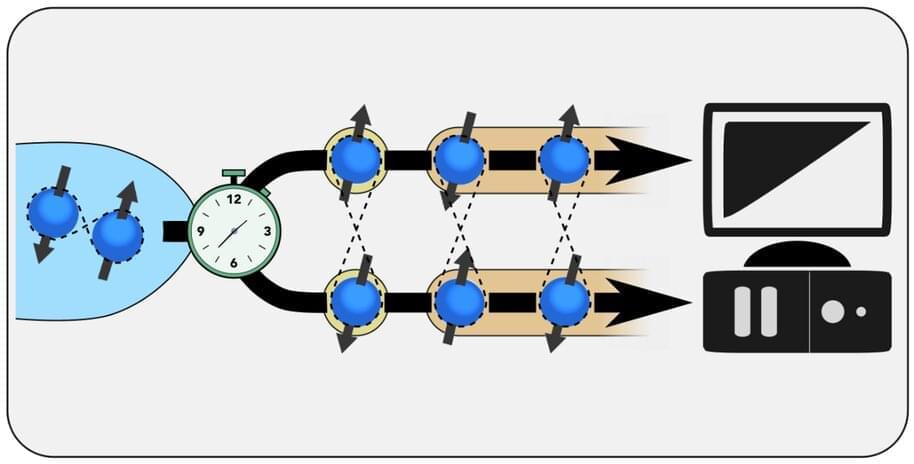
A team of researchers from Heriot-Watt University, the Indian Institute of Technology and the University of Glasgow has demonstrated a way to transport entangled particles through a commercial fiber cable with 84.4% fidelity. In their paper published in the journal Nature Physics, the group describes using a unique attribute of entanglement to achieve such high fidelity. Andrew Forbes and Isaac Nape with the University of Witwatersrand have published a News & Views piece in the same journal issue outlining issues with sending entangled particles across fiber cables and the work done by the team in this new effort.

The study of entanglement, its properties and possible uses has made headlines due to its novelty and —particularly in quantum computers. One of the roadblocks standing in the way of its use as an international computer communications medium is noise encountered along the path through fiber cables that destroys the information they carry. In this new effort, the researchers have found a possible solution to the problem—using a unique attribute of entanglement to reduce losses due to noise.

The work exploited a property of quantum physics that allows for mapping the medium (fiber cable) onto the quantum state of a particle moving through it. In essence, the entangled state of a particle (or photon in this context) created an image of the fiber cable, which allowed for reversing the scattering within it as a photon was transmitted. And furthermore, the descrambling could be achieved without having anything touch either the fiber or the photon that moved through it. More specifically, the researchers sent one of a pair of photons through a complex medium, but not the other. Both were then directed toward spatial light modulators and then on to detectors, and then finally to a device used to correlate coincidence counting. In their setup, light from the photon that did not pass through the complex medium propagated backward from the detector, allowing the photon to appear as if it had emerged from the crystal as the other photon.

/* */