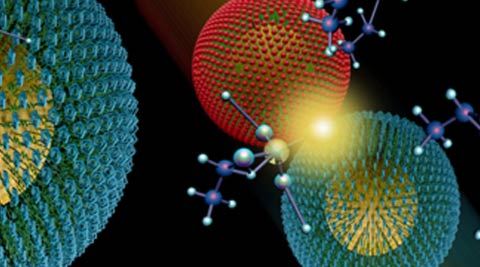
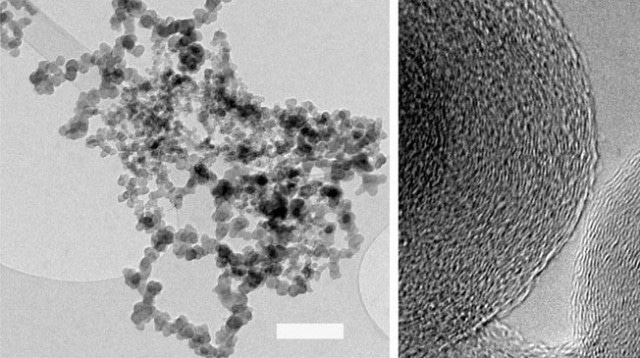
Engineers and physicists have discovered a property of silicon which could aid the development of faster computers.
SSDs and other flash memory devices will soon get cheaper and larger thanks to big announcements from Toshiba and Intel. Both companies revealed new “3D NAND” memory chips that are stacked in layers to pack in more data, unlike single-plane chips currently used. Toshiba said that it’s created the world’s first 48-layer NAND, yielding a 16GB chip with boosted speeds and reliability. The Japanese company invented flash memory in the first place and has the smallest NAND cells in the world at 15nm. Toshiba is now giving manufacturers engineering samples, but products using the new chips won’t arrive for another year or so.
Hosted by the IEEE Geoscience and Remote Sensing Society, the International Geoscience and Remote Sensing Symposium 2015 (IGARSS 2015) will be held from Sunday July 26th through Friday July 31th, 2015 at the Convention Center in Milan, Italy. This is the same town of the EXPO 2015 exhibition, whose topic is “Feeding the planet: energy for life”.
I sometimes wonder, How much data am I generating? Meaning: how much data do I generate just sitting there in a chair, doing nothing except exist as a cell within any number of global spreadsheets and also as a mineable nugget lodged within global memory storage systems — inside the Cloud, I suppose. (Yay Cloud!)
“An analysis of the history of technology shows that technological change is exponential, contrary to the common-sense “intuitive linear” view. So we won’t experience 100 years of progress in the 21st century — it will be more like 20,000 years of progress (at today’s rate). The “returns,” such as chip speed and cost-effectiveness, also increase exponentially. There’s even exponential growth in the rate of exponential growth. Within a few decades, machine intelligence will surpass human intelligence, leading to The Singularity — technological change so rapid and profound it represents a rupture in the fabric of human history. The implications include the merger of biological and nonbiological intelligence, immortal software-based humans, and ultra-high levels of intelligence that expand outward in the universe at the speed of light.” — Ray Kurzweil.
“With more artificial intelligence being built into operating systems and their greater ability to find and present relevant data, some have predicted contextual information may eventually push users off of third-party apps…After all, why open an app if the data within it is easily accessible through Google Now or Siri?” Read more
Researchers take inspiration from the developing brain to create improved computer algorithms.
Every 15 seconds, a computer, network, or mobile device is hacked by cyber-terrorists. To combat this problem, Syntek Industries has manufactured data couriers designed from advanced machine robotics. These couriers are known as SYNCS. Syncs are programmed to securely deliver data packages without interruption.
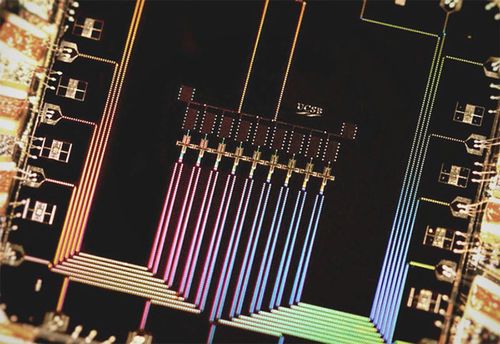
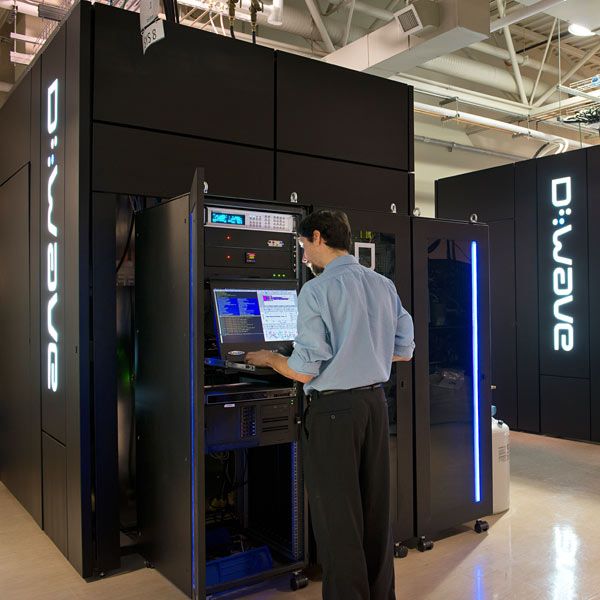
A peek at the early days of the Quantum AI Lab: a partnership between NASA, Google, USRA, and a 512-qubit D-Wave Two quantum computer. Learn more at http://google.com/+QuantumAILab.