Toggle light / dark theme

Computing a secret, unbreakable key

Awesome.


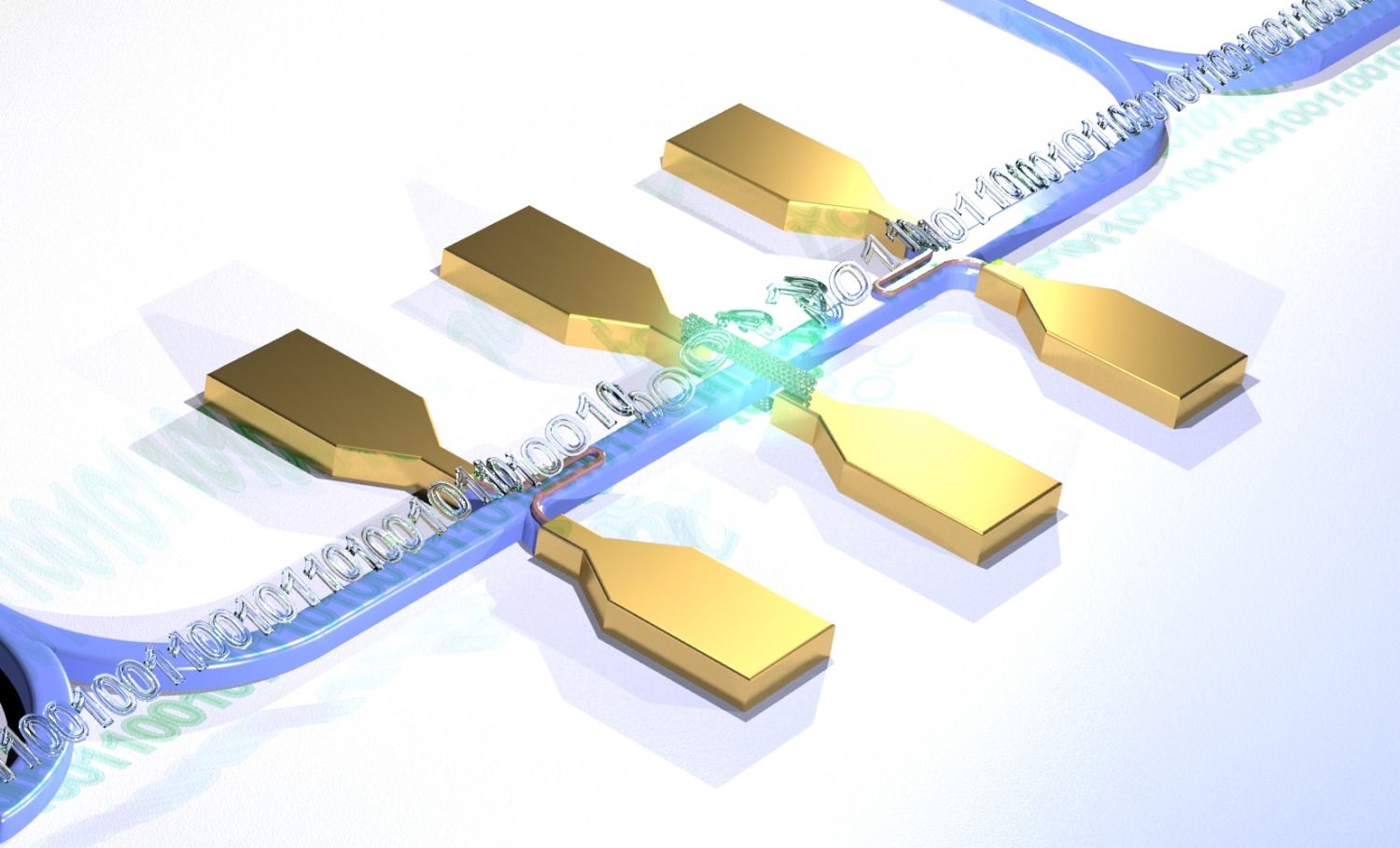
What once took months by some of the world’s leading scientists can now be done in seconds by undergraduate students thanks to software developed at the University of Waterloo’s Institute for Quantum Computing, paving the way for fast, secure quantum communication.

Researchers at the Institute for Quantum Computing (IQC) at the University of Waterloo developed the first available software to evaluate the security of any protocol for Quantum Key Distribution (QKD).

QKD allows two parties, Alice and Bob, to establish a shared secret key by exchanging photons. Photons behave according to the laws of quantum mechanics, and the laws state that you cannot measure a without disturbing it. So if an eavesdropper, Eve, intercepts and measures the photons, she will cause a disturbance that is detectable by Alice and Bob. On the other hand, if there is no disturbance, Alice and Bob can guarantee the security of their shared key.

New device steps toward isolating single electrons for quantum computing

Finally, some well deserved recogonition to Argonne Natl. Labs in their efforts on QC with the Univ. Of Chicago.


If biochemists had access to a quantum computer, they could perfectly simulate the properties of new molecules to develop novel drugs in ways that would take the fastest existing computers decades.

Electrons represent an ideal quantum bit, with a “spin” that when pointing up can represent a 0 and down can represent a 1. Such bits are small—even smaller than an atom—and because they do not interact strongly, they can remain quantum for long periods. However, exploiting electrons as qubits also poses a challenge because they must be trapped and manipulated. Which is exactly what David Schuster, assistant professor of physics, and his collaborators at UChicago, Argonne National Laboratory and Yale University have done.

“A key aspect of this experiment is that we have integrated trapped electrons with more well-developed superconducting quantum circuits,” said graduate student Ge Yang, lead author of the Physical Review X paper that reported the group’s findings. The team captured the electrons by coaxing them to float above the surface of liquid helium at extremely low temperatures.

With Moore’s Law in doubt, eyes turn to quantum computing

Moore’s Law was already identified as a problem regardless of Quantum. And, the move to Quantum happened regardless of Moores Law and the excitment around QC was not the result of Moores Law limitations. Just like all things, we evolve to better level of maturity.


The chip industry is giving another sign that Moore’s Law is coming to an end, but IBM is offering a glimpse at what might be computing’s future.

Industry experts from around the world who have been working together for years for forecast technology advances in the tech industry are throwing in the towel.

The next version of the International Technology Roadmap for Semiconductors, which is produced jointly by the semiconductor industry associations of the United States, Europe, Japan, South Korea and Taiwan, will be the last, the New York Times reported.

Theorists smooth the way to modeling quantum friction: New paradigm offers a strategy for solving one of quantum mechanics’ oldest problems

Princeton’s answer to Quantum friction.


Abstract: Theoretical chemists at Princeton University have pioneered a strategy for modeling quantum friction, or how a particle’s environment drags on it, a vexing problem in quantum mechanics since the birth of the field. The study was published in the Journal of Physical Chemistry Letters.

“It was truly a most challenging research project in terms of technical details and the need to draw upon new ideas,” said Denys Bondar, a research scholar in the Rabitz lab and corresponding author on the work.

Quantum friction may operate at the smallest scale, but its consequences can be observed in everyday life. For example, when fluorescent molecules are excited by light, it’s because of quantum friction that the atoms are returned to rest, releasing photons that we see as fluorescence. Realistically modeling this phenomenon has stumped scientists for almost a century and recently has gained even more attention due to its relevance to quantum computing.

Google supercharges machine learning tasks with TPU custom chip

Posted by norm jouppi, distinguished hardware engineer, google.

Machine learning provides the underlying oomph to many of Google’s most-loved applications. In fact, more than 100 teams are currently using machine learning at Google today, from Street View, to Inbox Smart Reply, to voice search.

But one thing we know to be true at Google: great software shines brightest with great hardware underneath. That’s why we started a stealthy project at Google several years ago to see what we could accomplish with our own custom accelerators for machine learning applications.

New type of graphene-based transistor will increase the clock speed of processors

New graphene transistor makes for a faster processor.


Scientists have developed a new type of graphene-based transistor and using modelling they have demonstrated that it has ultralow power consumption compared with other similar transistor devices. The findings have been published in a paper in the journal Scientific Reports. The most important effect of reducing power consumption is that it enables the clock speed of processors to be increased. According to calculations, the increase could be as high as two orders of magnitude.

“The point is not so much about saving electricity — we have plenty of electrical energy. At a lower power, electronic components heat up less, and that means that they are able to operate at a higher clock speed — not one gigahertz, but ten for example, or even one hundred,” says the corresponding author of the study, the head of MIPT’s Laboratory of Optoelectronics and Two-Dimensional Materials, Dmitry Svintsov.

A&S Physicist Awarded IBM Grant to Develop Quantum Computing

So, IBM is giving grant money to A&S to build a Quantum Computer. Hmmm; so IBM announced they had a Quantum Computer and computing services via cloud. Guessing IBM has a pseudo version of QC given this move.


A physicist in the College of Arts and Sciences has been awarded a major grant to help develop quantum computing technology.

Britton Plourde, associate professor of physics, is using a three-year, $900,000 grant from IBM to conduct research for the LogiQ Program. LogiQ is part of the Intelligence Advanced Research Projects Activity (IARPA), based in the Office of the Director of National Intelligence.

Short for “Logical Qubits,” LogiQ studies advanced and alternative computing platforms, quantum information science and qubit systems. LogiQ seeks to build the world’s first logical qubit, capable of storing quantum information immune to environmental influence or error.

QC will change many industries and even some fortunes as well

QC will change many industries and even some fortunes as well. So, no wonders Canada & Australia both deem it as a priority.


Mike Lazaridis, founder of Blackberry Limited and the visionary who led the establishment of the Perimeter Institute for Theoretical Physics (PI), the Institute for Quantum Computing (IQC) at the University of Waterloo and Quantum Valley Investments, delivered a keynote address highlighting the Quantum Valley model in Waterloo Region, Ontario, Canada and the emphasis both federal and provincial governments have placed on the development of quantum technologies.

The Quantum Europe conference comes at a time when large scale investments from tech companies and governments around the world, including in Canada, are being made as part of the “Second Quantum Revolution” – a new global industry fueled by the commercialization of new transformative quantum technologies.

Mr. Lazaridis led a Canadian delegation to the Conference that included Lawrence Hanson, Assistant Deputy Minister, Innovation, Science and Economic Development Canada, Giles Gherson, Deputy Minister, Research and Innovation and Economic Development, Employment and Infrastructure Ontario and representatives from IQC and PI.

/* */