Toggle light / dark theme

Will increased lifespans cause overpopulation?

Overpopulation is the most common objection people make to developing rejuvenation biotechnology and potentially increasing healthy human lifespan. We take a look at why that is and if the figures support this concern.


Any discussion of rejuvenation biotechnology almost certainly includes the subject of overpopulation and that objection medical advances that directly address the various processes of aging will lead to an overpopulated world. Such dire predictions are a common theme when advances in medicine that could increase human lifespans are concerned.

Overpopulation is a word that gives the simple fact of population growth a negative connotation. It implies that an increase in the number of people will harm our lives in different ways: it might be famine, scarcity of resources, excessive population density, increased risks of infectious diseases, or harm to the environment.

This concern, first raised by the work of 18th century Reverend and scholar Thomas Malthus, has been a constant theme in both popular fiction and early foresights related to population growth. But is it actually well-founded? Let’s take a look at the issues behind these concerns from a scientific point of view.

About Michael Kramer

Can we live to 1,000? It was outrageous when he said it at ideacity in 2008… and again in 2015. Now he’s back to update us on the incredible progress that has been made toward life extension.

Michael Kramer of Zoomer Radio talks with Aubrey de Grey at ideacity 2017. Aubrey de Grey is an English author and biomedical gerontologist, currently the Chief Science Officer of the SENS Research Foundation. Find out more about ideacity at http://www.ideacity.ca/ideacity-2017/

Magnetic nanoknots evoke Lord Kelvin’s vortex theory of atoms

(Phys.org)—In the late 1800s when scientists were still trying to figure out what exactly atoms are, one of the leading theories, proposed by Lord Kelvin, was that atoms are knots of swirling vortices in the aether. Although this idea turned out to be completely wrong, it ushered in modern knot theory, which today is used in various areas of science such as fluid dynamics, the structure of DNA, and the concept of chirality.

Now in a new paper published in Physical Review Letters, mathematical physicist Paul Sutcliffe at Durham University in the UK has theoretically shown that nanoparticles called magnetic skyrmions can be tied into various types of knots with different magnetic properties. He explains that, in a sense, these nanoknots represent a “nanoscale resurrection of Kelvin’s dream of knotted fields.”

Skyrmions are the name of a general class of particles that are made by twisting a field. When this field is a magnetic field, the skyrmions are called magnetic skyrmions. Magnetic skyrmions have attracted a lot of attention recently due to their potential applications in spintronics, where electron spins (which are related to the electron’s magnetic properties) are exploited in the design of transistors, storage media, and related devices.

This robot is learning how to print a human organ

Kentucky-based software company Advanced Solutions has developed what it calls the world’s first 3D human tissue printer that operates on a six axis robot.

Called the BioAssemblyBot, the machine is the second generation of 3D printers focused on producing biomedical materials intended to revolutionizing healthcare.

The goal is to 3D print human organs, Advanced Solutions president and CEO Michael Golway told CNBC on Friday.

Goodbye Dental Implants, Grow Your Own Teeth In Just 9 Weeks

Everyone knows that there are dental implants that were invented to benefit our lives in many ways, they are extremely useful and a great solution to fill the gap. But, trust me, once you read this you will be amazed.

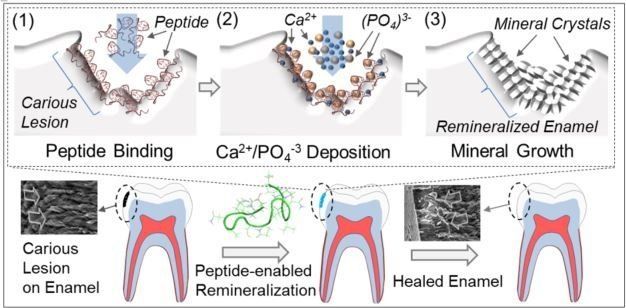
A group of experts in the dental field has made some amazing discoveries and there has been a really incredible development in the technology of dental implants that goes far beyond the classic implant or denture. They say that these discoveries will give us the chance to grow new and genuine teeth in the oral cavity.

The famous Dr. Jeremy Mao of Columbia University was the lea d investigator of this research and what he found was absolutely incredible. Dr. Mao built a scaffold for teeth, containing stem cells in the body. Using DNA, he succeeded in regenerating new teeth. This discovery of the modern technology promises a bright future when it comes to dental care.

Are Artificial Wombs the Future of Birth?

In April, Scientists based in Philadelphia unveiled an artificial womb undergoing testing on fetal lambs. With a prediction from one of the researchers that the technology could be ready for human testing in three to five years, artificial wombs suddenly became the most unexpected rage of 2017. But what sort of artificial wombs might realistically be a part of healthcare in the near future?

In this video series, the Galactic Public Archives takes bite-sized looks at a variety of terms, technologies, and ideas that are likely to be prominent in the future. Terms are regularly changing and being redefined with the passing of time. With constant breakthroughs and the development of new technology and other resources, we seek to define what these things are and how they will impact our future.

Follow us on social media:
Twitter / Facebook / Instagram

Why Life Extension is not Popular with the Public Yet

LEAF Director Elena Milova recently attended the International Longevity and Cryopreservation Summit in Madrid and gave a talk about effective advocacy and how we can engage better with the public as advocates for rejuvenation biotechnology.

Her talk touches upon effective message delivery as well as the basic principles of teaching, known as the didactic principles.

If we can learn to master this techniques it will help us all become better advocates and champions of rejuvenation biotechnology. Her talk is available below and for those who prefer reading, there is a text version of the main points addressed during the presentation. The presentation slides used in the video are available here or here for pdf.

/* */