New insights into the role of signal transducer and activator of transcription (STAT)-3 in regulating mitochondrial function in acute myeloid leukemia (AML): by linking STAT3 signaling to mitochondrial metabolism and apoptosis control, this study provides new mechanistic insight into how AML cells maintain their energy balance and resist cell death. These findings highlight mitochondrial regulation as a potential therapeutic vulnerability in AML.
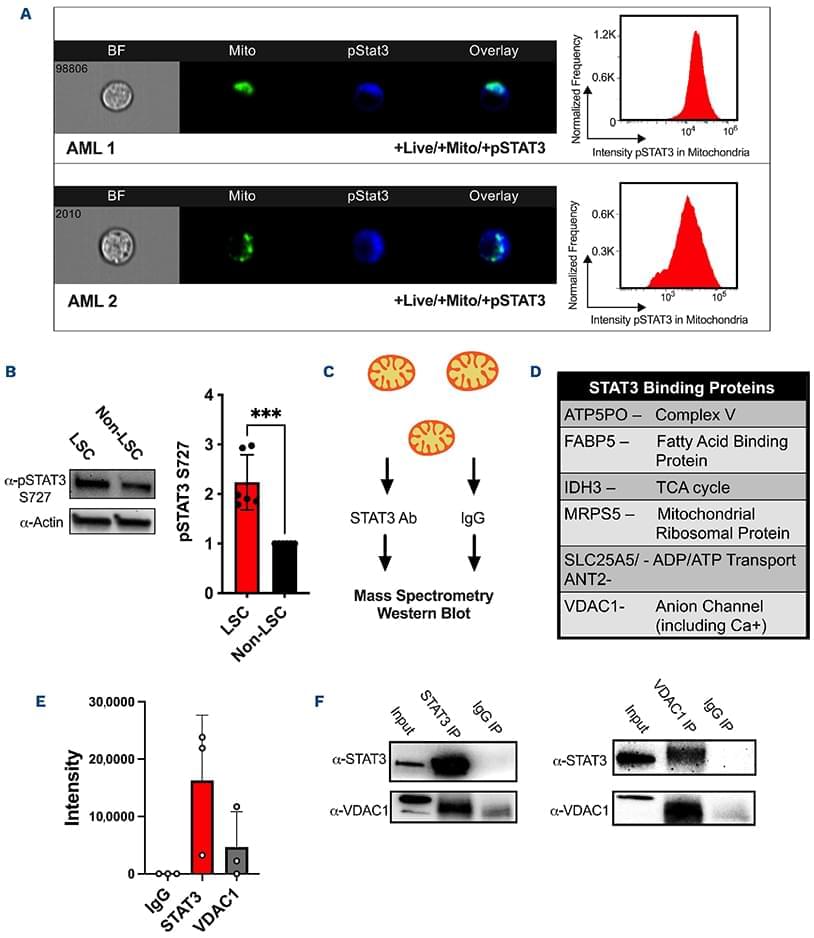
Signal transducer and activator of transcription 3 (STAT3) is a well-described transcription factor that mediates oxidative phosphorylation and glutamine uptake in bulk acute myeloid leukemia cells and leukemic stem cells. STAT3 has also been shown to translocate to the mitochondria in acute myeloid leukemia cells, and phosphorylation at the serine 727 (pSTAT3 S727) residue has been shown to be especially important for the mitochondrial functions of STAT3. We demonstrate that inhibition of STAT3 results in impaired mitochondrial function and decreased leukemia cell viability. We discovered a novel interaction of STAT3 with voltage-dependent anion channel 1 (VDAC1) in the mitochondria which provides a mechanism through which STAT3 modulates mitochondrial function and cell survival. Through VDAC1, STAT3 regulates calcium and oxidative phosphorylation in the mitochondria. STAT3 and VDAC1 inhibition also results in significantly reduced engraftment potential of leukemia stem cells, including primary samples resistant to venetoclax. These results implicate STAT3 as a therapeutic target in acute myeloid leukemia.
Acute myeloid leukemia (AML) is a genetically heterogenous and highly aggressive myeloid neoplasm with poor prognosis.1,2 Standard therapy for AML has historically consisted of induction chemotherapy with an anthracycline and cytarabine, followed by consolidation with either hematopoietic stem cell transplant or high-dose cytarabine.3 Recently, therapeutic options have broadened with the advent of novel targeted therapies.4–7 However, despite high response rates, relapse is common.6 Relapsed disease is believed to originate from a quiescent subpopulation of therapy-resistant leukemic stem cells (LSC)8 which are found in greater abundance at the time of relapse than at diagnosis,9–12 and negatively correlate with survival.10,11 LSC demonstrate a unique vulnerability in their preferential reliance on mitochondrial activity and oxidative phosphorylation (OXPHOS).12–14 While Bcl-2 inhibition with venetoclax in combination with the hypomethylating agent azacitidine has demonstrated selectivity for LSC through inhibition of OXPHOS,13 resistance frequently develops via alterations in mitochondrial metabolism or activation of alternative anti-apoptotic pathways.15–19 Furthermore, prior studies of patients who progress after frontline hypomethylating agent/venetoclax have shown very poor outcomes, with a median survival following failure of this combination of 3 months or less.20–22 New strategies targeting LSC via their reliance on OXPHOS are of significant interest and have been described in several reports,7,13,23 however, further research is needed to elucidate the mechanisms underlying the observations.
Signal transducer and activator of transcription 3 (STAT3) has been shown to be important for leukemogenesis and is known to be highly expressed in many AML patients’ samples and cell lines.24–27 Canonically, STAT3 is known to undergo phosphorylation at residue Tyr705 leading to dimerization and translocation to the nucleus where it functions as a transcription factor regulating cell development, renewal, proliferation, and cell death.25,28–30 Our previous work additionally established that the transcriptional activity of STAT3 regulates mitochondrial function via a MYC-SLC1A5-mediated pathway.27 Despite its well-described nuclear role as a transcription factor, STAT3 has also been discovered to localize to the mitochondria.31,32 Prior work has suggested a variety of functions in the mitochondria, including modulation of electron transport chain activity,31–33 regulation of mitochondrial genes,34 and regulation of mitochondrial calcium flux.35,36 While phosphorylation of STAT3 at both Tyr705 (pSTAT3 Y705) and Ser727 (pSTAT3 S727) sites have been found in the mitochondria,31–33,36,37 Ser727 phosphorylation is critical for modulation of mitochondrial functions such as electron transport chain activities.31,32 These data suggest that STAT3 plays a critical role in mitochondria, although this role in AML is not well characterized.