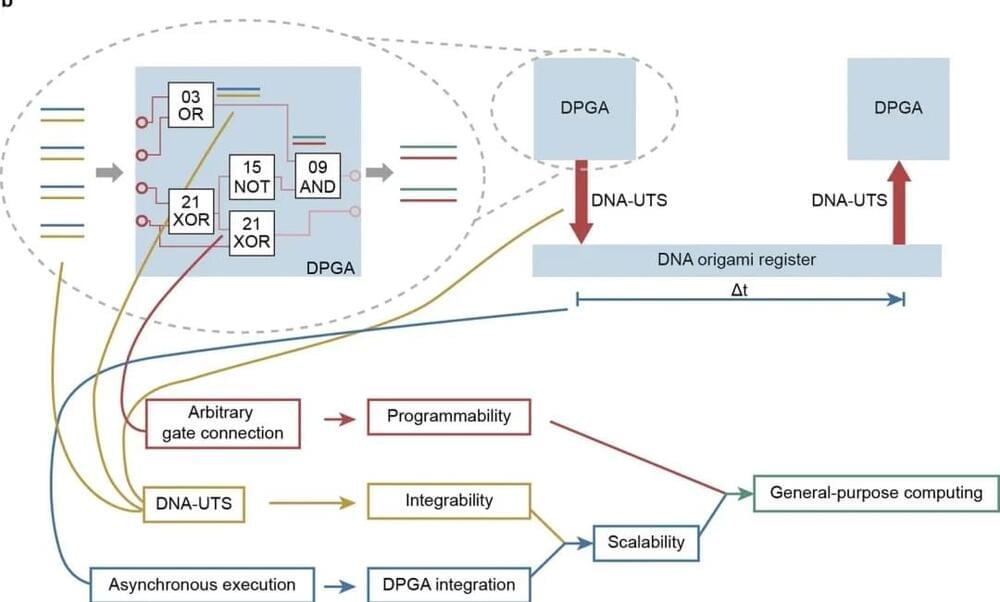
The group at Shanghai Jiao Tong University has demonstrated a DNA computer system using DNA integrated circuits (DICs) that can solve quadratic equations with 30 logic gates.
Published in Nature, the system integrates multiple layers of DNA-based programmable gate arrays (DPGAs). This uses generic single-stranded oligonucleotides as a uniform transmission signal can reliably integrate large-scale DICs with minimal leakage and high fidelity for general-purpose computing.
To control the intrinsically random collision of molecules, the team designed DNA origami registers to provide the directionality for asynchronous execution of cascaded DPGAs. This was used to assemble a DIC that can solve quadratic equations with three layers of cascade DPGAs comprising 30 logic gates with around 500 DNA strands.
To make a gene-editing tool more precise and easier to control, Rice University engineers split it into two pieces that only come back together when a third small molecule is added.
Researchers in the lab of chemical and biomolecular engineer Xue Sherry Gao created a CRISPR-based gene editor designed to target adenine ⎯ one of the four main DNA building blocks ⎯ that remains inactive when disassembled but kicks into gear once the binding molecule is added.
Compared to the intact original, the split editor is more precise and stays active for a narrower window of time, which is important for avoiding off-target edits. Moreover, the activating small molecule used to bind the two pieces of the tool together is already being used as an anticancer and immunosuppressive drug.
I wondered when this would happen. Reminds me of the video game “The Last of Us” and there’s a TV series as well. I’m sure they’ll stop it though.
Silver leaf disease is a curse for a variety of botanicals, from pears to roses to rhododendron. Infecting their leaves and branches, the fungus Chondrostereum purpureum can be fatal for the plant if not quickly treated.
Aside from the risk of losing the occasional rose bush, the fungal disease has never been considered a problem for humans. Until this year.
In what researchers suggest is the first reported case of its kind, a 61-year-old Indian mycologist appears to have contracted a rather serious case of silver leaf disease in his own throat, providing a rare example of a pathogen seemingly making an enormous leap across entire kingdoms in the tree of life.
It could be a new way to treat one of the more common and more frustrating symptoms of Alzheimer’s. A team at Johns Hopkins is leading a study on the drug, and you can get involved.
Leveraging Technology For Innovative, Patient-Centered Clinical Care — Dr. Peter Fleischut, MD — Group Senior Vice President And Chief Information & Transformation Officer, NewYork-Presbyterian Hospital
Dr. Peter M. Fleischut, M.D., is Group Senior Vice President and Chief Information and Transformation Officer at NewYork-Presbyterian (https://www.nyp.org/)where he oversees the strategic vision and management of enterprise information technology, lab operations, pharmacy operations, innovation, data and analytics, artificial intelligence, telemedicine, and cybersecurity.
Dr. Fleischut has led the development of the Hospital’s award-winning digital health services and the implementation of clinical operations at NewYork-Presbyterian David H. Koch Center, a world-class ambulatory care center. In his previous role as Senior Vice President and Chief Transformation Officer, he focused on creating a single electronic medical record across NewYork-Presbyterian and its affiliated medical schools, Weill Cornell Medicine and Columbia University Vagelos College of Physicians and Surgeons.
Dr. Fleischut also led efforts to standardize care across NYP’s ten hospitals and hundreds of clinics and doctor practices, and oversaw all aspects of Graduate Medical Education (GME) for programs across the NYP enterprise.
Joining NewYork-Presbyterian/Weill Cornell in 2006, Dr. Fleischut previously served as Medical Director of Operating Rooms, Deputy Quality Patient Safety Officer, founding Director of the Center for Perioperative Outcomes, Vice Chairman, Chief Medical Information Officer, Chief Innovation Officer and Chief Medical Operating Officer.
Revolutionizing Musculoskeletal Health Through Microcapsule Drug Delivery — Dr. @George R. Dodge, Ph.D. — CEO & Co-Founder — Mechano-Therapeutics LLC
Dr. George R. Dodge, Ph.D. is CEO & Co-Founder of Mechano-Therapeutics LLC (https://mechano-therapeutics.com/), a biotechnology company spun out from his lab, and the labs of his partners Dr. Rob Mauck and Dr. Daeyeon Lee, at the University of Pennsylvania, specializing in microcapsule development using proprietary microfluidics for drug encapsulation, with a mission to revolutionize musculoskeletal health using an innovative platform technology to enhance delivery of therapeutics for improving patient outcomes.
Dr. Dodge recently served on the faculty of Orthopaedic Surgery, Perelman School of Medicine, University of Pennsylvania; as Director, Philadelphia VA Shared Instrument Core; and Director, Translational Musculoskeletal Research Center, Philadelphia Crescenz Veterans Administration Medical Center, Department of Veteran Affairs.
Dr. Dodge has a B.S. (Biology) from Asbury College, a B.S. (Biology and Health Science / Public Health) from State University of New York, a Ph.D. (Biochemistry and Immunology) from McGill University, and did Post-Graduate work in Molecular and Cell Biology, at Thomas Jefferson University Department of Pathology and Cell Biology.
Dr. Dodge is an established investigator with a career long commitment to translational musculoskeletal research and in particular research focused on cartilage and chondrocyte biology, extracellular matrix and research related to osteoarthritis.
For the first time, a team from the University of Minnesota Twin Cities has synthesized a thin film of a unique topological semimetal material that has the potential to generate more computing power and memory storage while using significantly less energy. Additionally, the team’s close examination of the material yielded crucial insights into the physics behind its unique properties.
The study was recently published in the journal Nature Communications.
<em>Nature Communications</em> is a peer-reviewed, open-access, multidisciplinary, scientific journal published by Nature Portfolio. It covers the natural sciences, including physics, biology, chemistry, medicine, and earth sciences. It began publishing in 2010 and has editorial offices in London, Berlin, New York City, and Shanghai.
Insights into healing and aging were discovered by National Institutes of Health researchers and their collaborators, who studied how a tiny sea creature regenerates an entire new body from only its mouth. The researchers sequenced RNA from Hydractinia symbiolongicarpus, a small, tube-shaped animal that lives on the shells of hermit crabs. Just as the Hydractinia were beginning to regenerate new bodies, the researchers detected a molecular signature associated with the biological process of aging, also known as senescence. According to the study published in Cell Reports, Hydractinia demonstrates that the fundamental biological processes of healing and aging are intertwined, providing new perspective on how aging evolved.
NIH researchers researchers and collaborators have gained some key insights into the biological inner-workings of regrowing a body, the evolution of aging and a unique method to dispose of aging cells, by studying the genomes of a hermit crab (Hydractinia symbiolongicarpus).
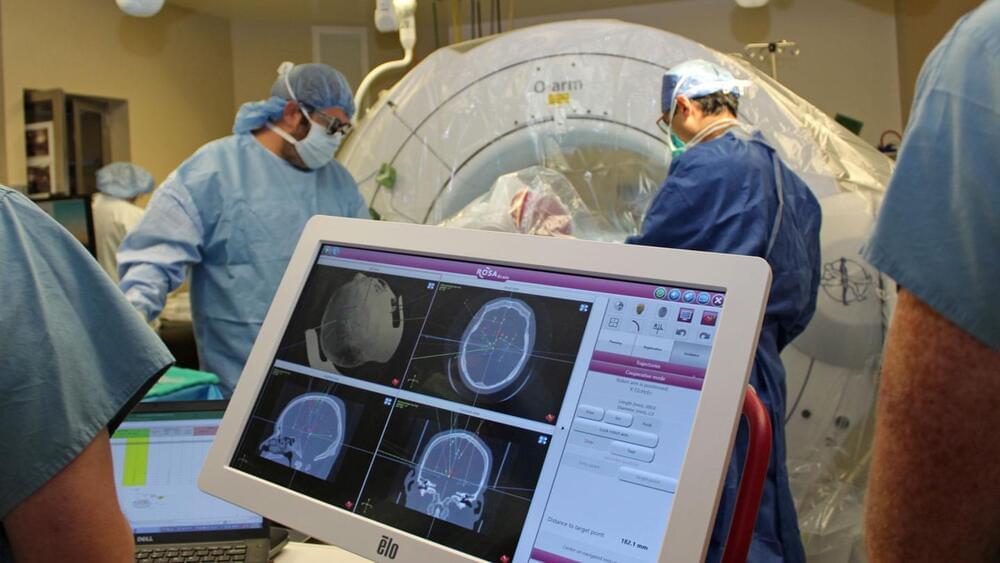
This is the third part in a series on deep brain stimulation for depression. Read from the beginning.
Early in the morning on August 22, 2022, Jon’s medical team told him that neurologist Helen Mayberg would check in with him just before his deep brain stimulation surgery.
Still seems unsafe to me until its 100% error free, but step in correct direction at least.
Researchers have found that splitting the gene editor used in traditional CRISPR technology creates a more precise tool that can be switched on and off, with significantly less chance of causing unintended genome mutations. They say their novel tool can potentially correct around half of the mutations that cause disease.
CRISPR is one of those scientific terms that has made it into the everyday lexicon. Arguably one of the biggest discoveries of the 21st century, the gene-editing tool has revolutionized research and the treatment of genetic and non-genetic diseases. But the primary risk associated with CRISPR technology is ‘off-target edits,’ namely unexpected, unwanted, or even adverse alterations at locations in the genome other than the targeted site.
Now, researchers at Rice University have developed a new CRISPR-based gene-editing tool that’s more precise and significantly reduces the likelihood of off-target edits occurring.