Toggle light / dark theme

Fluorescent molecule could shed light on the inner workings of the cellular environment

A fluorescent molecule whose luminosity depends upon how fast it can rotate is helping researchers measure how viscous the fluid is inside different parts of a cell.

“There’s a lot of interest in the biophysical field in developing that can be used to characterize the environment inside a cell or any kind of biological compartment,” says Peter Bond, from A*STAR’s Bioinformatics Institute.

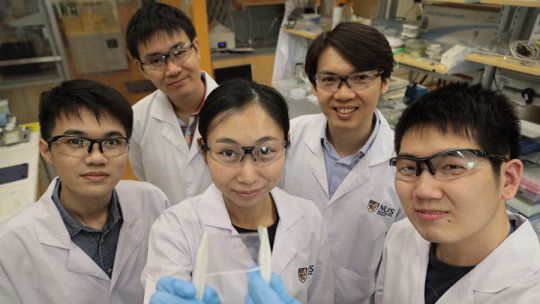
Researchers from the United Kingdom and Singapore—including A*STAR scientists such as Bond’s team who led the computational arm of the project—have modeled, developed and tested a molecule comprising two parts; a genetic probe designed to home in on particular proteins, so it can be directed to wherever in a cell that is found; and a molecular rotor—a fluorescent molecule whose fluorescence lasts longer, the slower it spins. A*STAR researchers simulated how this molecule would perform in different microenvironments at scales of millionths or even billionths of a meter.

Molecular switches are not just ‘on’ or ‘off’

👀


The GTPases constitute a very large protein family, whose members are involved in the control of cell growth, transport of molecules, synthesis of other proteins, etc. Despite the many functions of the GTPases, they follow a common cyclic pattern (Figure 1). The activity of the GTPases is regulated by factors that control their ability to bind and hydrolyse guanosine triphosphate (GTP) to guanosine diphosphate (GDP). So far, it has been the general assumption that a GTPase is active or “on” when it is bound to GTP and inactive or “off” in complex with GDP. The GTPases are therefore sometimes referred to as molecular “switches.”

The bacterial translational elongation factor EF-Tu is a GTPase, which plays a crucial role during the synthesis of proteins in bacteria, as the factor transports the amino acids that build up a cell’s proteins to the cellular protein synthesis factory, the ribosome. Previous structural studies using X-ray crystallography have shown that EF-Tu occurs in two markedly different three-dimensional shapes depending on whether the factor is “on” (i.e. bound to GTP) or “off” (i.e. bound to GDP) (Figure 2). The binding of GTP/GDP have therefore always been thought to be decisive for the factor’s structural conformation.

However, a research collaboration between researchers from the Department of Molecular Biology and Genetics at Aarhus University and two American universities reveals that EF-Tu’s structure and function, and probably also those of other GTPases, are far more complex than previously assumed. In Søren Thirup’s group, X-ray crystallographic analysis of E. coli EF-Tu has shown that EF-Tu bound to a variant of GTP, GDPNP, can also occur in the “off” state, which is characterised by a more open structure. In collaboration with American researchers, Charlotte Knudsen’s Ph.D. student, Darius Kavaliauskas, conducted further studies using a special form of fluorescence microscopy that makes it possible to observe the spatial structure of individual EF-Tu molecules in solution.

Prince Charles Says He “Utterly Objects” to The Idea of People Becoming Part Human, Part Machine

From the perspective of critics, there are many reasons to be concerned about the rise of artificial intelligence.

Billionaire inventor Elon Musk — perhaps the world’s most vocal AI antagonist — has warned that the technology could become “an immortal dictator from which we would never escape.”

Several years before his death, Stephen Hawking, the renowned theoretical physicist, said artificial intelligence could bypass biological evolution, leaving humans unable to compete.

/* */