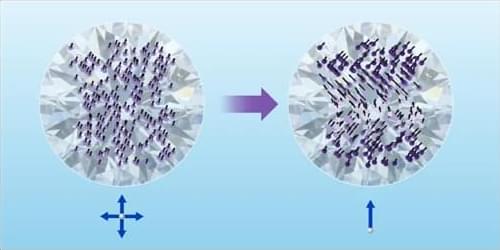
Robust collective spin dynamics have been achieved in diamond by winding the spins into a nanoscale spiral and making their interactions symmetric.
Spins behave like tiny magnetic needles. Their precession in a magnetic field makes them sensitive probes of that field. Being quantum, spins in collective states—such as entangled or squeezed states—can sense better than they do independently. Interactions between spins are key to preparing such states. However, interactions with randomly located nearby spins scramble the collective motion, while interactions with remote spins distributed in 3D space sum to nearly zero. Now Piotr Put at Harvard University and his colleagues have found a way around these obstacles [1]. By winding spin orientations in diamond into a nanoscale spiral and modifying the spins’ interactions using microwave pulses, the researchers sustained collective motion despite the spins’ random positions in 3D space. The team’s approach marks a milestone toward quantum-enhanced magnetic sensing using dense ensembles of solid-state spins.
Quantum measurements are inherently noisy. Because each measurement gives a random result, averaging over many measurements still leaves some unavoidable statistical uncertainty. Entangled or squeezed states of many spins can reduce this uncertainty because if one spin is found pointing in a particular direction, the others have a higher probability of pointing in that same direction than they would if they were independent. In the 1980s, squeezed light was proposed to improve interferometry [2], and this principle now enhances gravitational-wave detection at LIGO [3]. To achieve analogous squeezed states using spins, one route is to generate so-called one-axis-twisting interactions [4]. Here, the precession frequency of one spin depends on how much the other spins are aligned along that spin’s precession axis.