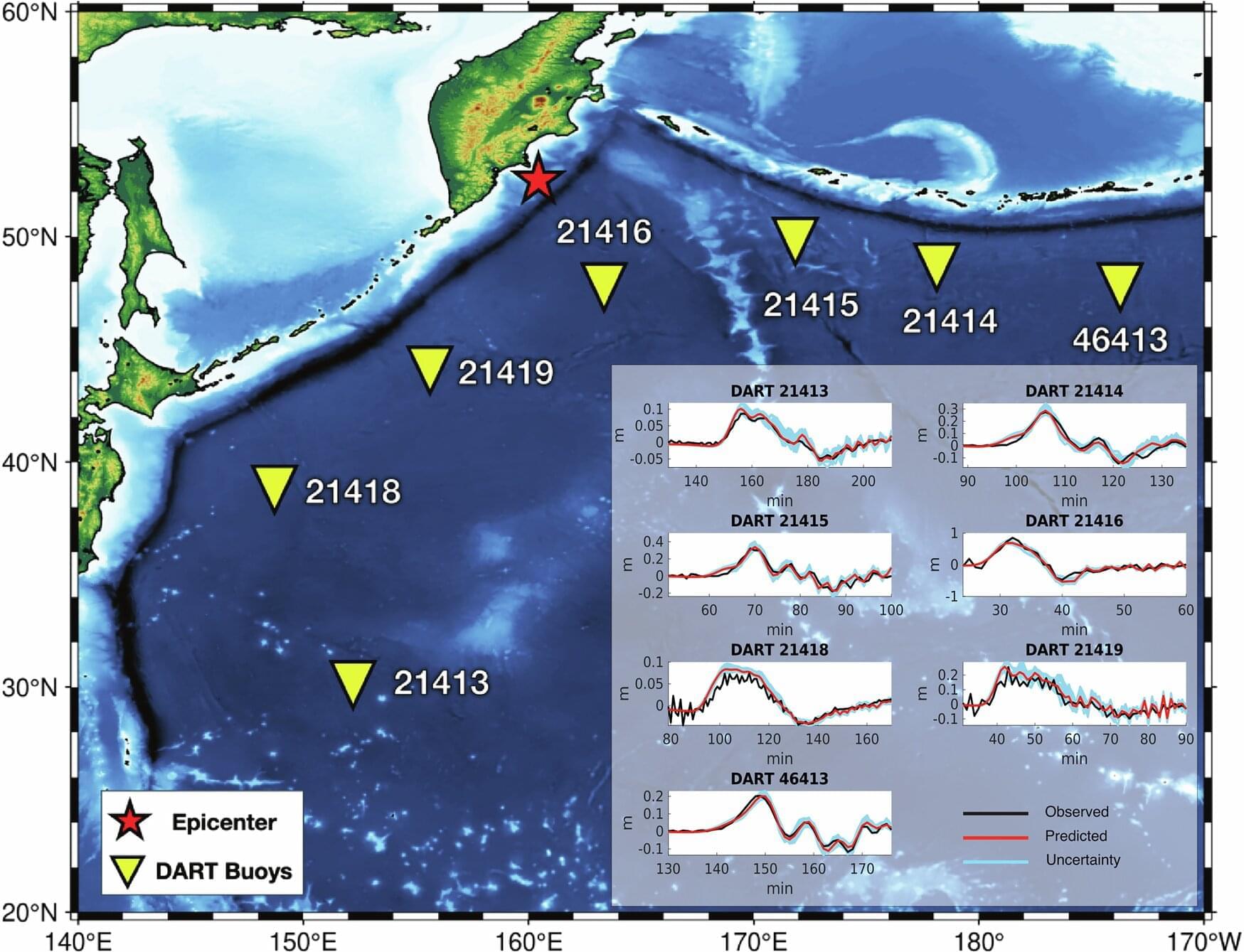
In 2025, along parts of Kamchatka’s coast in Russia, a magnitude 8.8 earthquake caused a tsunami to surge nearly 20 meters (65 feet) above sea level. Yet across the Pacific, its waves were much smaller than those produced by the region’s great 9.0 earthquake in 1952. How could the tsunami climb so high near the source yet have a comparatively modest impact far away?
The November 1952 quake located close to Kamchatka sent destructive waves across the ocean. The resulting tsunami destroyed most of Severo-Kurilsk, a town in the Kuril Islands. Even in distant Hawaii, it wrecked boats and piers and demolished a bridge linking Hilo’s shore to Coconut Island. Its destruction both near and far makes it a compelling comparison to the 2025 event.
A new reconstruction of the later earthquake published in Communications Earth & Environment by Stefano Lorito of Italy’s National Institute of Geophysics and Volcanology and colleagues points to what happened beneath the seabed. The earthquake’s size mattered, but so did where the rocks moved—a difference that helps explain the two tsunamis’ contrasting effects.