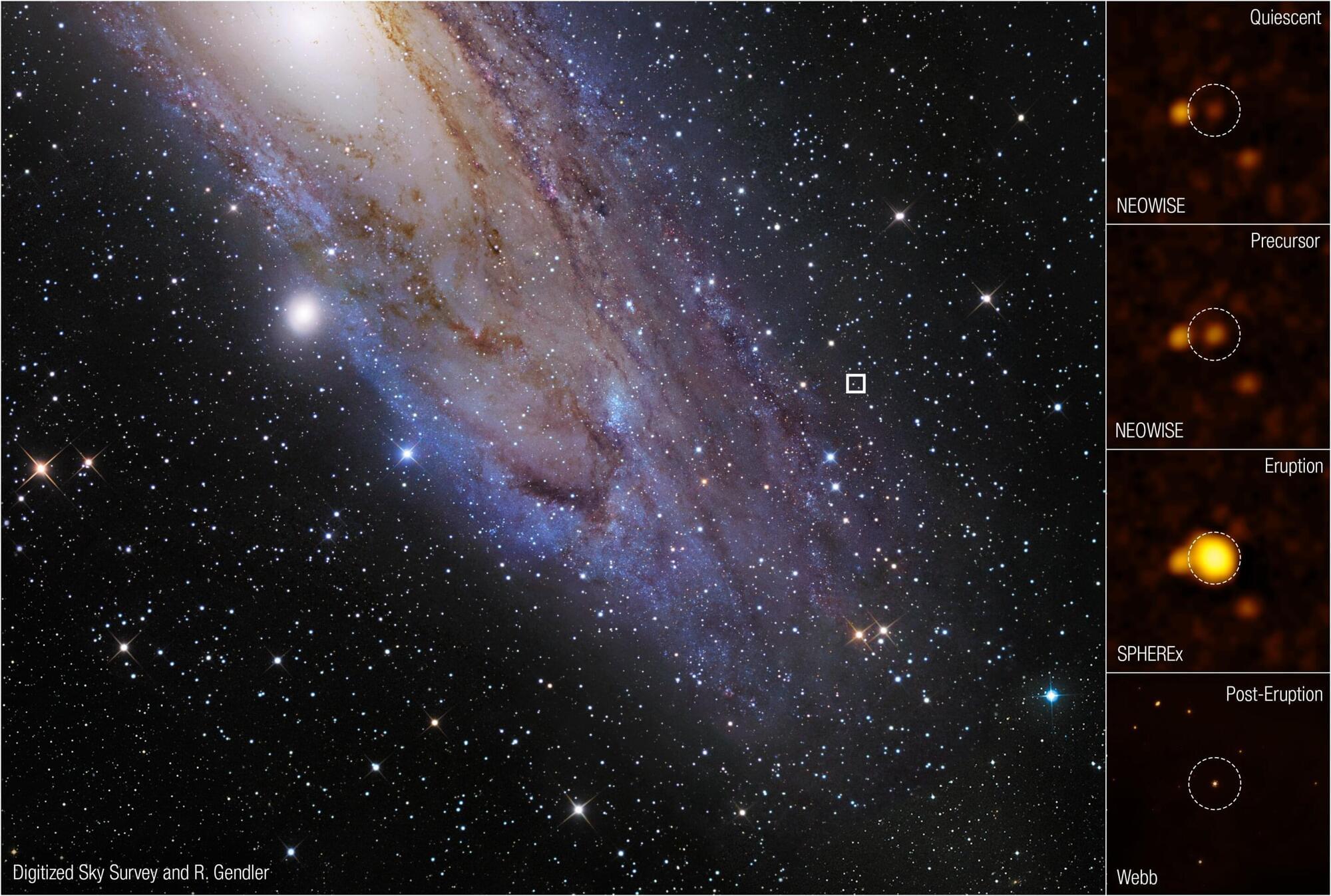
Researchers recently identified a first of its kind: A star slightly less massive than the sun spiraled into and merged with a puffy supergiant star on the outskirts of our neighboring Andromeda galaxy. They nicknamed the newly single, potentially “rejuvenated” star Bao. Their discovery was then bolstered by quick-turn observations from NASA’s James Webb Space Telescope that were carefully cross-referenced with extensive data from telescopes in space and on the ground.
“Stellar mergers are very, very difficult to observe in real time because they are hard to predict,” said Viraj Karambelkar, the first author of a new paper published in Nature and a NASA Hubble Fellow at Columbia University in New York. “However, we noticed something unusual was going on in 2023 and continued to monitor the system to see what it would do. Then, in 2025, it erupted.
Webb observed Bao only 47 days after the stars’ eruption peaked, the earliest-ever follow-up of an event like this. The telescope’s data helped us characterize what the system looked like before, during and immediately after the merger, which is absolutely mind-blowing.