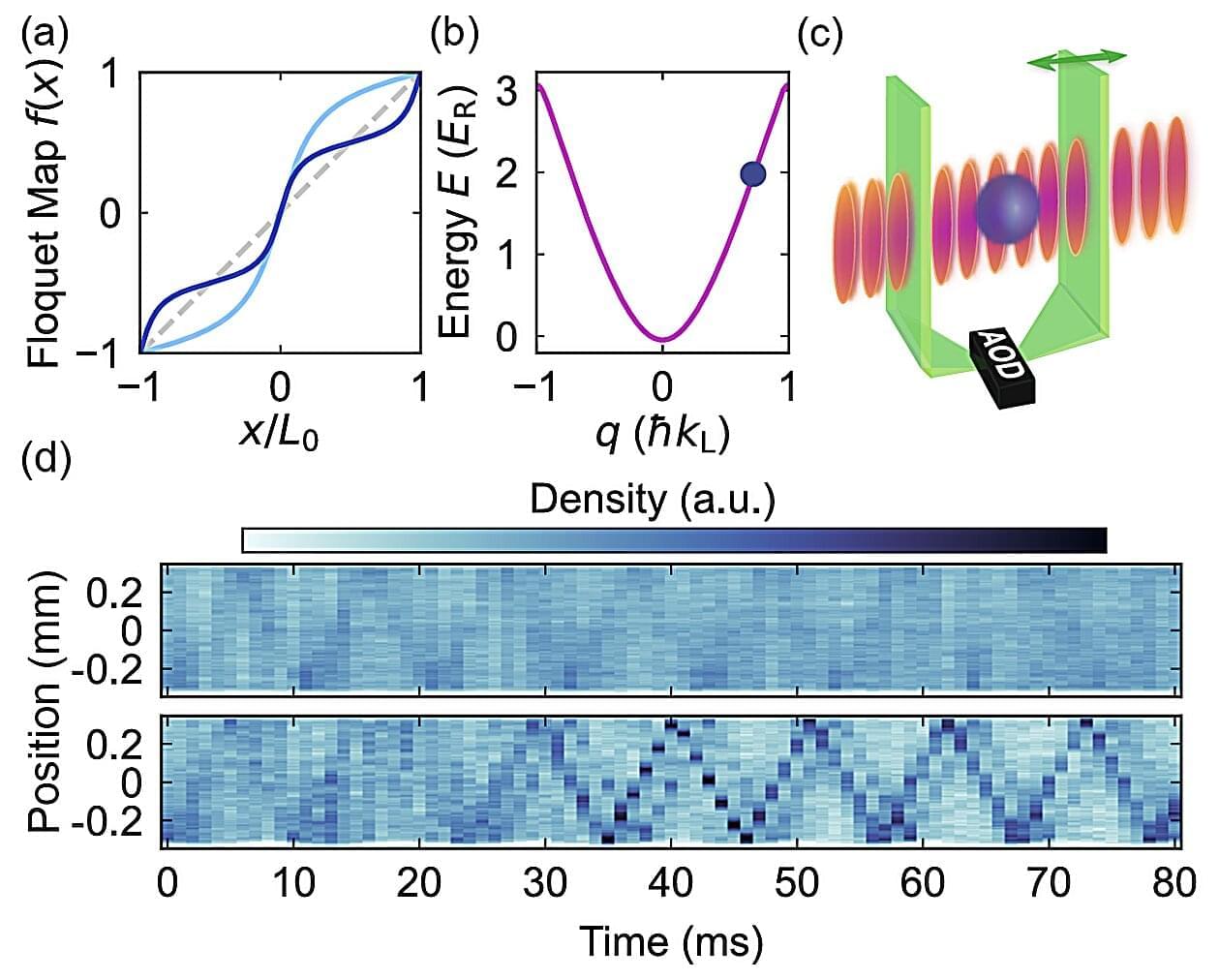
Optical cavities are pairs of light-trapping mirrors and underpin the operation of lasers, atomic clocks and many types of precision sensors. If the distance between the mirrors is changed rapidly enough, some theories predict that the waves inside them should bunch together into short, intense pulses. So far, however, this prediction has never been tested directly.
Through new experiments, David Weld and colleagues at the University of California, Santa Barbara, have confirmed it for the first time by swapping the roles of light and matter. Strikingly, they found that the cavity behaves in ways that mimic the strange physics of curved spacetime.
Their results have been published in Physical Review Letters.