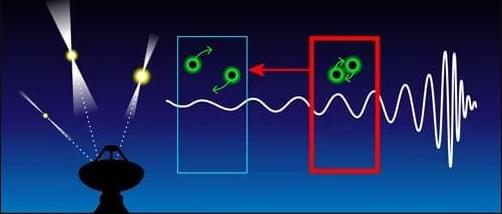
Researchers have used radio observations of rapidly spinning neutron stars to search for signals from supermassive black hole pairs at the dawn of galaxy formation.
In our lifetimes, an amazing thing has happened: Black holes have advanced from “remarkable inventions of the human mind” [1] to empirical objects studied with telescopes and gravitational-wave detectors. A major puzzle in black hole astronomy is understanding the assembly of “supermassive” black holes—those having masses over a million times that of the Sun. The debate hangs on decades of impressive work but can be summed up simply: Did black holes start massive, grow massive, or build up through mergers? Yiqin Chen from Beijing Normal University and her colleagues have opened up a new way to tackle the problem [2]. They use a long-running experiment called the Parkes Pulsar Timing Array, located in Australia, to probe a possible signal of early-Universe black hole binaries in low-frequency gravitational waves.