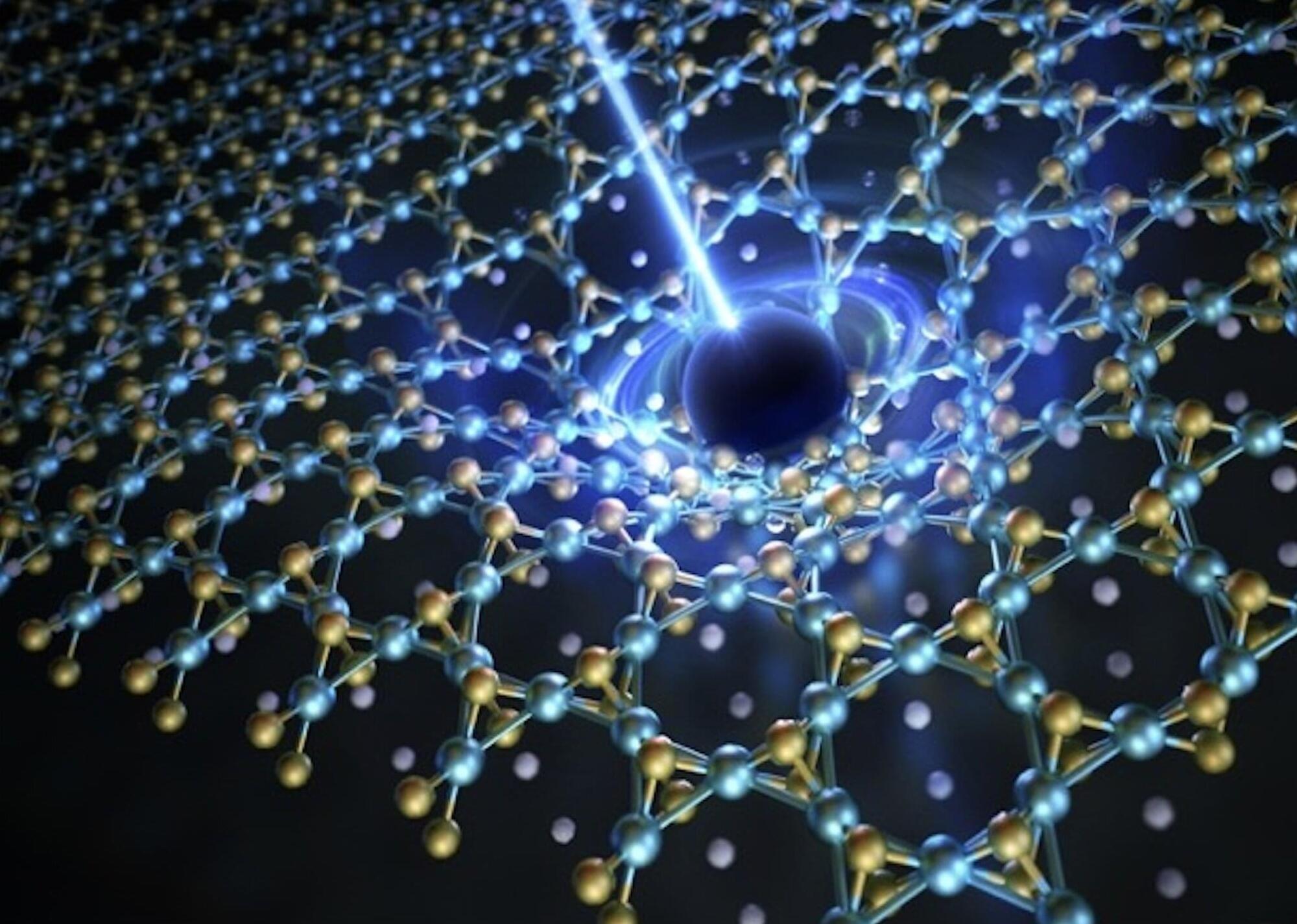
How atoms are arranged inside materials can influence the behavior of electrons and the resulting electronic states. Kagome lattices, repeating arrangements of atoms forming triangles that share corners (with hexagonal spaces between them), have been linked with the emergence of unusual electronic states.
Researchers at Seoul National University, the Center for Complex Phase of Materials and other institutions recently realized a two-dimensional (2D) kagome material that could be used to investigate quantum physics phenomena. This material, presented in a paper published in Nature Physics, was found to retain a set of tunable electron states with nearly identical energies (i.e., a flat electronic band) in a single layer.
“A central theme in condensed matter physics is the emergence of new electronic behavior from the underlying lattice geometry and symmetry,” Mingu Kang, senior author of the paper, told Phys.org. “A well-known example is graphene, where the symmetry of its hexagonal lattice gives rise to massless Dirac electrons (m = 0). Another extensively studied example in theoretical physics is the kagome lattice, composed of corner-sharing triangles.”