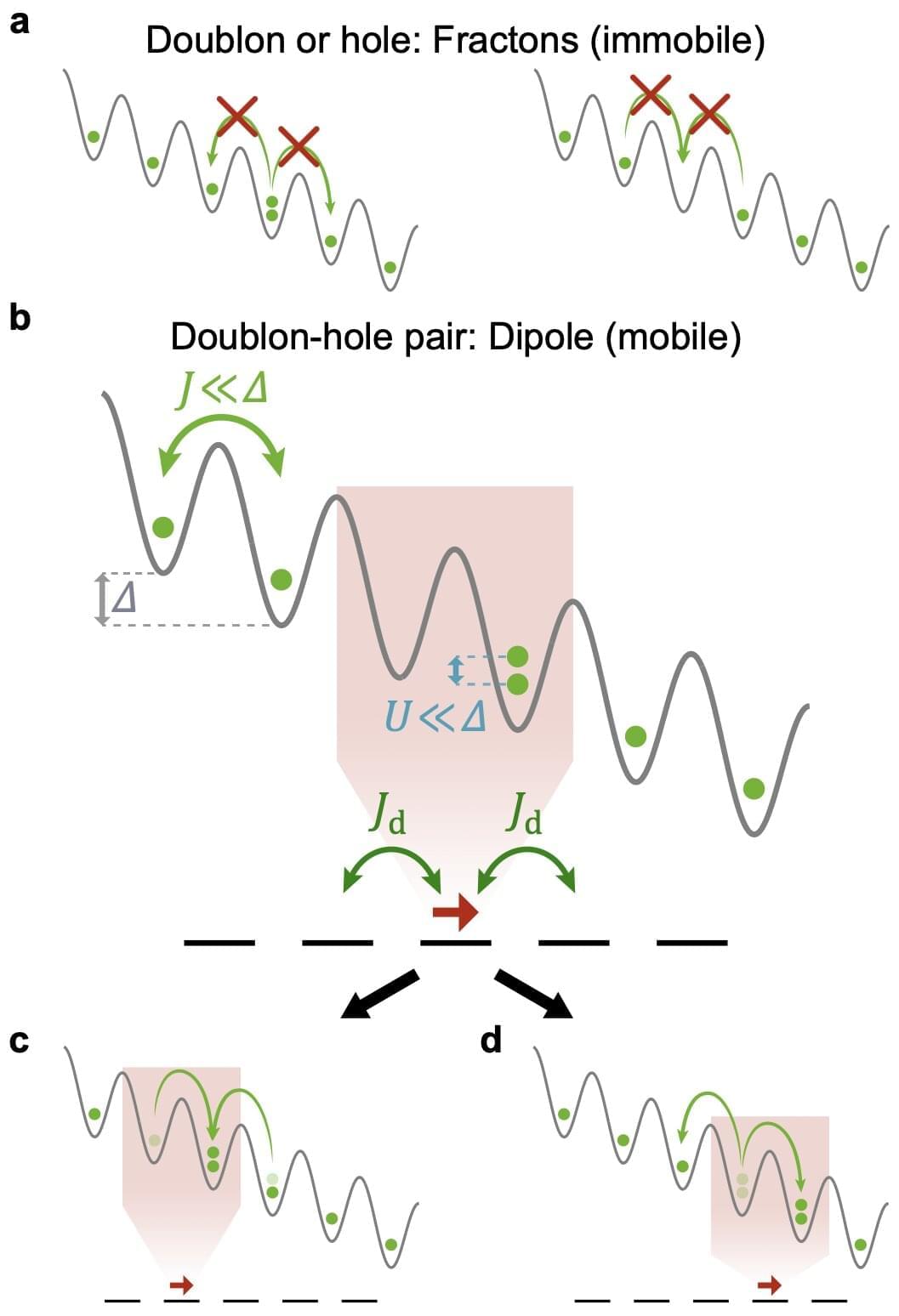
Particles can generally move between neighboring sites in a crystal, a solid in which atoms are arranged in a regular, repeating pattern, or an optical lattice, an arrangement of laser-based traps that confines atoms. A strong potential gradient (i.e., a steep change in potential energy across a crystal or lattice) makes this ordinary particle hopping difficult and energetically costly.
In these conditions, interactions between particles can still give rise to coordinated movements that preserve the system’s center of mass (i.e., its average position weighted by mass). This can produce so-called fractonic behavior, in which individual excitations called fractons cannot move alone, while certain bound states of these excitations can.
A research team at Harvard University and other institutions recently studied the fractonic behavior of hole-doublon pairs in a one-dimensional chain of ultracold atoms confined in an optical lattice. A hole is a site in the lattice that is missing an atom, while a doublon is a site that contains two atoms.