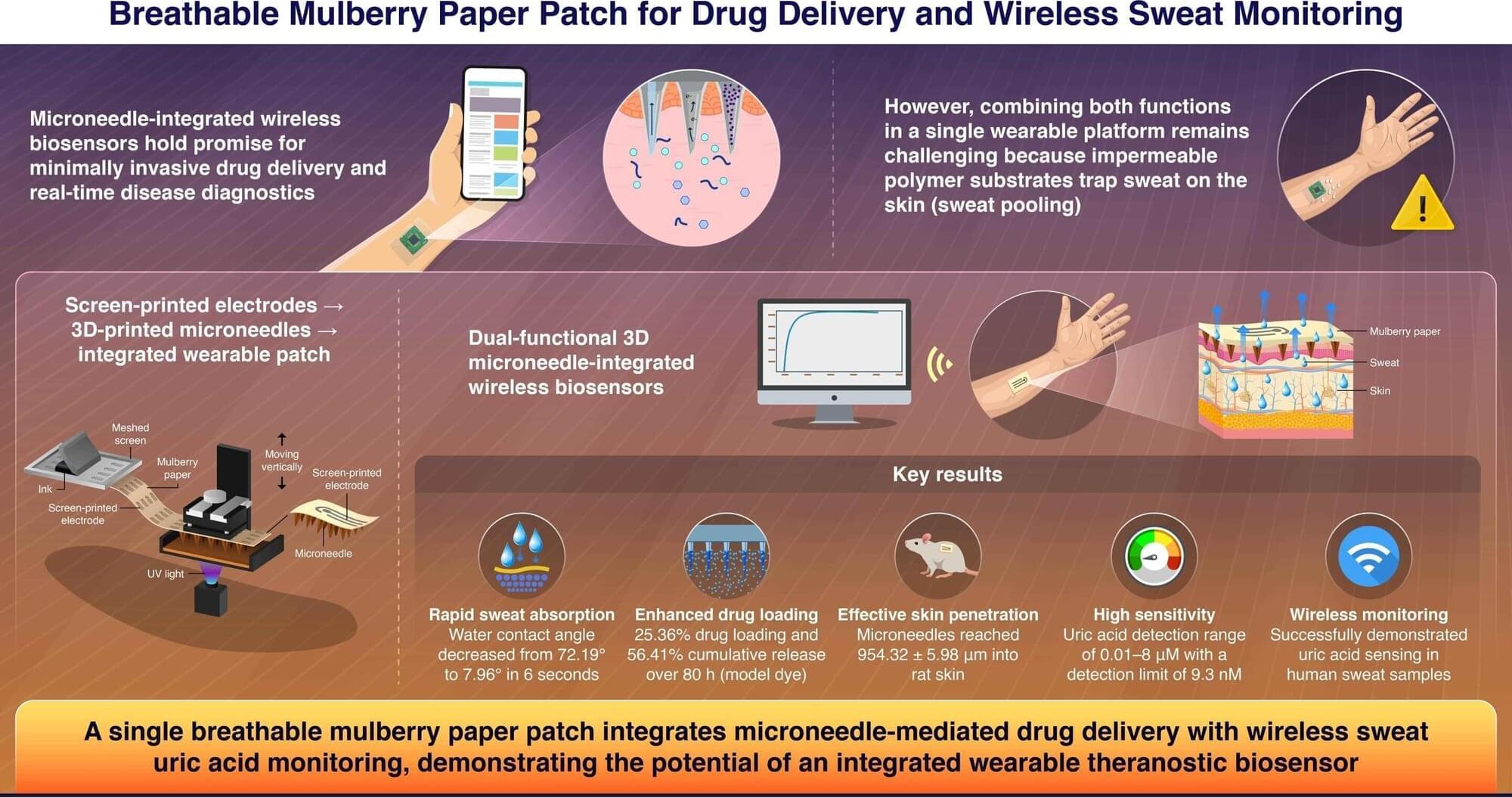
Wearable health-monitoring devices are becoming increasingly important for personalized health care, but conventional patches often rely on substrates that restrict airflow, trap sweat and cause skin discomfort during prolonged use. These limitations can also interfere with the reliable collection and analysis of sweat, highlighting the need for breathable materials that support both comfortable wear and accurate sensing.
Addressing this challenge, researchers led by professor Sooman Lim at Jeonbuk National University, South Korea, have developed a breathable wearable patch using traditional Korean mulberry paper, known as hanji. The platform combines 3D-printed microneedles for potential drug delivery with printed electrodes for wireless uric acid sensing. The study, published in Chemical Engineering Journal, demonstrates the feasibility of incorporating both functions into a single paper-based platform. The first authors of the study are Aqila Che Ab Rahman and Habibulla Imran, who contributed equally.
“Conventional wearable patches often struggle to balance skin comfort with reliable sweat collection. By using breathable mulberry paper, we aimed to develop a platform that supports moisture transport while accommodating both microneedles and printed sensing electrodes,” says Lim of Jeonbuk National University.