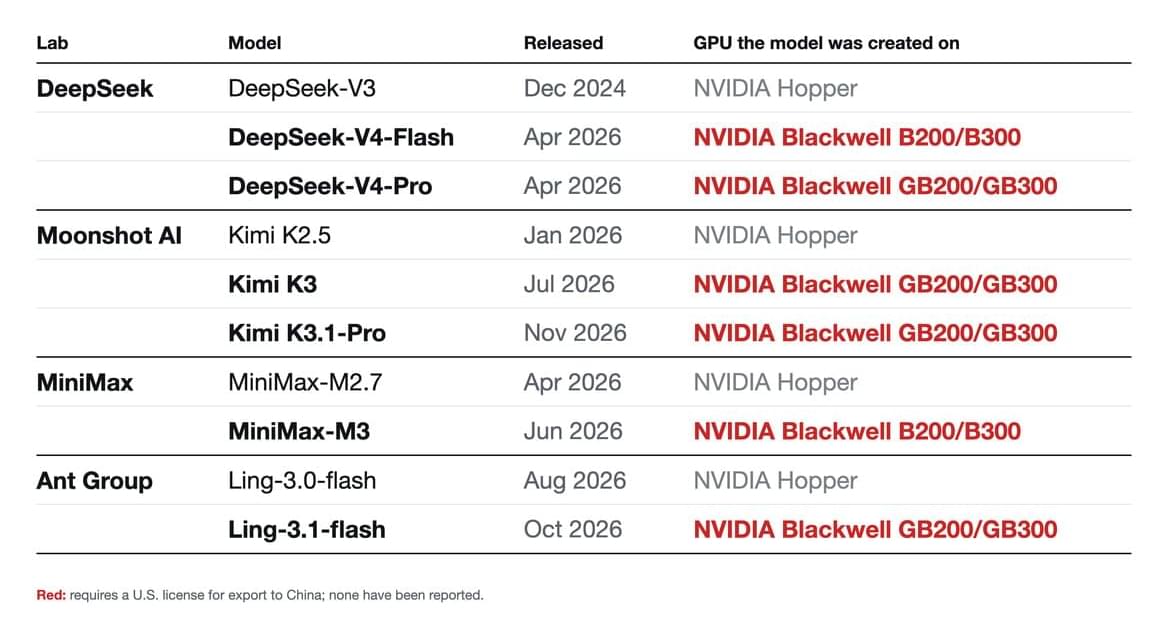
Four major Chinese frontier labs appear to have gained access to export-controlled NVIDIA Blackwell GPUs.
If this holds up under further scrutiny, the fallout for NVIDIA—and Jensen Huang—could be massive, and the implications for U.S. export controls and national security would be unprecedented.
Here is how a clever new forensic technique uncovered the evidence directly inside open-source model weights …
How do you audit AI hardware from open-source model weights alone? With GPU thread forensics.🔬💻
A fascinating new technical report by former OpenAI researcher Will DePue (Unemployment Labs) demonstrates a clever cryptographic-style method for identifying the exact NVIDIA GPU architecture used to initialize—and likely train—frontier AI models, simply by inspecting their publicly released weights.
How the “Hardware Fingerprint” Works:
1️⃣ Deterministic Initialization:
Before training starts, frameworks like PyTorch populate billions of model parameters using NVIDIA’s ‘cuRAND‘ library and the Philox pseudorandom number generator (PRNG). Given a starting seed, Philox generates a deterministic sequence of numbers.
2️⃣ Streaming Multiprocessor ℠ Striding: To fill billions of weights in parallel, the GPU splits the work across hardware threads (standardized at 2,048 threads per SM). Because different GPU generations have different SM counts, they assign numbers to memory addresses using completely different strides:
• Hopper (H100 / H800): 132 SMs = 270,336 threads • Blackwell (B200 / B300): 148 SMs = 303,104 threads • Blackwell (GB200 / GB300): 152 SMs = 311,296 threads
3️⃣ Surviving Training: Even after months of backpropagation, parameters tied to rare or unused tokens remain untouched—retaining their exact starting values. Even heavily trained weights preserve a faint statistical shadow 20 sigma to 1,385 sigma of that initial thread layout.
What the Weights Reveal:
Testing open-weight releases across major Chinese AI labs shows a clear generational shift starting in mid-2026:
🔹 DeepSeek: Transitioned from Hopper (DeepSeek-V3) to Blackwell B200/GB200 layouts (DeepSeek-V4-Flash & V4-Pro, April 2026).
🔹 Moonshot AI: Shifted from Hopper (Kimi K2.5) to Blackwell GB200/GB300 (Kimi K3 & K3.1-Pro, July–Nov 2026).
🔹 MiniMax & Ant Group: Both transitioned from Hopper to Blackwell architectures in their mid-to-late 2026 releases (MiniMax-M3 and Ling-3.1-flash).
🔹 Meanwhile, recent open models from Alibaba (Qwen), Zhipu (GLM), and Tencent still read as Hopper-trained.
The Caveat:
While the math provides compelling evidence of access to Blackwell-scale compute (estimated at 500 to 3,000 GPUs per run), weight forensics only reveal what silicon initialized the parameters —not where those clusters are physically hosted or how compute access was arranged.
Still, it’s a remarkable reminder that in frontier AI, hardware architectures leave subtle mathematical signatures right inside the open weights.
#Semiconductors #NVIDIA #DeepSeek #AIHardware #ArtificialIntelligence
Our forensic analysis of publicly released AI models finds evidence that DeepSeek, Moonshot AI, MiniMax and Ant Group have gained access to NVIDIA’s Blackwell GPUs, despite restrictions on exporting these chips to China, and are using that hardware to create their AI models.