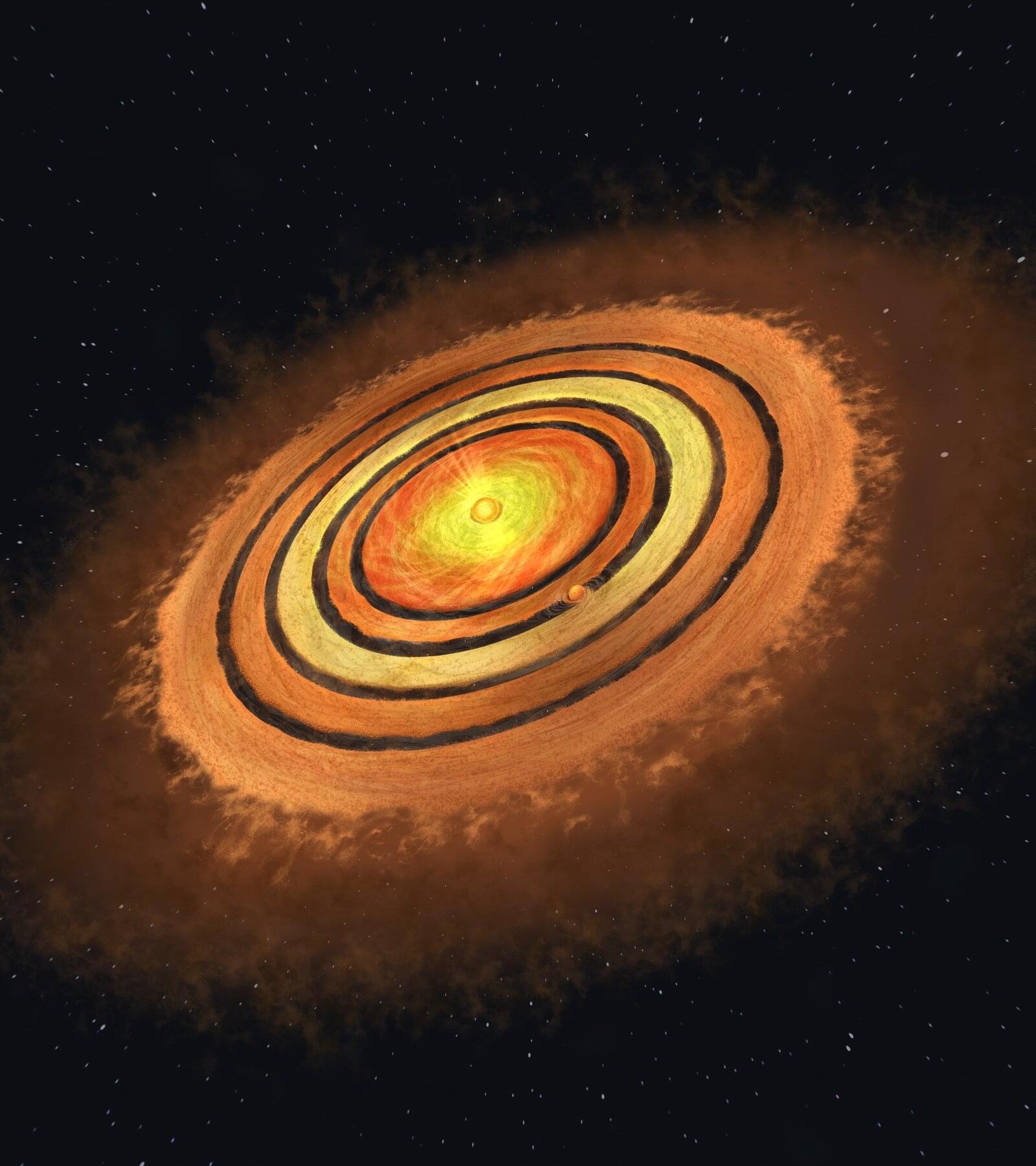
How are planets formed in a solar system? While the question is simple, the answer is not so straightforward. Astrophysicists have long peeked into the sky, observing early stars and planets to find the answer. A common pattern observed in early stars is sequential rings of bright and dark areas emanating from the center, like grooves on a vinyl record.
To understand how these rings form, a research team from Kyushu University studied archived data of V1094 Sco, a young star with these sequential patterns. They applied new imaging techniques to get a clearer look and discovered that the grooves form in two different ways depending on their proximity to the star. The inner rings are formed by a new planet orbiting the young star, while the outer ring is formed through dust clumping together under its own gravity, a mechanism known as “secular gravitational instability.”
The study, published in The Astrophysical Journal, provides new insights into how solar systems like ours form and demonstrates how much new science can be extracted from old data using new imaging techniques.