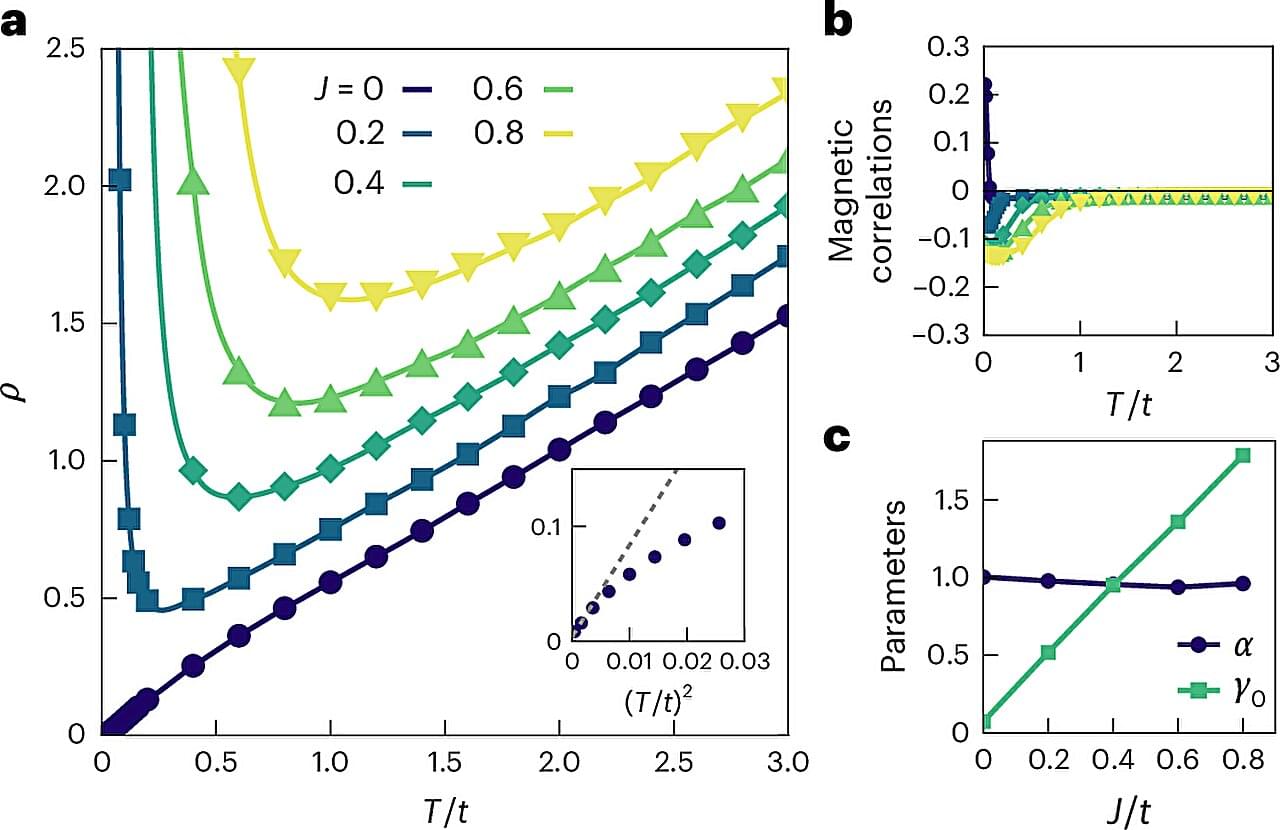
In an ordinary metal, electrons behave like well-defined particles that occasionally bump into imperfections or vibrations of the crystal. Many materials with strong electron–electron interactions, including the copper-oxide (cuprate) superconductors, break these rules. In these “strange metals,” electrical resistance rises in a straight line with temperature over a very wide range. Electrons seem to lose their momentum at the fastest rate quantum mechanics allows, the so-called Planckian limit. What causes this is still an open question.
In a study published in Nature Physics, a team led by Simone Fratini at Institut Néel (CNRS / Université Grenoble Alpes), with Arnaud Ralko (Institut Néel), Ivan Duchemin (CEA, Grenoble) and Sergio Ciuchi (University of L’Aquila), offers a simple answer. Planckian behavior does not come from how electrons collide. It comes from the quantum nature of how they respond to an electric field.
The team used the t–J model, a standard description of strongly interacting electrons in the copper-oxide planes. With improved numerical techniques, they computed its electrical properties exactly down to temperatures that correspond to about 40 Kelvin in real cuprates, reaching record-low temperatures (lower than the effective temperatures that can be achieved in cold atom simulators)—a range earlier calculations could not reach.