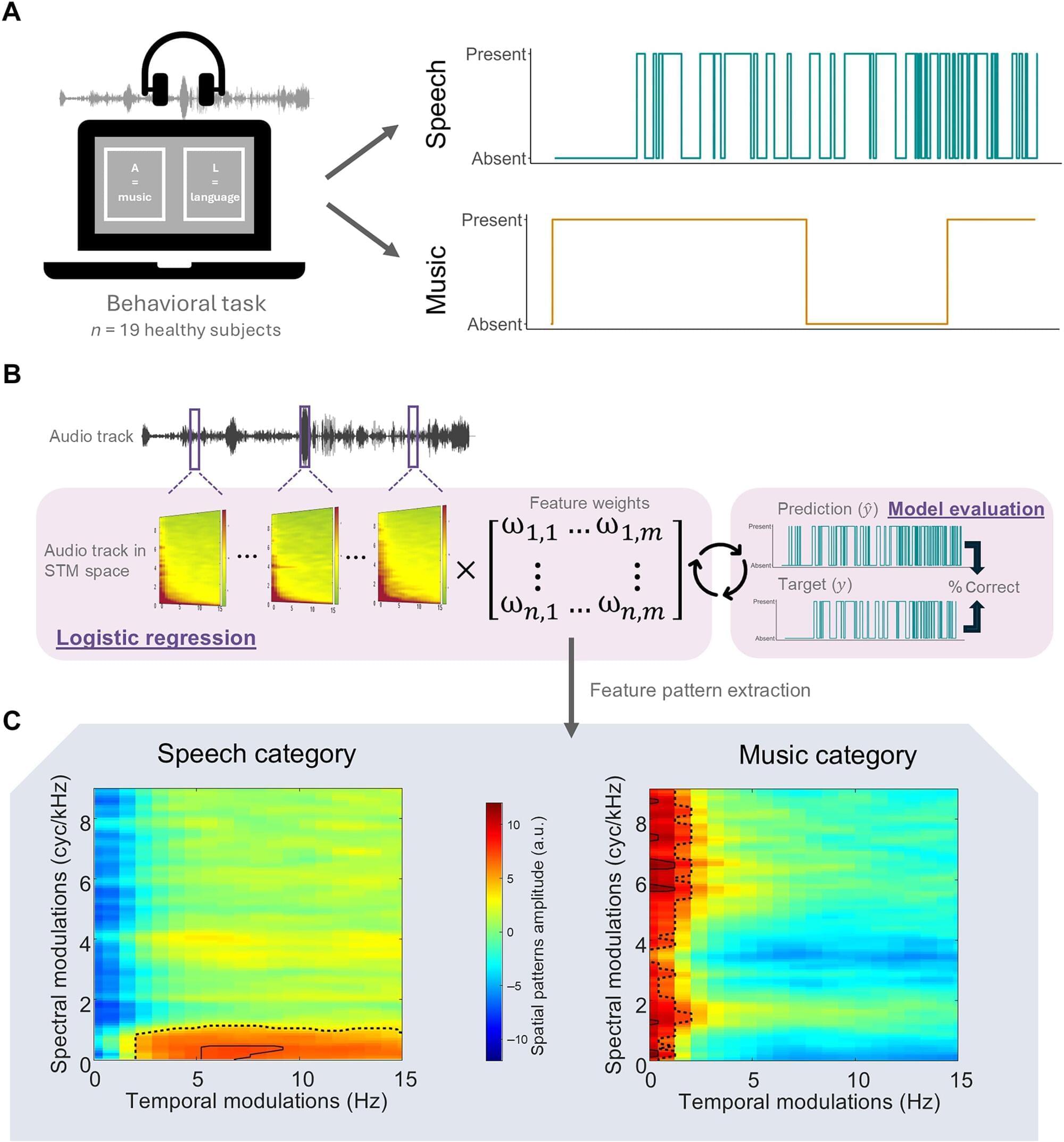
When speech and music overlap or occur in rapid succession, listeners can recognize both almost instantaneously. Researchers have wanted to understand why this happens for a while. Now, a new study, published in Science Advances, corroborates previous findings that suggest the brain’s auditory cortex differentiates between speech and music using patterns that describe how acoustic energy changes over time and across frequencies. The new study suggests these processes are sufficient to do the job under normal listening conditions—which, in this study, involve the Harry Potter soundtrack.
The auditory cortex tracks patterns in how sound changes over time and how energy is distributed across frequencies. Researchers call these spectrotemporal modulations, or STMs. Brain-imaging and electrode studies have identified regions that respond selectively to speech, music or singing. Earlier experiments often tested short, isolated sounds rather than the continuously changing mixtures heard in daily life, making it difficult to attribute more complex mixes to the same processes. And scientists have debated whether recognizing sound categories, like speech and music, requires specialized brain mechanisms beyond STM-related acoustic processing.
The authors of the new study write, Several recent influential studies have specifically suggested that the human auditory cortex is organized to support specialized processing pathways for behaviorally meaningful sound categories. According to this framework, while processing within early stages of the auditory pathway can be largely explained by tuning to basic acoustic features, category-specific representations emerge beyond these early areas, where neural processing becomes increasingly nonlinear.