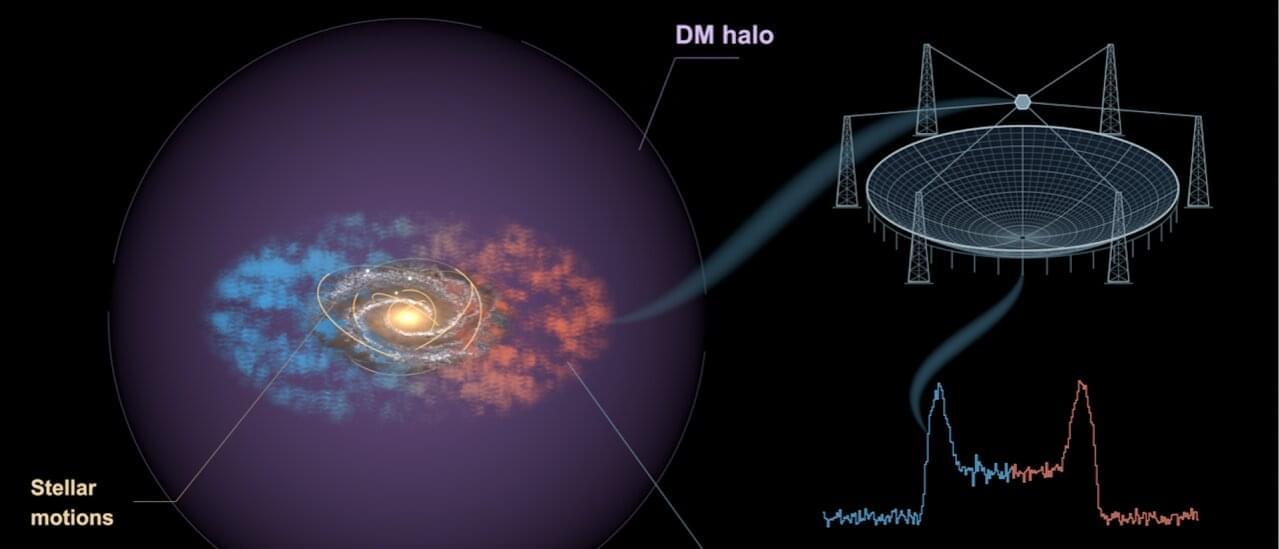
Galaxies appear to hold a surprise beneath their visible stars: Their inner regions contain less dark matter than some of our most advanced simulations predict. Dark matter is invisible, but its gravitational pull helps govern the motions of stars and gas. By measuring these movements, astronomers can reconstruct where this unseen matter lies and test the computer simulations used to understand the universe. A study of 136 nearby galaxies, involving the Instituto de Astrofísica de Canarias (IAC), reveals a discrepancy that becomes more extensive in more massive systems, offering fresh clues about how galaxies form and evolve.
Led by Yu Lei, of the Shanghai Astronomical Observatory, the team combined measurements of stellar motions from the MaNGA and CALIFA surveys with radio observations of neutral hydrogen, including data from the Five-hundred-meter Aperture Spherical radio Telescope (FAST). Together, these observations trace the gravitational field from galaxy centers to their distant outskirts. The work is published in the journal Nature Astronomy.
Lei explains, “The stars and the gas give us complementary views of a galaxy’s gravitational pull. By bringing them together, we can trace its dark matter much farther out and test whether the galaxies in our simulations resemble those we actually observe.”