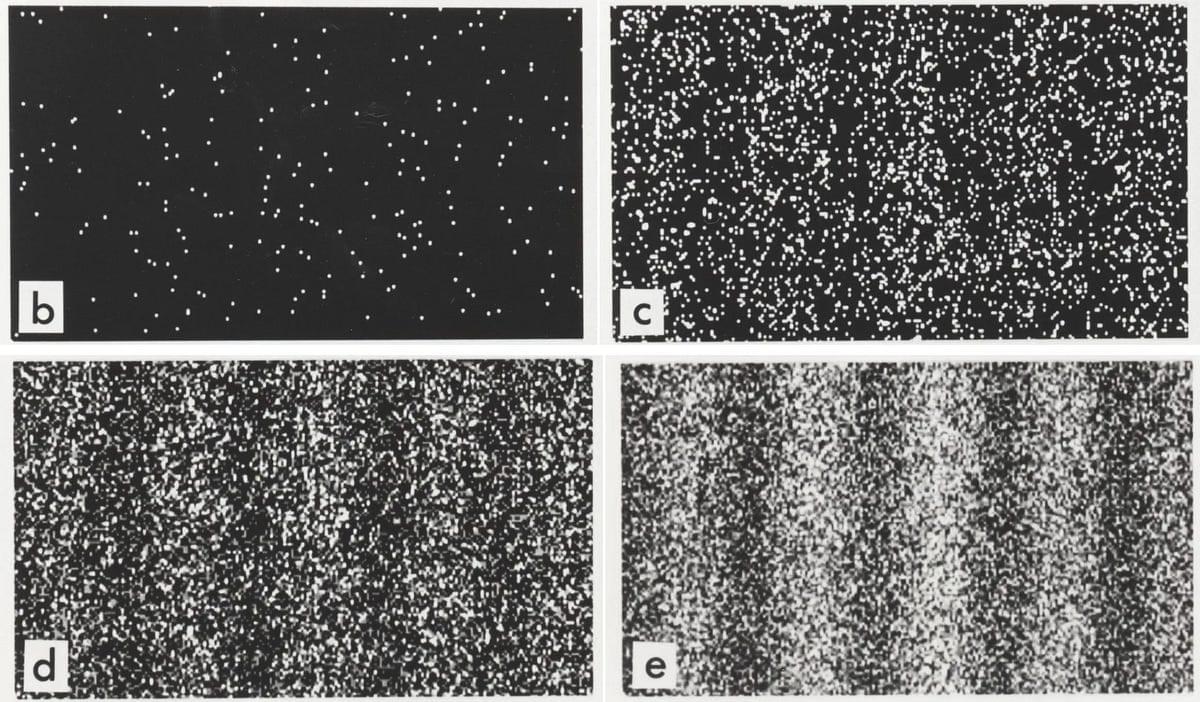
When we divide up matter into the smallest possible chunks that it’s made of — into the stuff that can be divided or split no further — those indivisible things we arrive at are known as fundamental particles: the elementary quanta that compose our Universe. But unlike the macroscopic, familiar objects that make up our world, we can’t simply assign definitive properties to them like “position” and “momentum” in an unambiguous fashion. Instead, the story gets complicated each time we ask the question: how does each individual quantum behave? Do they behave like particles? Or do they behave like waves?
The most puzzling fact about quantum mechanics is that the answer you get depends on how, or even whether, you look at the individual quanta that are part of the experiment. If you make certain classes of measurements and observations, they behave and interact like particles; if you make other choices, they behave and propagate like waves. Whether and how you observe your own experiment really does change the outcome, and the double-slit experiment is the perfect way to illustrate how, even more than 200 years after it was first performed.