et al. developed exceptionally powerful cell-type selective enhancers to drive strong expression of an anti-tumor gene therapy payload (HSV-TK and IL-12), demonstrating impressive results for treating a mouse model of glioblastoma via local AAV1 injection. In my view, these data are more convincing than most studies at a similar stage since most of the mice survived the study, the tumors shrank significantly, and the mice survived reintroduction of new tumors after treatment. Additionally, the mouse model featured an immunosuppressive tumor microenvironment reminiscent of human glioblastomas.
Gene therapies require the targeted expression of payloads in specific cell populations to achieve appropriate therapeutic dosing and to minimize off-target effects. Various strategies to attain this selectivity can be explored, including delivery routes, capsid engineering and regulatory elements (for example, promoters, enhancers, untranslated regions and termination signals)2. Enhancers determine cell-type-specific expression by recruiting complementary transcription factors (TFs) at high density via TF-binding motifs (TFBMs)3,4. However, natural enhancers often have suboptimal features for application in gene therapy vectors, such as size, strength, selectivity and quality of the sequence (for example, GC-rich or repetitive sequences). Strategies for creating artificial promoters and enhancers have typically focused on screening small (around 10 bp) synthetic TFBMs and assembling them into concatamers5,6,7. However, this approach is inadequate owing to the lack of a natural TFBM grammar, that is, the spacing, order, orientation and affinity of TFBMs, which are necessary for cell-type selectivity8.
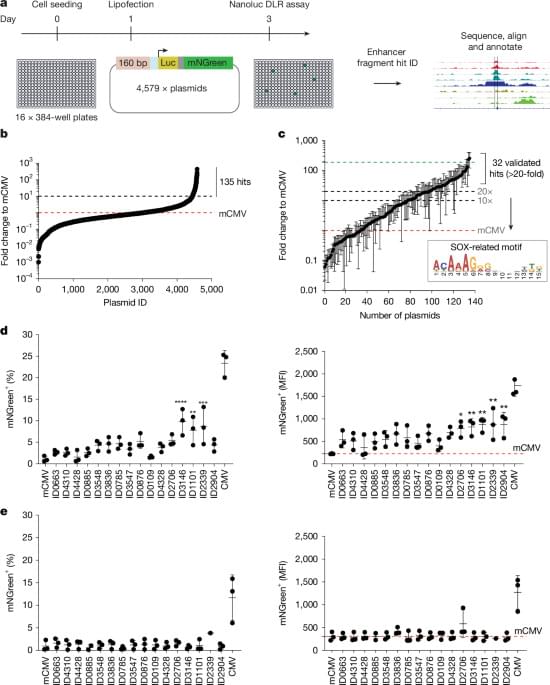
Cell-type-specific enhancers are often clustered in the genome to create super-enhancers9,10. Super-enhancers typically regulate transcriptional programs associated with cell identity through the local clustering of low-affinity motifs8. This leads to increased high-density binding of lineage and signalling TFs to promote RNA polymerase II recruitment and high transcriptional output11,12. We propose that synthetic super-enhancers (SSEs) can be engineered by assembling natural enhancer fragments associated with different genes into multipart arrays and then functionally screening them to identify desired activity and selectivity. The resulting transgene regulatory elements would capture the fundamental grammar of the combinations of TFs that define a specific cell type and signalling state. Such SSEs could have substantial value in gene therapy applications.
We focused on glioblastoma (GBM) to test this platform. GBM is an incurable brain cancer that is driven by cells with fetal neural stem-like phenotypes termed GBM stem cells (GSCs). These cells express high levels of master regulatory TFs associated with neural stem and progenitor cells, including SOX2 (ref. 13). SOX2 is a pioneer TF and reprogramming factor essential for inducing and maintaining the identity of neural stem cells (NSCs)14,15 and GSCs1,16,17,18. SOX2 is also a crucial master regulatory TF that is broadly expressed across diverse GSC subtypes18.