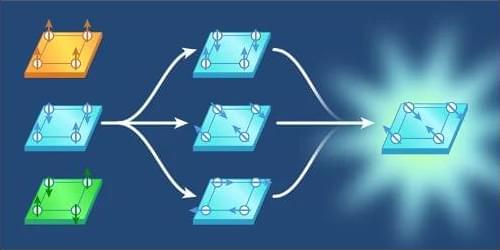
New symmetry-based computational approaches could make it easier to identify magnetic materials for spintronic devices and other technologies.
From the ancient compass to modern data storage, magnetic materials have played an important role in science and technology. Their properties depend on the arrangement of microscopic magnetic moments, which can be viewed as minuscule magnets carried by atoms. One application of this arrangement, giant magnetoresistance, enables the readout of information stored on hard disks that helped establish the field of spintronics. Despite this long history, many important problems in magnetism remain difficult to solve. Giant magnetoresistance enables the readout of information stored on hard disks and helped establish the field of spintronics. For N magnetic atoms, the moments are described by 3N real numbers. Sampling just ten values for each number yields 103N configurations. Fortunately, nature does not favor all these configurations equally. Symmetry, a fundamental concept in modern physics, provides a simple way to organize this vast space.