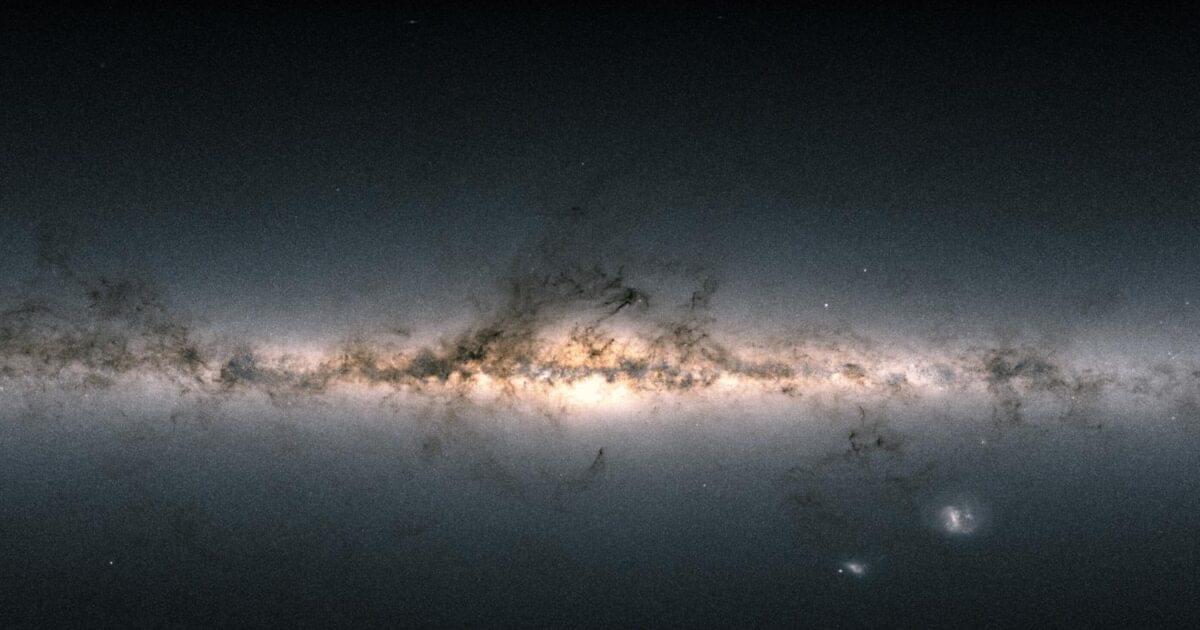
The new results are based on the team’s analysis of data taken by the Gaia and APOGEE instruments. Gaia is an orbiting space telescope that tracks the precise location, distance, and motion of more than 1 billion stars throughout the Milky Way galaxy, while APOGEE is a ground-based survey. The physicists analyzed Gaia’s measurements of more than 33,000 stars, including some of the farthest stars in the galaxy, and determined each star’s “circular velocity,” or how fast a star is circling in the galactic disk, given the star’s distance from the galaxy’s center.
The scientists plotted each star’s velocity against its distance to generate a rotation curve — a standard graph in astronomy that represents how fast matter rotates at a given distance from the center of a galaxy. The shape of this curve can give scientists an idea of how much visible and dark matter is distributed throughout a galaxy.