Trapped within diamond’s crystal lattice are tiny defects called nitrogen-vacancy (NV) centers, where a nitrogen atom sits beside an empty gap where a carbon atom should be. Because of their quantum spins, electrons trapped at these defects behave like tiny magnets, turning diamond into a highly sensitive detector for magnetic fields.
If many spins could be made to act together, these sensors would become even more powerful—but this collective behavior is difficult to sustain unless each spin is precisely positioned or individually controlled.
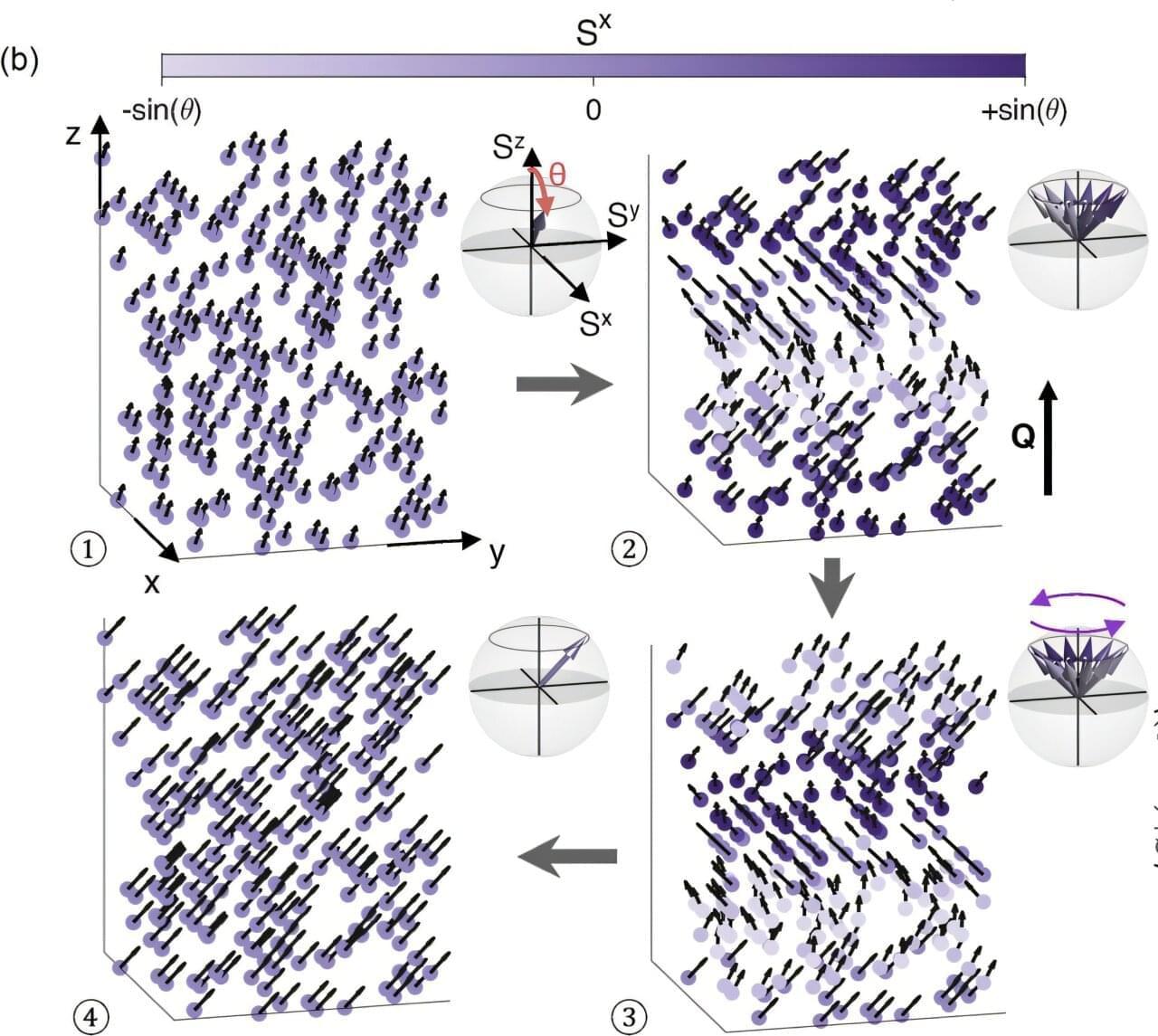
Through new research published in Physical Review X, a team led by Piotr Put at Harvard University has created coordinated motion, driven by interactions between randomly positioned spins, inside a 3D diamond sensor at room temperature.