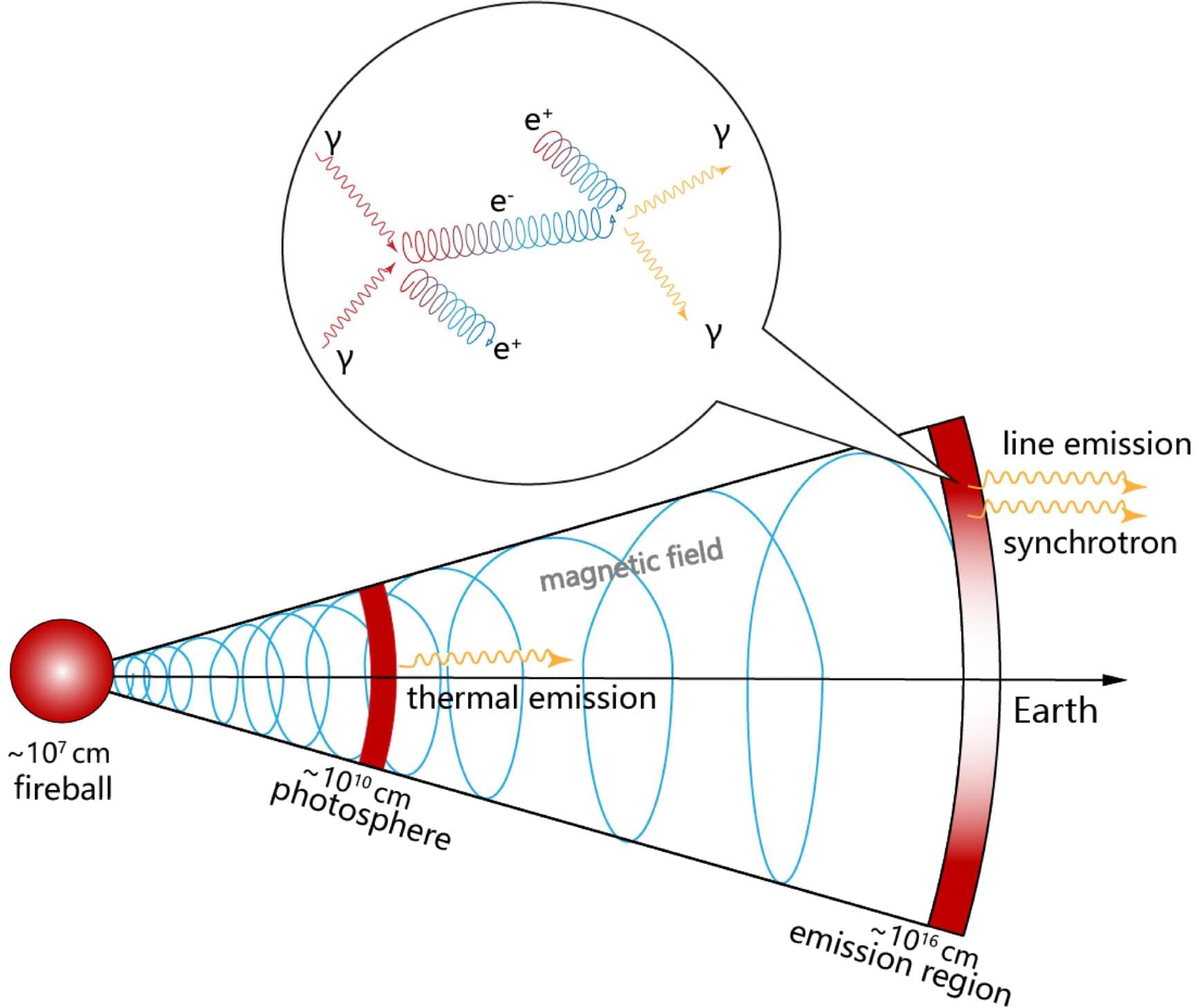
A China–Italy joint research team has reconstructed the time-resolved spectrum of GRB 221009A, the brightest gamma-ray burst (GRB) ever observed, and proposed that the burst may have produced a magnetically dominated jet with a hollow core. This is presented as a possible interpretation of the emission line’s rise-then-fall evolution rather than a direct detection.
Led by the Institute of High Energy Physics (IHEP) of the Chinese Academy of Sciences, the researchers used HEPP-H, the high-energy detector of the High Energy Particle Package developed by IHEP and carried aboard the CSES-01 (Zhangheng-1) satellite. CSES-01 is a Chinese-Italian mission supported by the China National Space Administration and the Italian Space Agency. The study was published in The Astrophysical Journal Letters on Nov. 12.
Evidence of GRB 221009A, about 2.4 billion light-years away, reached Earth on Oct. 9, 2022. Its extreme brightness saturated many conventional gamma-ray detectors during the brightest phase.