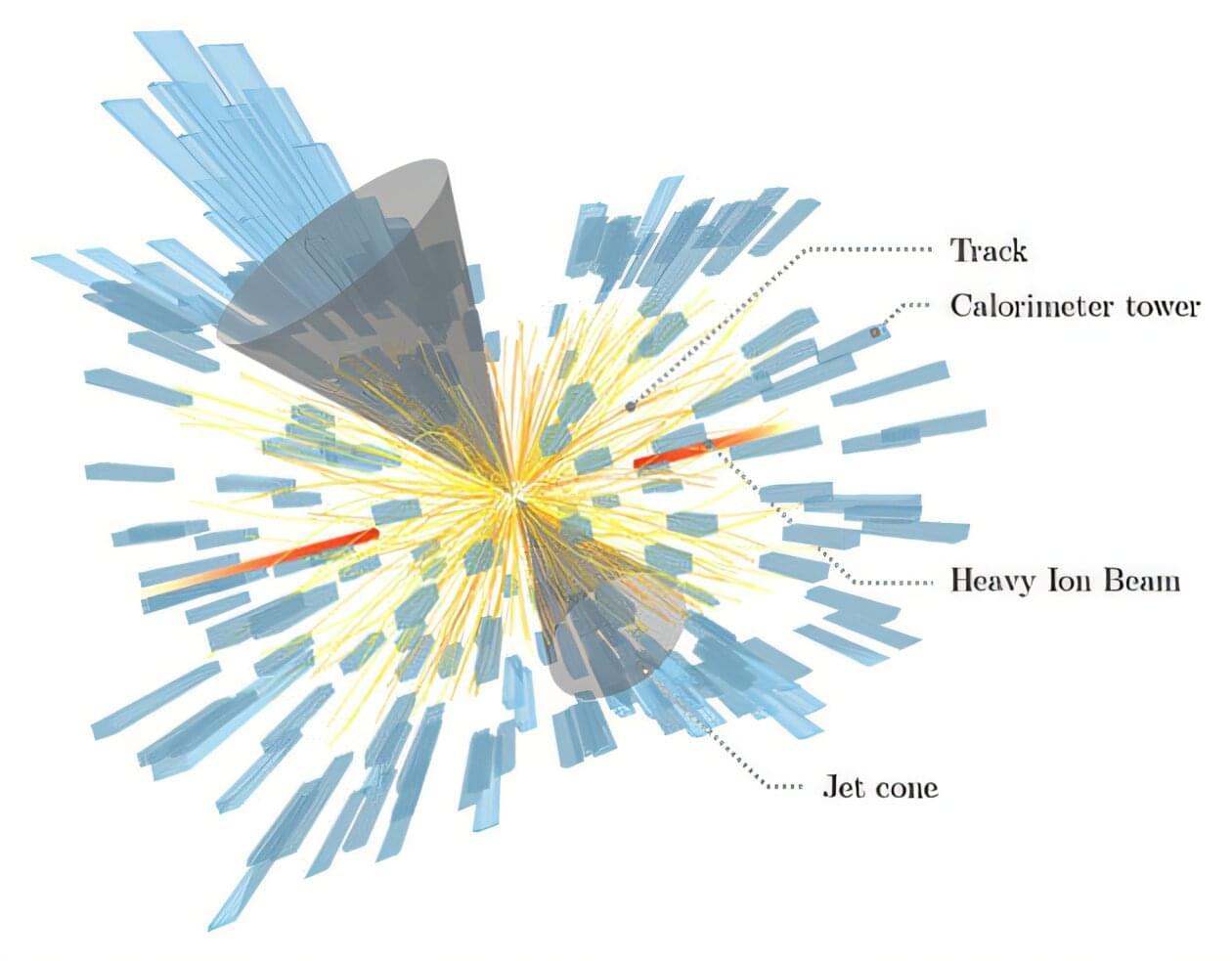
A team of physicists and computer scientists led by researchers at the U.S. Department of Energy’s (DOE) Brookhaven National Laboratory developed a new artificial intelligence (AI) approach that learns on its own to separate important high-energy particle jet signals from the enormous background of particles recorded in relativistic heavy-ion collisions, where two beams of heavy ions collide at near the speed of light.
The advance could help scientists make more precise measurements of the quark-gluon plasma (QGP), a hot, dense state of matter that existed a microsecond after the Big Bang.
At Brookhaven Lab, physicists recreated early-universe conditions that produce the QGP, a “soup” of free quarks and gluons, in heavy-ion collisions at the Relativistic Heavy Ion Collider (RHIC), a DOE Office of Science user facility for nuclear physics research that completed operations in early 2026. Physicists use jets—collimated sprays of high-energy particles produced in relativistic heavy-ion collisions—as one of the best probes of the QGP to glean more about how quarks and gluons behave and about the strongest force in nature that binds them together.