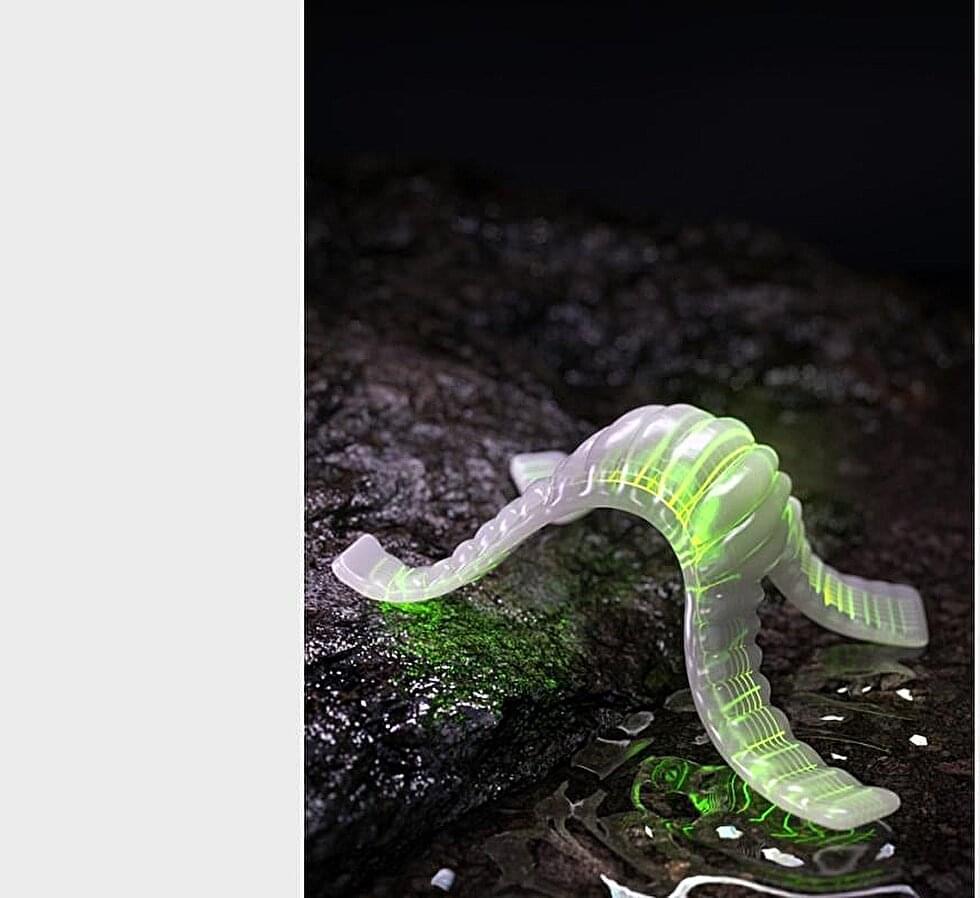
A research team led by Professor Soon Moon Jeong of the Department of Advanced Technology at the Graduate School of Engineering Practice at DGIST, has developed a new sensing technology for soft robots that emits light whenever the robot moves, providing an intuitive visual representation of its movement trajectory without requiring separate batteries or complex electronic circuits. The study is published in the journal Small Structures.
Made from flexible materials such as rubber or silicone, “soft robots” move smoothly like octopus arms or human muscles and are promising as next-generation robots for applications in medical devices and disaster rescue operations. However, detecting their subtle movements traditionally requires attaching numerous rigid electronic sensors and wires, which poses a major challenge in maintaining the inherent flexibility of the robot.
To address this challenge, the research team focused on the phenomenon of “mechanoluminescence,” in which a material emits light on its own when subjected to external mechanical forces (such as stretching, bending or pressure). The team developed a new type of thin, tough “tubular mechanoluminescent fiber” by mixing luminescent particles (zinc sulfide) with a flexible polymer material and filling an elastic silicone tube with this mixture.