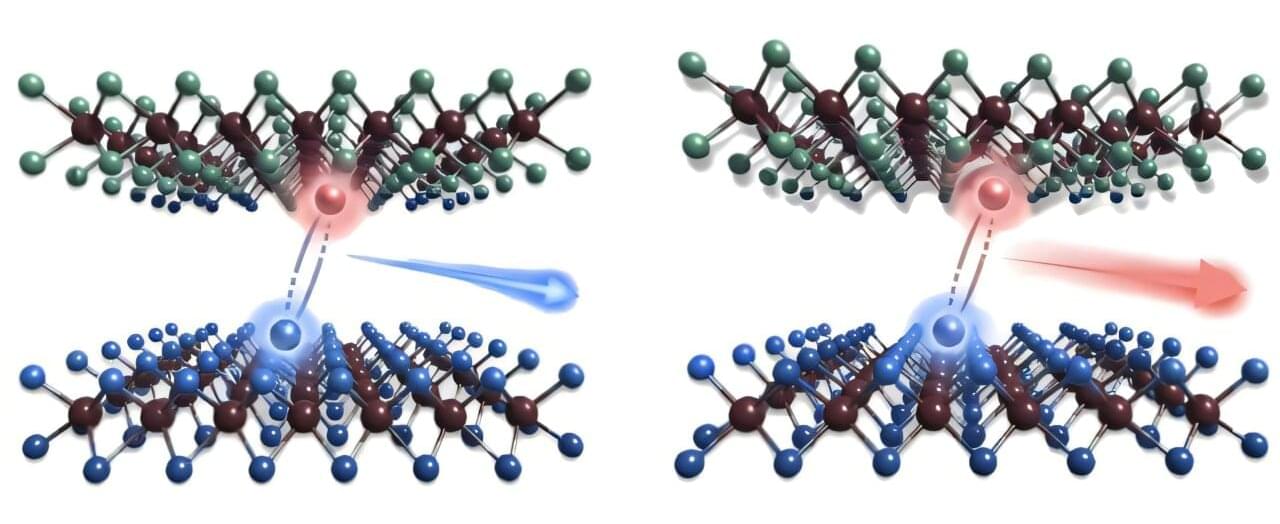
When light shines on a semiconductor, negatively charged electrons and positively charged holes—empty states left behind when electrons move away—pair up and bind together. This bound state is called an exciton. When two atomically thin semiconductor layers are stacked, electrons and holes can reside in different layers, forming what is known as an interlayer exciton (IE).
Compared with ordinary excitons, IEs have lifetimes that are tens of times longer and can be more easily controlled by external voltage, making them a key building block for next-generation ultra-low-power optoelectronic devices and quantum computing technologies.
However, conventional 2D semiconductors have had practical limitations: Due to their isotropic structural characteristics, IEs could emit light only at specific angles, such as 0° and 60°, and without polarization.