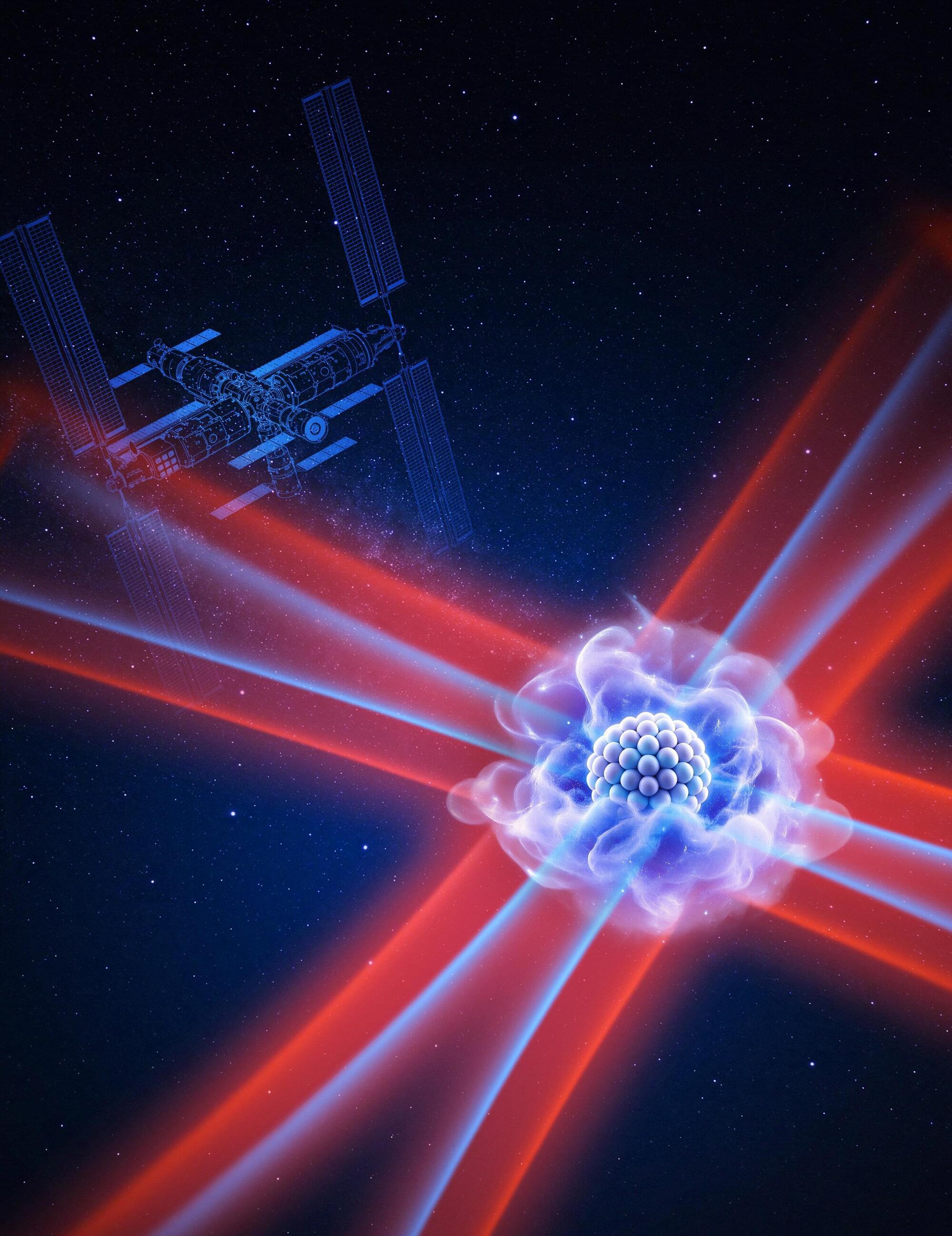
Matter starts to behave differently at extremely low temperatures, creating conditions ideal for studying quantum physics and new states of matter. Now, researchers from China have achieved a new low-temperature record aboard their Tiangong space station. Their research, recently published in Science, might lead to a new generation of experiments in quantum physics and precision measurements in space.
At temperatures near absolute zero, atoms can form a kind of cloud, called a Bose–Einstein condensate (BEC), that behaves as a shared quantum wave. BECs are valuable for physics research. The authors of the new study describe them as “versatile platforms for quantum simulation.” The colder atoms get, the more they slow down, allowing scientists to take better measurements. This has led to a quest for lower and lower temperatures.
But achieving extremely low temperatures near absolute zero can be difficult. Gravity creates restrictions by making atoms sag in the trap. Magnetic levitation has been used to counteract gravity, but it creates a new issue by forcing atoms to have the same internal spin state. Optical traps use laser beams and offer more flexible control, but they had not directly produced a condensate under microgravity conditions before the new study.