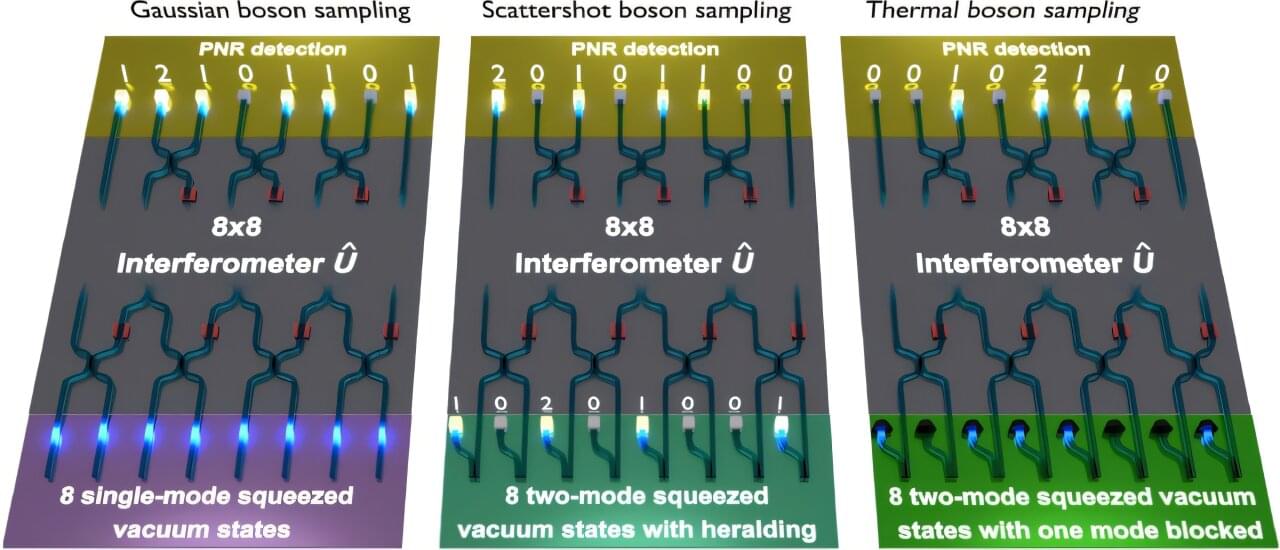
Photonics-based quantum computers open up new possibilities for investigating highly complex problems in mathematics and have the potential to revolutionize fields ranging from energy and chemical research to secure communications. By utilizing the unusual properties of light particles, they can perform calculations that pose enormous challenges even for the most powerful supercomputers—or remain entirely beyond their reach. At Paderborn University, researchers are now investigating a fundamental question using Germany’s first scalable photonic quantum computer, a ‘Gaussian boson sampler’: which quantum resources are most important for the performance of these devices?
The research team at the Institute for Photonic Quantum Systems (PhoQS) and the Department of Physics at Paderborn University, led by Dr. Christine Silberhorn, has published new findings—obtained using the ‘Paderborn Quantum Sampler (PaQS)’—in the journal PRX Quantum.
This new research goes beyond the mere demonstration of a large-scale quantum system. It investigates how individual quantum resources contribute to the capabilities of a so-called Gaussian boson sampler: a type of photonic quantum computer designed to process and sample complex light patterns.