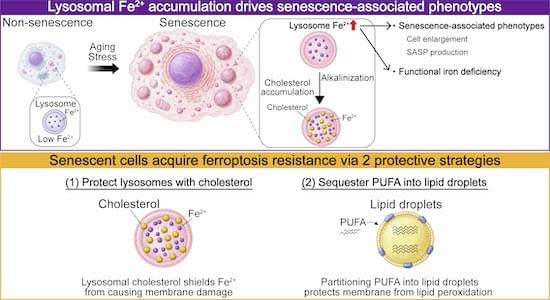
Iron accumulation is a conserved hallmark of cellular as well as organismal aging, yet its mechanistic role in senescence remains largely elusive. Here we show that the accumulation of ferrous iron (Fe2+) in lysosomes, a unique feature of senescent cells, is crucial for the induction of multiple senescence-associated phenotypes. Intriguingly, we found that this lysosomal Fe2+ sequestration is rendered “safe” by a dual metabolic adaptation that confers robust resistance to ferroptosis. First, Fe2+ accumulation triggers lysosomal alkalinization and subsequent cholesterol accumulation, which reinforces the lysosomal membrane against permeabilization. Second, senescent cells partition polyunsaturated fatty acids into lipid droplets, thereby depleting these ferroptosis-prone substrates from cellular membranes. Our findings establish that such cholesterol-enabled safe sequestration of Fe2+ serves as a central modulator linking senescence-associated remodeling to ferroptosis resistance. Modulating this lysosomal iron-centered pathway may provide new opportunities to target and control the behavior of senescent cells.