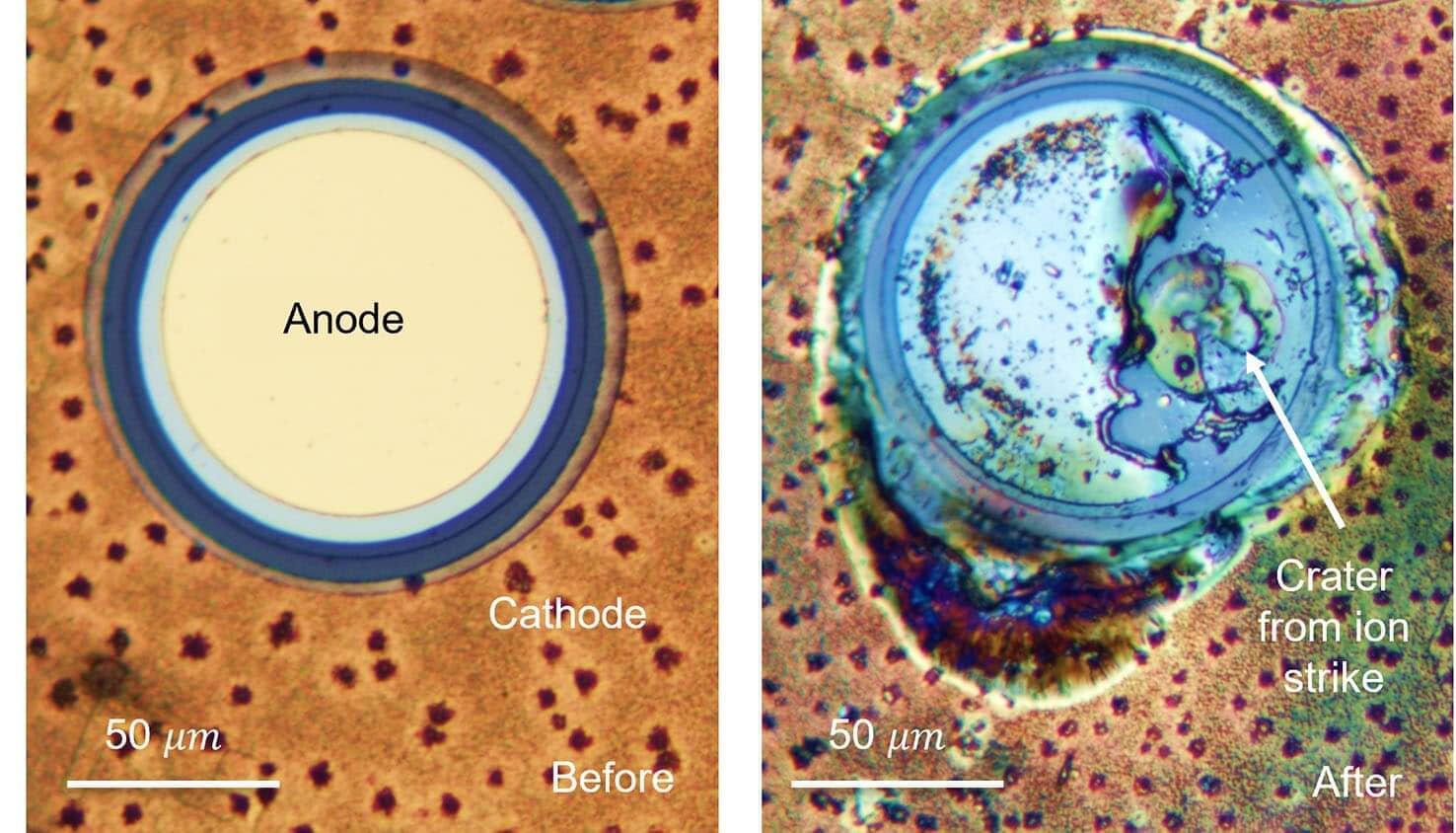
Researchers have solved a longstanding physics puzzle, explaining why electronic devices can fail catastrophically when exposed to radiation. Their findings may hold the key to engineering new electronics that can better withstand extreme environments, with applications ranging from nuclear energy to space exploration.
The discovery stems from work the researchers were doing on aluminum nitride (AlN), which is an ultrawide bandgap semiconductor. That means AlN can be used in electronic devices that handle large power loads. In theory, AlN also holds promise for use in extreme environments, such as radioactive settings.
To test that theory, the researchers wanted to explore a phenomenon called single-event burnout (SEB), which is when an electronic device is exposed to radiation and a single energetic particle causes catastrophic failure in the device—making the device inoperable and causing structural damage. SEB occurs when high voltage is applied to a device that is exposed to radiation. Different devices can handle different amounts of voltage before SEB occurs.