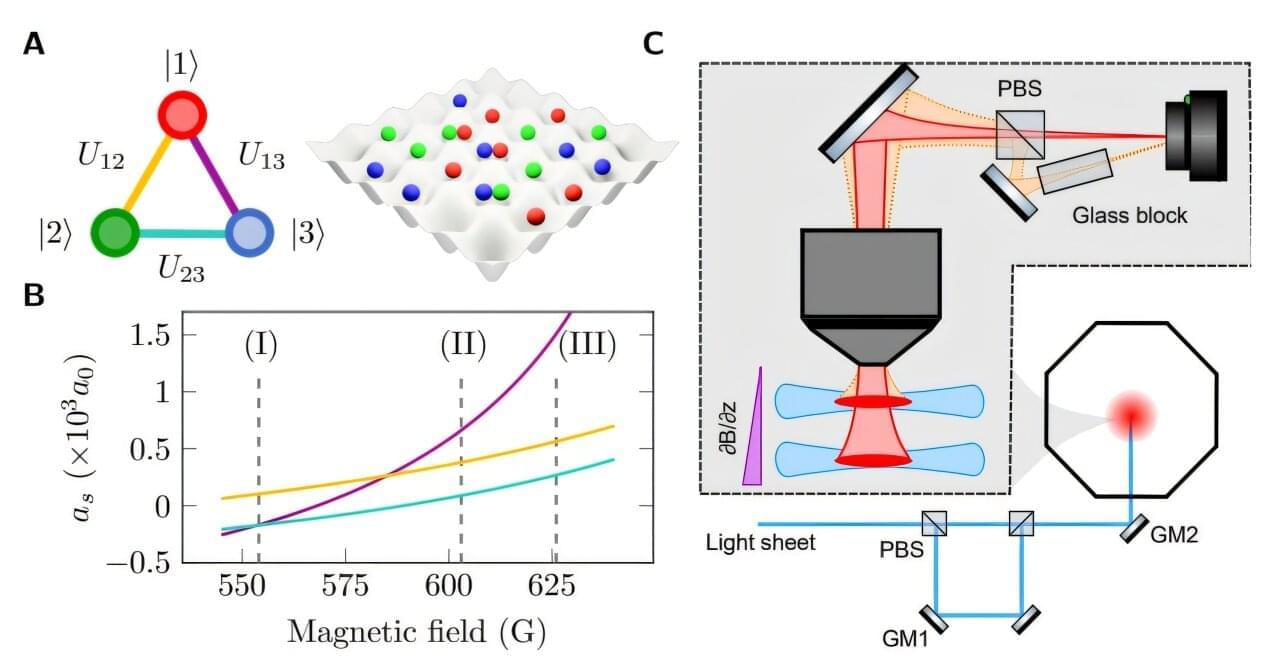
For the first time, an international team of researchers from Germany, Thailand, India, China and the United States has created a three-component Hubbard system with tunable interactions in the laboratory. In doing so, the team used a quantum gas microscope to make the individual atoms visible. The study, published in Science, provides an important foundation for future quantum simulations of nuclear physics and materials science.
Ultracold atoms are often employed to construct systems that resemble those found in solid-state physics. In this context, the fermionic atoms play the role of electrons in a solid. This system is unique in that it realizes a Hubbard model, which is one of the most important models for describing the interactions of fermions on a lattice. This approach is considered particularly promising for understanding high-temperature superconductivity.
The standard Hubbard model typically considers two spin states: spin-up and spin-down. A third component makes the system significantly more versatile, enabling researchers to investigate richer quantum mechanical phases.