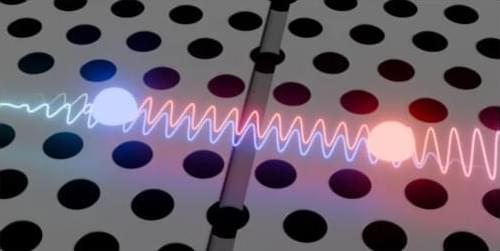
Researchers demonstrate directional control of a single-photon source by coupling two quantum dots together.
A quantum dot is a small chunk of semiconductor material that emits single photons when excited by light, just as an atom does. By placing two dots in an optical waveguide, researchers have created a “molecule” whose emission direction along the waveguide can be controlled [1]. This directional emission has been observed previously with microwaves, but this experiment is the first to demonstrate such control at optical frequencies. The design could potentially find application as an optical switch in quantum networks.
Single-photon emitters have important uses in quantum networking. A popular choice for an emitter is a quantum dot, which can be excited either electrically or optically. When the dot drops back to its ground state, it releases a photon with a characteristic frequency.