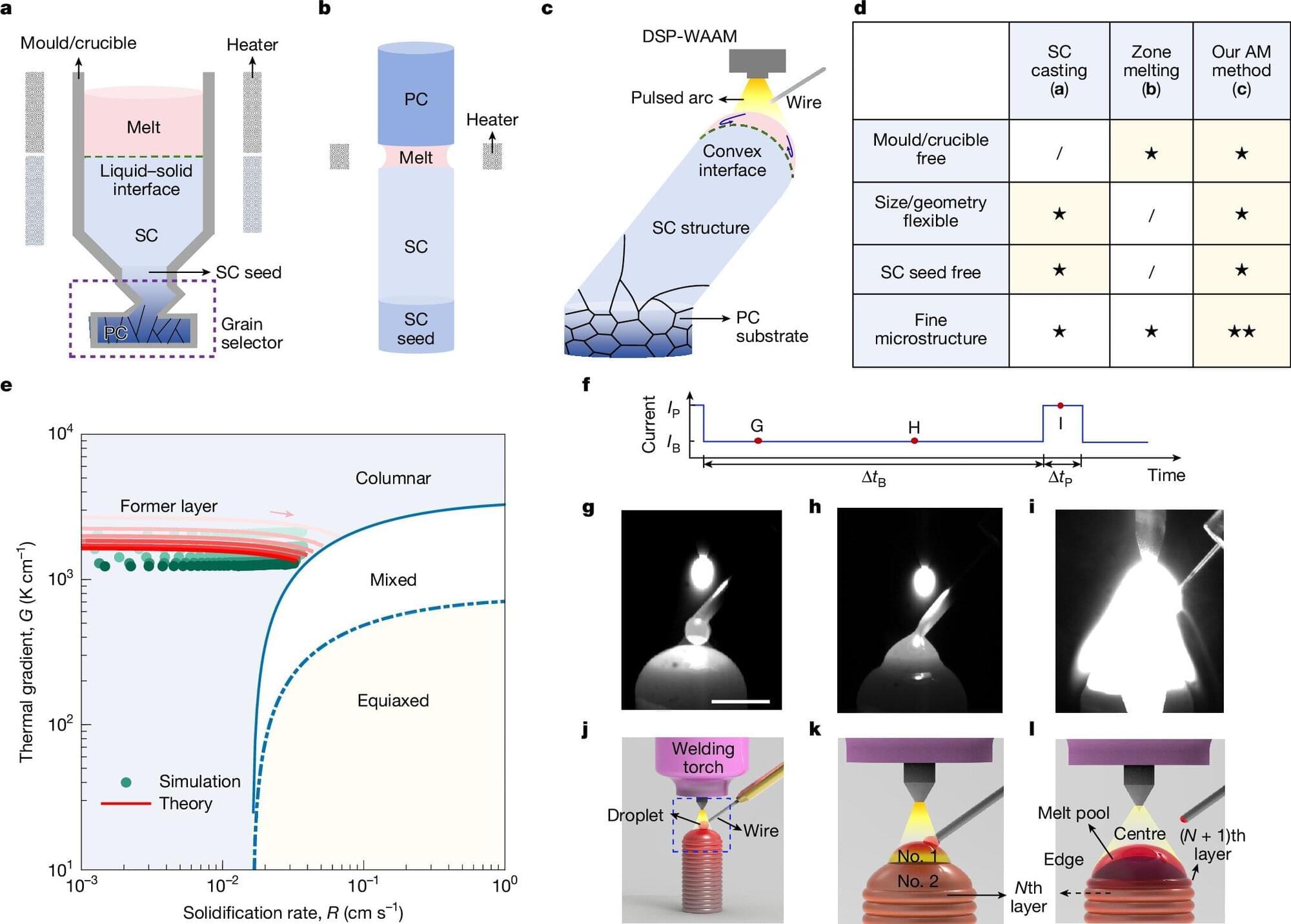
Researchers from China have developed a new 3D-printing process capable of building titanium-alloy rods more than a meter (3.3 feet) tall composed entirely of a single crystal. The new method, described in the team’s recently published study in Nature, eliminates some of the constraints associated with conventional crystal-growing methods and opens up new opportunities for technical applications, ranging from reactor components to laser mirrors.
Most metals are polycrystalline, containing many crystal grains. The boundaries of these crystal grains can become weak points under prolonged heat and stress. On the other hand, metals consisting of a single, uniform crystal structure do not have these boundaries and are valuable for high-stress and high-heat applications, such as aerospace components.
Conventional crystal-growing methods restrict the materials, sizes and shapes manufacturers can produce. For example, the high reactivity and the high melting points of some metals create limitations for the common mold-based approach since the molds can’t withstand these extremes. Meanwhile, another method, called floating-zone melting, is costly and limits allowable fabrication size and shape.