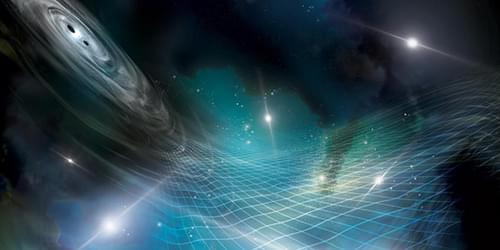
Millisecond pulsars—highly magnetized, rapidly rotating neutron stars—emit pulses of radiation that radio telescopes on Earth can detect. Correlated fluctuations in the arrival times of pulses from a hundred or so pulsars betray gravitational waves rippling through spacetime. In 2023, collaborations that look at pulsar timing arrays (PTAs), which are sensitive to frequencies up to 100 nanohertz, began reporting detections of this pervasive rumbling. Since then, researchers have tried to identify the background’s origins. Chiara Cecchini of the University of Trento in Italy and her colleagues now rule out one promising test used in this research [1]. Their analysis shows that PTA measurements are insensitive to amplitude distributions that purportedly distinguish between certain models.
One explanation for the low-frequency gravitational background involves pairs of supermassive black holes, which orbit each other for millions of years, creating an anisotropic gravitational-wave background with a non-Gaussian amplitude distribution. The other explanation involves inflation and other early-Universe processes, which sent out perturbations, creating an isotropic background with a Gaussian amplitude distribution. To see if they could distinguish between the two, Cecchini and her colleagues simulated the pulsar timing responses to different populations of supermassive black holes as well as the response to a primordial isotropic background. Then, using statistical tools, they tried to tease apart the amplitude distribution of the gravitational-wave background that gave rise to these simulated pulsar signals. They found that even after accounting for noise, the pulsar timing data always converged on a Gaussian amplitude distribution.
The result does not rule out departure from isotropy as a distinction between black hole and primordial signals. Rather, it suggests that non-Gaussian patterns cannot be used as a diagnostic without additional assumptions about the sources.