A Cornell psychologist built a machine in 1958 that taught itself to distinguish left from right. A book co-written by someone who had attended his high school helped convince the field that his approach was a dead end. He died at 43, decades before the world would fully appreciate what he had started.
Today, his work is recognized as one of the foundations of modern artificial intelligence.
His name was Frank Rosenblatt. His invention was called the Perceptron.
Rosenblatt wasn’t a computer scientist. He was a psychologist fascinated by a deceptively simple question:
What is the minimum a machine needs to learn in order to do something resembling what a brain does?
So he tried to build one.
In July 1958, the US Navy unveiled his creation: a machine that could learn to recognize patterns.
An IBM 704 computer, weighing several tons and occupying an entire room, was fed punch cards representing patterns with markings on the left or right.
Nobody explicitly programmed the distinction into it.
Instead, the machine learned from examples, adjusting its internal connections as it made mistakes.
The basic principle was remarkably simple:
- Make a guess. — If it’s wrong, adjust the connections. — Try again. — Repeat until the machine gets better at recognizing the pattern.
The New York Times announced it with the headline: “New Navy Device Learns By Doing.”
The New Yorker described it as “the first serious rival to the human brain ever devised.”
The excitement quickly turned into extravagant predictions. The Times reported that the Navy envisioned machines that might eventually “walk, talk, see, write, reproduce itself and be conscious of its existence.”
But the scientific community was divided. The hype was running ahead of what the technology could actually accomplish, and Rosenblatt’s ideas became the subject of heated debate.
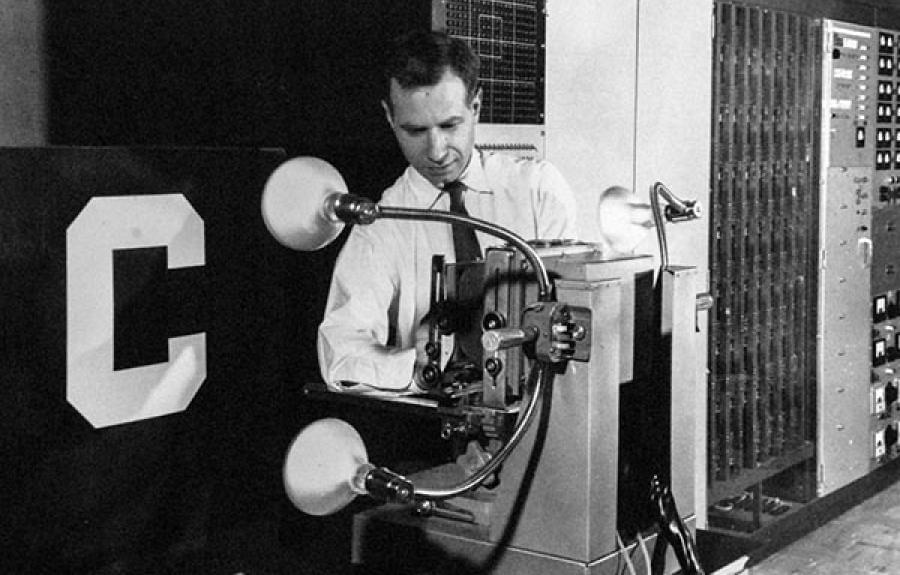
By 1960, he had developed the Mark I Perceptron, a physical machine designed to recognize visual patterns.
Its artificial eye consisted of a 20-by-20 grid of 400 light sensors. As it learned, its internal connections were adjusted through an electromechanical system of motors and controls.
Rosenblatt himself was an unconventional visionary.
He once bought a $3,000 telescope so enormous that he had nowhere to put it. His solution? Buy a house in the countryside, move some of his graduate students in, and build an observatory in the yard.
Then came the setback.
In 1969, MIT researchers Marvin Minsky and Seymour Papert published Perceptrons, a book examining the mathematical limitations of the technology.
There was an interesting historical connection: Minsky and Rosenblatt had both attended the Bronx High School of Science.
The book demonstrated that single-layer perceptrons could not solve certain fundamental problems, including XOR.
The mathematical criticism was legitimate. But its implications were often interpreted far more broadly: that neural networks themselves were a dead end.
Funding and research interest shifted elsewhere. Neural-network research entered a prolonged period of decline.
Rosenblatt never got to see the eventual revival of his ideas.
On July 11, 1971, his 43rd birthday, he died in a boating accident in Chesapeake Bay.
But the story didn’t end there.
Researchers eventually discovered how to overcome some of the limitations of the original perceptron by connecting multiple layers of artificial neurons and developing learning methods that could adjust connections throughout the network.
The principle of learning through repeated predictions, errors and adjustments became central to the development of modern neural networks.
That lineage leads to the technology behind image recognition, machine translation, speech recognition and today’s large language models.
In 2024, the Nobel Prize in Physics was awarded to John Hopfield and Geoffrey Hinton for foundational discoveries and inventions enabling machine learning with artificial neural networks.
It was another recognition of the field Rosenblatt had helped pioneer.
Rosenblatt once described his invention as:
“The first machine which is capable of having an original idea.”
He was decades ahead of his time.
The technology wasn’t ready. The scientific community wasn’t convinced. And the man who helped set the direction of modern neural networks didn’t live long enough to witness their extraordinary evolution.
Frank Rosenblatt wasn’t wrong about the possibility of machines learning. He was simply far too early.
#Perceptron #ArtificialNeuralNetworks #ArtificialIntelligence #deeplearning
In July 1958, the U.S. Office of Naval Research unveiled a remarkable invention.
An IBM 704 – a 5-ton computer the size of a room – was fed a series of punch cards. After 50 trials, the computer taught itself to distinguish cards marked on the left from cards marked on the right.
It was a demonstration of the “perceptron” – “the first machine which is capable of having an original idea,” according to its creator, Frank Rosenblatt ’50, Ph.D. ’56.