Pre-operative stereotactic radiosurgery (SRS) and intraoperative cesium-131 (Cs-131) brachytherapy are alternatives to post-operative SRS for resected brain metastases (BMs). The randomized phase 3 Radiation One and Done Study (ROADS; NCT04365374) showed improved surgical-bed control with Cs-131 tiles versus post-operative stereotactic radiotherapy, but outcomes relative to pre-operative SRS are undefined.
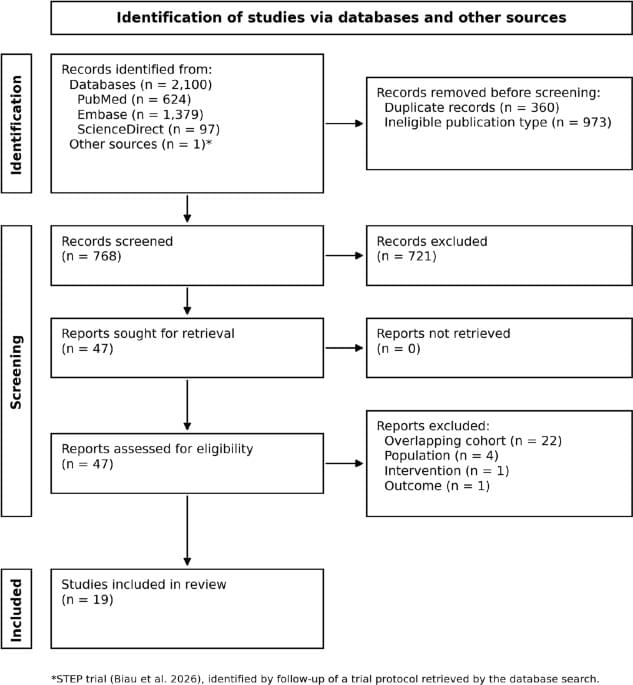
PubMed, Embase, and ScienceDirect were searched through October 2026 (PRISMA 2020); one further trial was identified by other methods. Twelve-month local control (LC), leptomeningeal disease (LMD), radiation necrosis (RN), and overall survival (OS) were extracted for treatment-naïve BMs. Proportions were pooled with random-effects generalized linear mixed models and compared with a test for subgroup differences; sensitivity analyses included meta-regression, Hartung–Knapp, leave-one-out, follow-up, and fractionation analyses.
Fifteen pre-operative SRS studies (918 patients/940 BMs) and four brachytherapy studies (207 patients/217 BMs) were included. Pooled 12-month LC was 97% (95% CI 90–99) with Cs-131 brachytherapy and 90% (86–93) with pre-operative SRS (test for subgroup differences p = 0.054; meta-regression p = 0.019; Hartung–Knapp p = 0.066); among studies reporting observed counts, LC was 99% vs. 90% (p = 0.009). Within pre-operative SRS, LC was 96% after hypofractionated and 86% after single-fraction treatment (p = 0.005). LMD (9.1% vs. 5.1%) and RN (0.7% vs. 5.2%) did not differ significantly. Median OS was 15.6 months with brachytherapy (range 5.9–42.5; 11.0 months, range 5.9–20.1, excluding the ROADS estimate) and 14.4 months with pre-operative SRS (range 6.3–26.4).