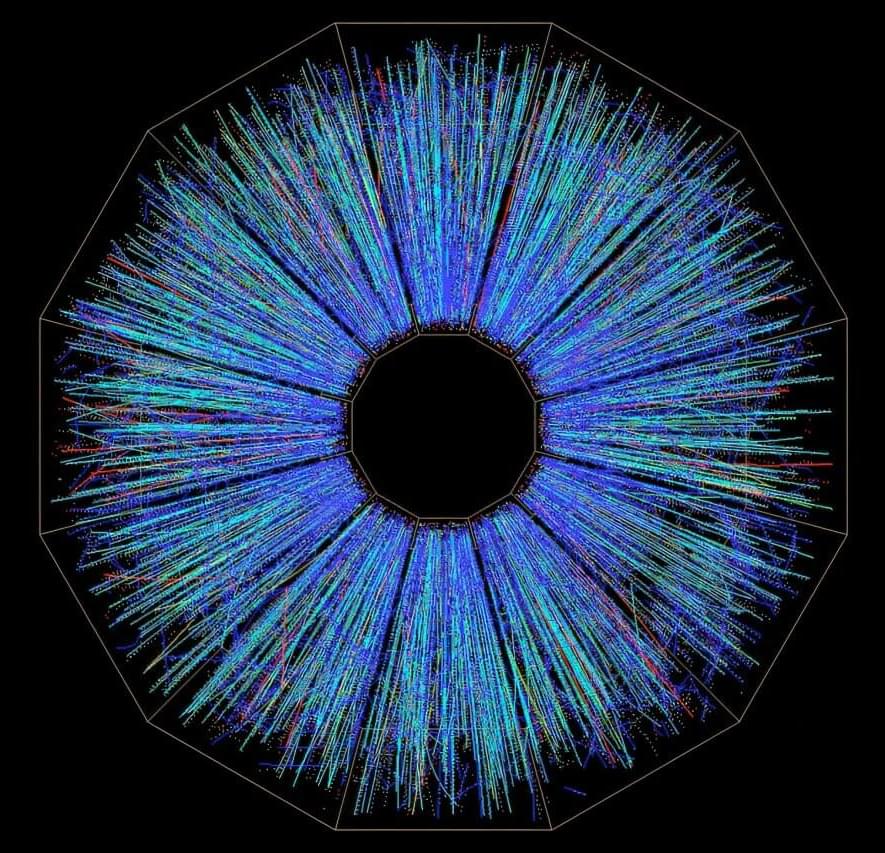
In the first fraction of a second following the Big Bang, matter existed as a trillion-degree plasma of quarks and gluons—subatomic particles that zinged around at close to the speed of light. This roiling soup lasted for just a few microseconds before the particles coalesced into more stable protons and neutrons.
To study this primordial fluid, scientists recreate quark-gluon plasma in large particle accelerators, where ions are smashed together at close to the speed of light. These collisions create droplets of plasma roughly the size of an atomic nucleus that exist for only tens of septillionths of a second.
One way scientists study this plasma is by tracking other particles, such as heavy quarks, that are not part of the plasma but happen to move through it. The way a heavy particle moves through a fluid should tell something about the microscopic structure of the fluid itself. This general relationship was established famously by physicist Albert Einstein in 1905.