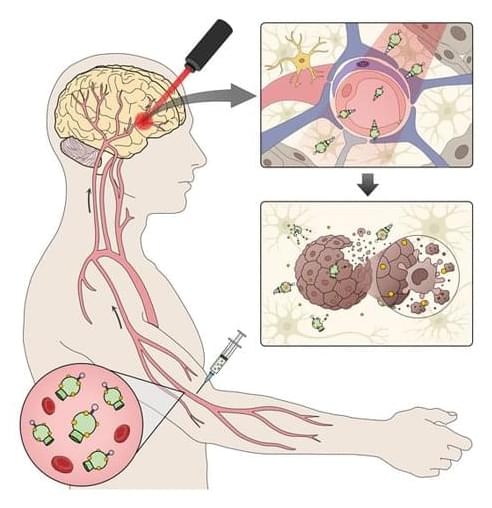
Caltech’s tiny brainbots deliver cancer drugs past blood-brain barrier.
A team led by professor Wei Gao at Caltech created 250-nanometer nanorobots from safe, biodegradable materials. Near-infrared light through the skull activates them, propelling the bots across the blood-brain barrier via transcytosis to release chemotherapy directly in the brain. In mouse glioblastoma models, the BrainBots delivered five times more doxorubicin than standard methods, slowing tumor growth, extending survival, and cutting side effects. Published November 25 in Science Robotics, the preclinical advance holds promise for brain cancer and diseases like Parkinson’s, with hopes for future human trials.
The blood-brain barrier (BBB) is the body’s most formidable biological fortress. While it brilliantly protects the central nervous system from toxins and pathogens, it also acts as a massive bottleneck for treating neurological disorders and brain cancers. Traditional nanoparticle drug delivery methods often fail here; they rely on passive diffusion or simple receptor-binding, which are frequently thwarted by the brain’s cellular recycling and efflux mechanisms that pump foreign invaders back out.
To overcome this, a team of researchers has developed a groundbreaking solution: BrainBot, a light-activatable, self-propelled nanorobotic system designed to actively and safely traverse the BBB on demand.
How BrainBots Work.
The brilliance of the BrainBot lies in its “sleeper agent” design. In the bloodstream, the nanobot is completely inert and safe. It consists of an asymmetric, PEGylated silica shell that encapsulates a thermosensitive gas-generating fuel and a photothermal transducer, all sealed by a phase-change material “gate.”
When the nanobots reach the brain’s vascular network, doctors apply localized near-infrared (NIR) light to the target area. This light triggers a photothermal reaction: the localized heat melts the phase-change gate and rapidly decomposes the fuel. In an instant, the passive, dormant nanoparticles are transformed into directionally motile nanorobots, generating their own propulsion.
A Synergistic Breakthrough.
This transient, on-demand propulsion is the game-changer. The nanobots are also equipped with surface-conjugated, BBB-penetrating aptamers (biological targeting molecules). The self-propelled movement synergizes with these aptamers, actively driving the nanobots through the endothelial cells via receptor-mediated transcytosis. In laboratory (in vitro) tests, this active approach yielded substantially higher BBB transport rates compared to non-propulsive or targeting-only control nanoparticles.
Real-World Impact in Living Models.
The true test came in vivo. After systemic administration in mouse models, localized NIR activation of the BrainBots resulted in significantly increased drug accumulation in the brain. Crucially, this enhanced delivery was achieved without disrupting the integrity of the blood-brain barrier or inducing any detectable damage to surrounding healthy tissue.
To prove its therapeutic potential, the researchers loaded the BrainBots with doxorubicin, a common but highly toxic chemotherapy drug, and tested them in a mouse model of orthotopic glioblastoma (an aggressive brain cancer). The results were striking: the BrainBots successfully enhanced drug delivery to the tumor, significantly suppressed tumor growth, and markedly reduced the severe systemic toxicity typically associated with free-drug administration.
The Future of Brain Therapeutics.
The BrainBot platform represents a major paradigm shift in neuro-medicine. By converting passive vascular association into efficient, actively propelled BBB transcytosis within a highly controlled safety window, this technology provides a versatile, noninvasive framework. It opens the door to a new era of targeted, effective, and safer treatments for glioblastoma, neurodegenerative diseases, and other central nervous system disorders that were previously considered difficult or impossible to treat with systemic drugs.
#neuroscience #Brainbots #bloodbrainbarrier
A controllable nanorobotic strategy uses photothermally gated propulsion to actively cross the blood-brain barrier.