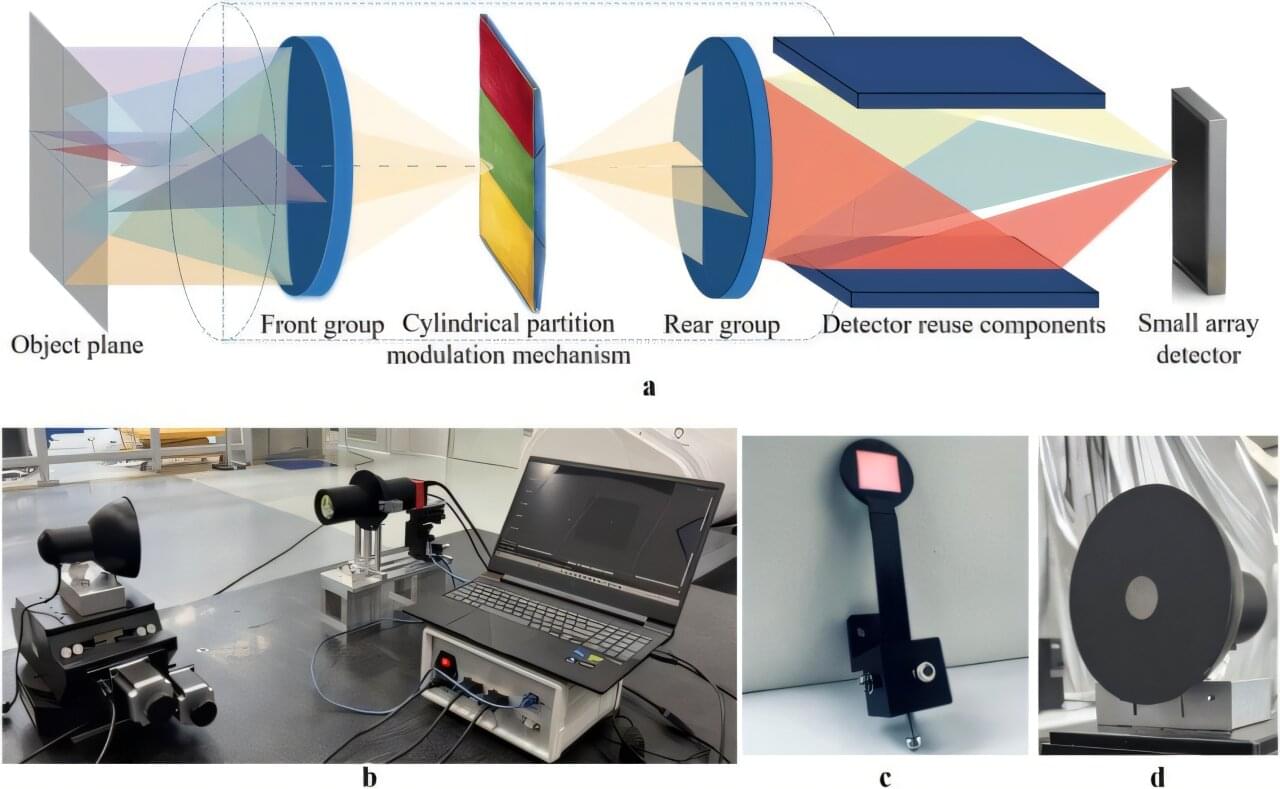
Researchers from the Changchun Institute of Optics, Fine Mechanics and Physics of the Chinese Academy of Sciences have developed an optical system that focuses light from several subfields onto a single small-format detector. By analyzing field-dependent spot shapes, the system identifies which subfield an isolated infrared target comes from. In sequence-level tests, it identified the correct field in about 89% of cases. The study is published in Optics and Laser Technology.
Wide-field infrared imaging typically uses large focal-plane arrays, where each part of the scene occupies a distinct detector region. Larger arrays increase demands on detector fabrication, cooling, electronic readout and system integration. The researchers pursued another route by reusing the same detector area for several viewing regions. This enables the optical field to expand without increasing the detector format in direct proportion, which may reduce the hardware burden of wide-field systems designed for sparse point-like targets.
In scenes with only a few isolated targets, much of a large array may carry no useful target signal at a given moment. The new design uses that sparsity by mapping several regions to shared detector pixels.