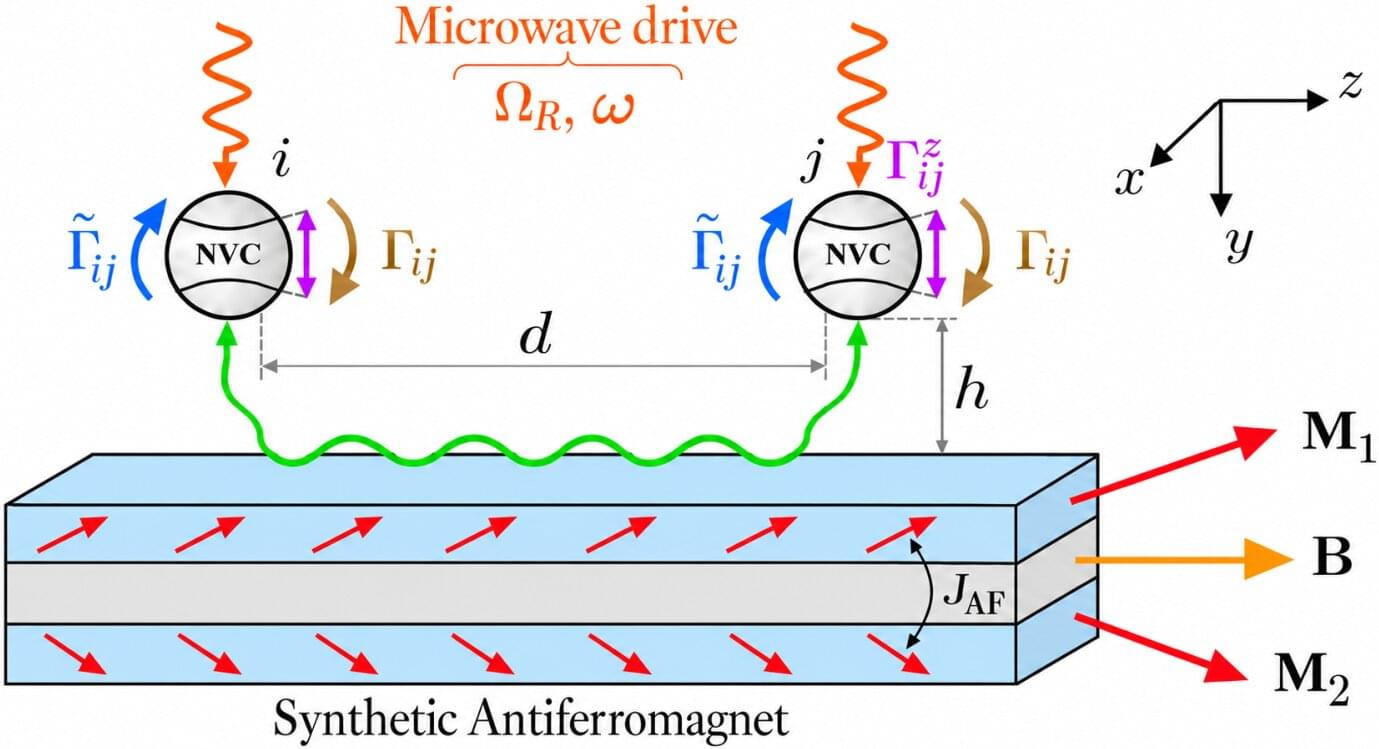
In a new study accepted in the journal Physical Review B, a team of physicists from the University of Delaware may have found a way to overcome limitations in maintaining the entanglement of diamond qubits. The model involves driving the qubits away from equilibrium using microwave radiation while the surrounding material is allowed to remain in equilibrium. The approach allows for both long-range and steady-state entanglement of the qubits. The paper is published on the arXiv preprint server.
Nitrogen-vacancy centers (NVCs) are atomic-scale defects in diamond that can act as quantum bits, or qubits, which are useful in quantum technology and nanoscale sensing. When entangled, these qubits create shared quantum states that could support advanced sensors and quantum computers. However, direct coupling becomes too weak beyond around 10 nanometers of separation.
The authors of the new study write, “The long-range entanglement is required because independent and simultaneous optical readout of two NVCs positioned at ≲ 10 nm is virtually impossible due to the spatial and emission-wavelength overlap of their fluorescence. Thus, protocols for such entanglement have been intensely pursued over the past decade or so, as mediated by photons, phonons or magnons.”