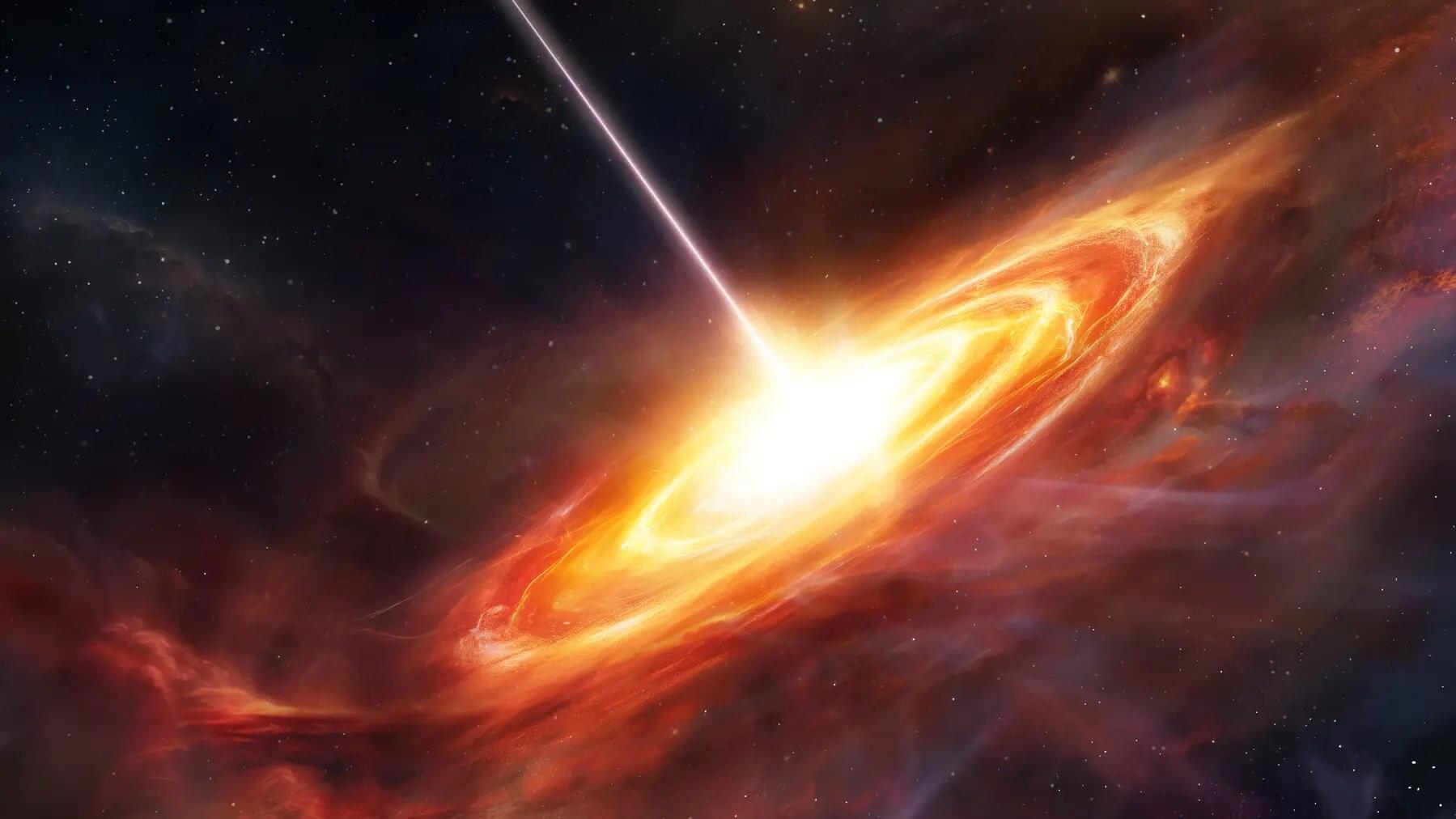
A team of astronomers led by Julien Wolf, a postdoctoral researcher at the Max Planck Institute for Astronomy (MPIA) in Heidelberg, Germany (now at the European Southern Observatory in Garching bei München, Germany), discovered the most distant quasar to date. First identified in the Euclid Wide Survey (EWS), the object was confirmed to be a quasar by subsequent observations with some of the most powerful telescopes on the ground and in space.
After the W. M. Keck Observatory and the Hubble Space Telescope provided the first hints, the Large Binocular Telescope and ultimately the James Webb Space Telescope revealed a redshift of z = 8.13, corresponding to a cosmic age of 630 million years after the Big Bang.
Redshift is a measure of how much the wavelength of the light emitted at the source has been stretched due to cosmic expansion by the time it reaches the telescope. Depending on how the cosmos evolved over time, this redshift can be translated into a distance. Commonly referred to as J1504+6252 and nicknamed “Dún Aonghasa” by the team, this quasar existed 40 million years earlier than the previous record holder and is the first quasar with a redshift greater than eight.