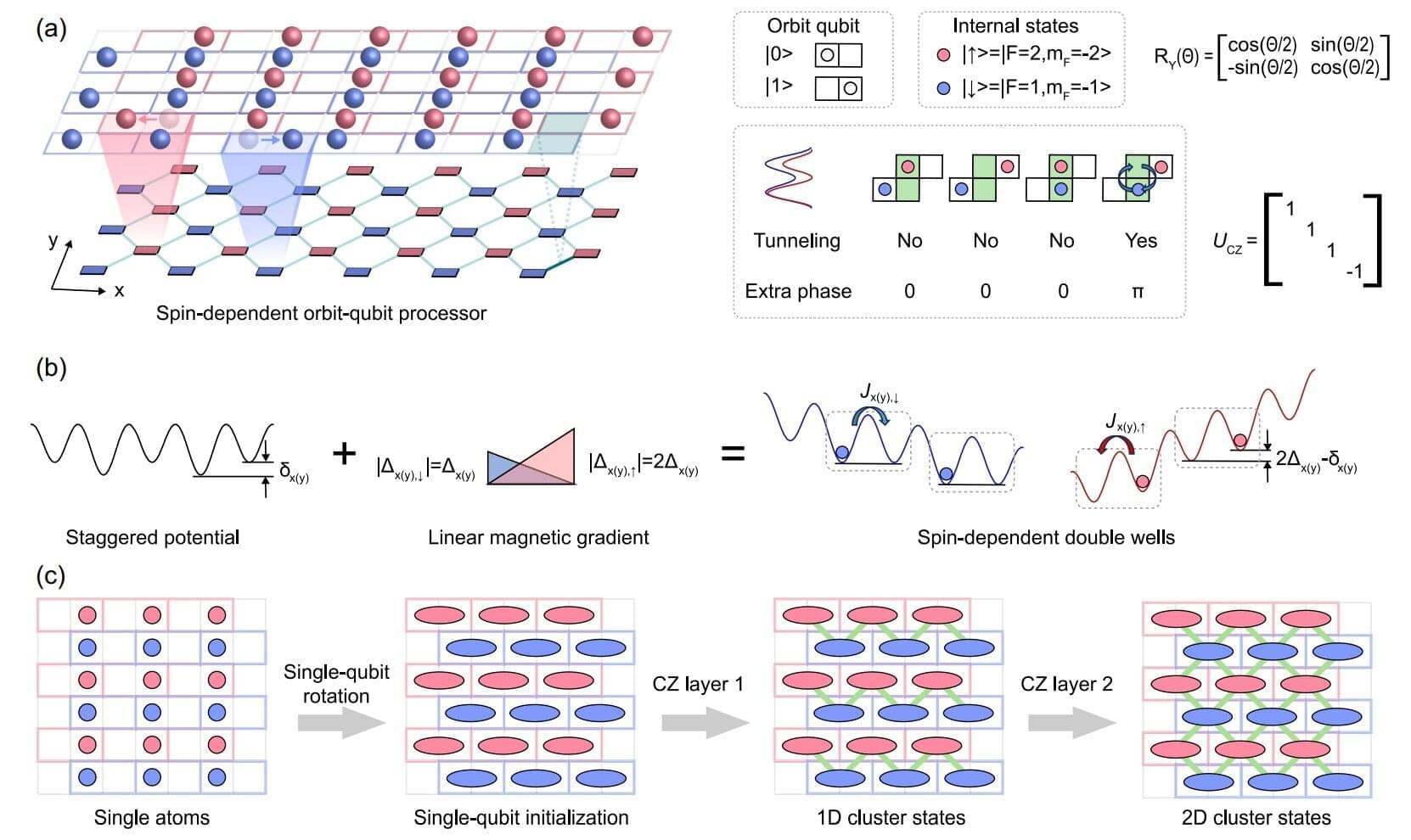
Researchers are constantly getting closer to making practical quantum computers. Now, a team of researchers has overcome another hurdle in the process. Their study, published in Physical Review Letters, describes a new platform for manipulating entangled atomic networks in measurement-based quantum computation—a process usually hindered by difficulties manipulating only one atom or one group of atoms at a time.
Optical lattices—grids of laser light that trap ultracold atoms—provide a way to control many quantum bits, or qubits, together. In measurement-based quantum computation, a sequence of single-qubit measurements is made on a pre-entangled resource state, called a cluster state. Measuring selected qubits then processes information. However, the atoms are very close together, making it difficult to manipulate them individually without disturbing their neighbors.
The authors of the new study write, “As the typical lattice spacing between neighboring sites approaches the optical diffraction limits of current quantum gas microscopy, this inevitably causes operational crosstalk during attempts of single-site manipulation. Consequently, the inadequate fidelity of local operations poses a significant barrier to accurately verifying cluster states, as well as restricting their further computational applications.”